
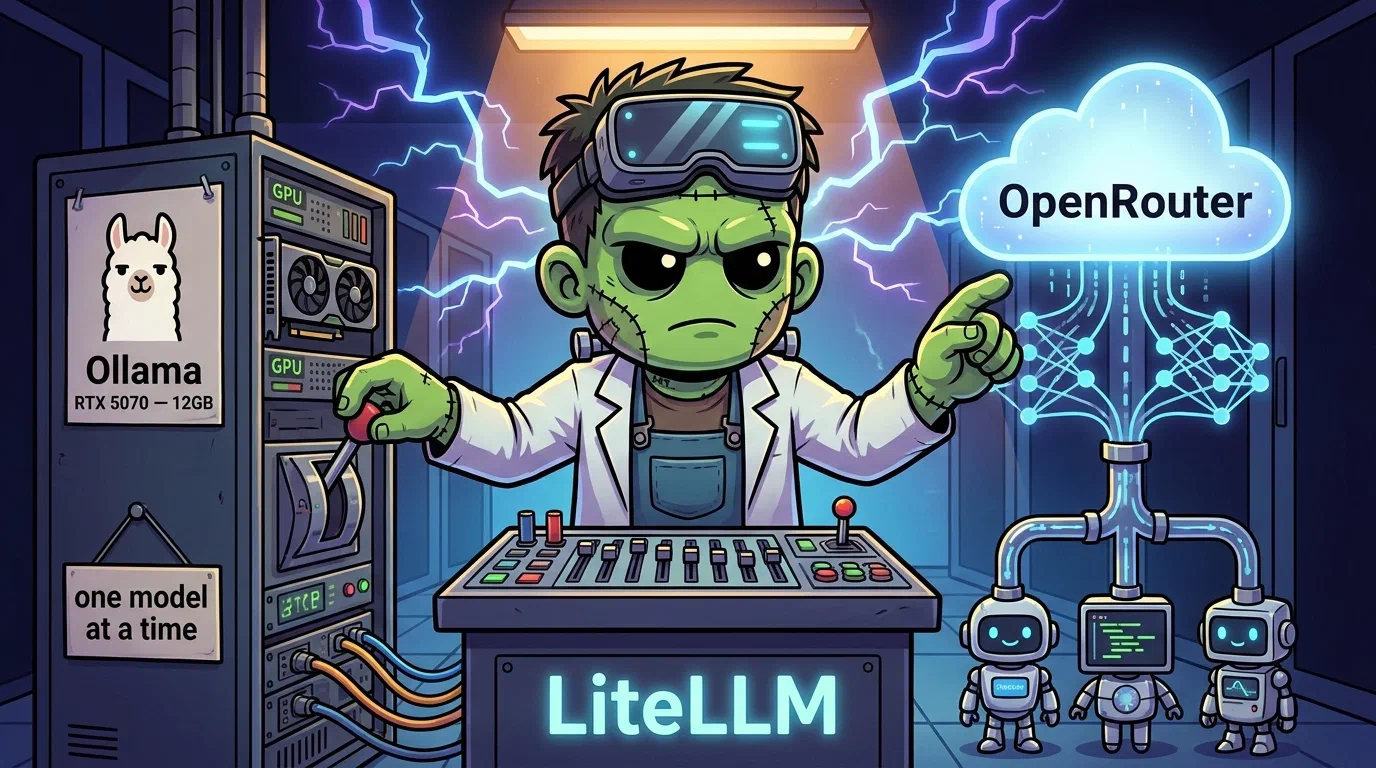
Local Inference — Ollama, LiteLLM, and OpenRouter
The cluster has a GPU. Layer 4 installed the NVIDIA operator. Layer 5 gave the mini nodes their Intel iGPUs. But none of that is useful until something actually runs inference.
Layer 10 wires up a unified Large Language ModelA model trained to predict text, served behind a chat or completion endpoint. On Frank these run locally on the GPU node rather than against a hosted provider. gateway. Any tool on the network — agentic frameworks, document processors, coding assistants — talks to one OpenAI-compatible endpoint at 192.168.55.206:4000. Behind that endpoint, requests route to a model alias, and the consumer never needs to know which backend serves it.
The layer originally routed to two places: local models on gpu-1’s RTX 5070 Ti, and free cloud models via OpenRouter. The free tier was dropped on 2026-06-04 (see Cloud Models below), so the live routing table is local-only. The diagram shows what the config declares today:
    flowchart TD
  subgraph Consumers[Consumers]
    AGI[AnythingLLM]
    Agent[Agent frameworks]
    Doc[Document processors]
  end
  subgraph Gateway[LiteLLM — 192.168.55.206:4000]
    Router[Model routing<br/>virtual keys, spend tracking]
    PG[PostgreSQL<br/>usage data]
  end
  subgraph Local[Local — gpu-1]
    Ollama[Ollama<br/>RTX 5070 Ti, 16GB]
    Models[mistral-small3.2:24b<br/>gemma4:12b<br/>qwen3.6:35b-a3b<br/>qwen2.5-coder:14b-instruct-q6_K<br/>qwen3:14b<br/>qwen2.5vl:7b]
  end

  AGI -->|OpenAI-compatible| Router
  Agent -->|OpenAI-compatible| Router
  Doc -->|OpenAI-compatible| Router
  Router -->|local aliases| Ollama
  Ollama --> Models
  Router --> PG
Why Not Just Ollama
Ollama alone handles local models well. But the moment you want cloud fallback, multiple consumers with different keys, or spend tracking, you need a routing layer. LiteLLM adds that without changing how consumers connect. It also means model migration is invisible — if a cloud model is retired or a better local model appears, you update LiteLLM’s config, and no consumer reconfigures.
Local Models: What Fits in 16GB
The RTX 5070 Ti has 16GB of Graphics Double Data Rate 7The memory standard on current NVIDIA consumer cards. It sets how much model weight the card can hold at once — the 16GB figure that decides which quantisation a model has to run at.. That is the hard constraint. Six base models, each chosen to fit alongside its Key-Value cacheThe attention keys and values a transformer keeps for tokens it has already produced, so it need not recompute them each step. It grows with context length and competes with the model weights for VRAM — which is what makes context window a memory decision rather than a free knob. cache:
| Alias | Tag | Quant | Video RAMMemory on the GPU itself. Both the model weights and the KV cache live here, which makes it the binding constraint on what a single card can serve. | Context | Best For |
|---|---|---|---|---|---|
mistral-small-24b | mistral-small3.2:24b | Q4_K_M | ~14 GB | 128K | Default, function calling |
gemma-12b | gemma4:12b | Q4_K_M | ~9 GB | 256K | Multimodal — general vision |
qwen-vl-7b | qwen2.5vl:7b | Q4_K_M | ~12 GB | 128K | Multimodal — OCR, tables |
qwen-coder-14b | qwen2.5-coder:14b-instruct-q6_K | Q6_K | ~12 GB | 32K | Code generation |
qwen-think-14b | qwen3:14b | Q4_K_M | ~10 GB | 32K | Reasoning with thinking mode |
qwen36-a3b | qwen3.6:35b-a3b | Q4_K_M | ~11 GB VRAM + ~15 GB host RAM | 256K | MoE flagship, general reasoning |
Those six models, plus two derived tags, carry twelve aliases. The extras are not new models: gemma-12b-nothin and qwen36-a3b-nothin point at the same backend with think: false in extra_body, and gemma-12b-64k / qwen36-a3b-64k point at derived Ollama tags whose Modelfile sets PARAMETER num_ctx 65536 (apps/ollama/values.yaml) — each of which also has its own -nothin variant. That last pair exists because LiteLLM cannot pass num_ctx per request to ollama_chat (litellm#12930, closed not-planned), so a per-model tag is the only escape hatch from the server-wide OLLAMA_CONTEXT_LENGTH.
qwen36-a3b is the one model that does not fit. At Q4_K_M it is ~24GB on disk, so Ollama offloads inactive experts to gpu-1’s 128GB of host RAM. Measured at num_ctx=4096: a 41% CPU / 59% GPU split, ~20 tok/s generation. Mixture-of-experts routing keeps that usable because only ~3B weights are active per token; a dense 35B at the same split would be far slower.
Only one model stays loaded at a time (OLLAMA_MAX_LOADED_MODELS=1). The default is kept warm for 24 hours (OLLAMA_KEEP_ALIVE=24h). Switching takes ~5 seconds — Ollama unloads one and loads the other from the Longhorn PersistentVolumeClaimA Kubernetes request for durable storage. The pod names a claim and the storage layer — Longhorn on Frank — binds real disk behind it, so the data outlives the pod..
Why Two Multimodal Models
gemma-12b and qwen-vl-7b are both vision models, but their strengths differ. Gemma 4’s vision tower excels at “what is in this picture” — general visual reasoning, screenshots. Qwen2.5-VL was trained on structured visual content — tables, charts, scanned documents — and produces noticeably better OCR. Picking one forces every vision request through a model wrong for half the cases.
qwen-vl-7b was first pinned to the q8_0 tag, on the reasoning that OCR fidelity is worth the extra bits at only 7B. That was a budgeting error. The tag is 9.4GB on disk, and once the 128K-context KV cache and the vision tower load alongside it, the total pushed past 16GB and Ollama refused with model requires more system memory. The default Q4_K_M fits in ~12GB with headroom. OCR fidelity is slightly lower; gemma-12b remains the heavier option in the same multimodal slot. Weights are not the whole budget — KV cache and a vision tower are the rest of it.
Why Q6 for the Coder
At Q4_K_M, 14B-class coding models produce more syntax errors and forget API surface details. At Q6_K the model uses ~3GB more VRAM but error rates drop noticeably. The 16GB budget makes that trade-off available.
Cloud Models: The Free Tier
OpenRouter aggregates providers with free tiers for many models. The catch: availability shifts constantly. Models get promoted, retired, or rate-limited without notice. The roster had to be verified against the live API (/api/v1/models), never the marketing page — four of the six models chosen for the initial config were already retired by the time it deployed.
On 2026-06-04 the free tier was removed entirely. The policy is now local Ollama, or a paid frontier key if frontier scale is ever needed, and never a :free entry. The churn above was half the reason; the data-policy fine print on free inference was the other half. apps/litellm/values.yaml records the rule at the top of the file, and the OPENROUTER_API_KEY entry came out of the ExternalSecret with it.
The pattern of verifying against the live API outlived the command that motivated it.
Deploying Ollama
Ollama uses the community Helm chart via ArgoCD:
# apps/ollama/values.yaml
ollama:
  gpu:
    enabled: true
    type: nvidia
    number: 1
  models:
    pull: []
    run: []

extraEnv:
  - name: OLLAMA_KEEP_ALIVE
    value: "24h"
  - name: OLLAMA_MAX_LOADED_MODELS
    value: "1"
  # Server-wide default context window. Per-request num_ctx does not
  # survive LiteLLM's ollama_chat path — see litellm#12930.
  - name: OLLAMA_CONTEXT_LENGTH
    value: "16384"

persistentVolume:
  enabled: true
  size: 200Gi
  storageClass: longhorn

tolerations:
  - key: nvidia.com/gpu
    operator: Exists
    effect: NoSchedule

nodeSelector:
  kubernetes.io/hostname: gpu-1
Those last two blocks do different jobs, and conflating them is an easy way to end up debugging a pod on the wrong node. The toleration only permits scheduling onto gpu-1, which carries an nvidia.com/gpu:NoSchedule taint — it grants no preference. What actually pins the pod is the nodeSelector. The GPU resource request would also constrain placement to nodes advertising nvidia.com/gpu, but gpu-1 is the only such node, so the selector is what makes the intent explicit rather than incidental.
Deploying LiteLLM
Two ArgoCD apps — one for the Helm chart, one for the raw manifests:
| App | Source | Purpose |
|---|---|---|
litellm | Open Container InitiativeThe body behind the standard image and runtime formats. "OCI registry" means any registry speaking that standard, not a specific vendor's. Helm chart (docker.litellm.ai/berriai/litellm-helm) | Gateway + PostgreSQL |
litellm-extras | apps/litellm/manifests/ | ExternalSecret, Argo Rollouts canary, AnalysisTemplate scaffold |
That second app is worth naming precisely, because it holds more than the secret. rollout.yaml declares an Argo Rollouts canary with replicas: 5 and a workloadRef wrapping the chart’s Deployment. The Rollout owns the pods; the chart Deployment gets scaled to zero. That is also why the litellm Application carries an ignoreDifferences entry on the Deployment’s /spec/replicas — without it, ArgoCD and the Rollout controller would fight over the replica count forever. It matters operationally too, in a way that looks alarming the first time (see Verifying the gateway below).
The model routing config maps aliases to backends:
proxy_config:
  model_list:
    - model_name: mistral-small-24b
      litellm_params:
        model: ollama_chat/mistral-small3.2:24b
        api_base: http://ollama.ollama.svc.cluster.local:11434

    - model_name: qwen36-a3b-64k-nothin
      litellm_params:
        model: ollama_chat/qwen3.6:35b-a3b-64k
        api_base: http://ollama.ollama.svc.cluster.local:11434
        extra_body:
          think: false
Every entry in the live config now has this shape: an ollama_chat/ model and an in-cluster api_base. No provider keys, no api_key lines. The ExternalSecret still exists — it carries LITELLM_MASTER_KEY from Infisical, so no plaintext lands in the repo — but the OPENROUTER_API_KEY entry it used to hold was removed with the cloud section.
Gotchas
Ollama PostStart Model Pull
Initial deployment used a postStart lifecycle hook to pull models on startup. This caused CrashLoopBackOff — the hook holds the container in a waiting state, and if the pull takes too long (a 14GB model download), Kubernetes kills and restarts it. Models are pulled on first request via LiteLLM instead.
LiteLLM Image Tags
The Helm chart generates an image tag from the chart version (e.g., main-v1.81.13). That tag does not exist on GitHub Container RegistryGitHub's OCI registry at `ghcr.io`. Where Frank's CI-built images are published before ArgoCD rolls them out.. Override it explicitly.
The first override was the floating main-stable with pullPolicy: Always, which fixed the immediate breakage and introduced a slower one: the running image could change under a pod restart with no repo change to explain it. It did. A later main-v1.83.14-stable pull landed a broken arm64 layer, which mattered because the chart’s PreSync migration Job had no scheduling constraints and defaulted onto a Raspberry Pi. The current pin is exact, and the pull policy no longer re-resolves it:
image:
  repository: ghcr.io/berriai/litellm-database
  tag: "main-v1.83.14-stable.patch.1"
  pullPolicy: IfNotPresent
main-stable is the right first move under an outage and the wrong steady state. A floating tag plus Always means the version you are running is decided by whenever the pod last restarted, which is exactly the fact you need when something breaks.
LoadBalancer IP Pinning
The LiteLLM chart does not expose a service.loadBalancerIP field. Use a Cilium annotation:
service:
  type: LoadBalancer
  annotations:
    lbipam.cilium.io/ips: "192.168.55.206"
Tool Calling Compatibility
The Ollama API uses ollama_chat/ prefix for native stream-safe tool calling. The ollama/ prefix works for basic chat but produces malformed tool calls under streaming. LiteLLM aliases must use ollama_chat/ for any model that uses function calling.
Verifying the gateway
Day-to-day operations for this layer live in the companion post, Operating on Frank — Inference: pod status, ollama ps, nvidia-smi, log reading, model pulls, and the recovery paths. This section covers only the four things that are specific to how this layer is deployed, and that will mislead you if you do not know them in advance.
1. Do not count Ready pods. Ask the Rollout.
This is the one that looks like a disaster and is not. Because the Rollout’s workloadRef owns the pods, the Deployment reads as if nothing is running at all (captured 2026-08-02):
$ kubectl -n litellm get deploy litellm
NAME      READY   UP-TO-DATE   AVAILABLE   AGE
litellm   0/0     0            0           145d
kubectl -n litellm get pods is no kinder: at that same moment it listed 18 pods, only 6 of them Running — and one of those six is litellm-postgresql-0, so five are actually serving. The other 12 sit in phase Succeeded, which Kubernetes does not garbage-collect. Their status.reason and status.message are both empty, so the objects do not record why they ended; I can tell you what they are, not what put them there. Both readings are correct and the gateway is healthy. The instinct to count Ready pods reports a catastrophe on a working system.
Ask the resource that actually owns the replicas:
$ kubectl -n litellm get rollout litellm
NAME      DESIRED   CURRENT   UP-TO-DATE   AVAILABLE   AGE
litellm   5         5         1            5           128d
AVAILABLE is the number to read. If it is below DESIRED, you have a real problem. UP-TO-DATE 1 is not one: the Rollout is paused mid-canary at CanaryPauseStep, step 1, and has been since 2026-07-25. There is no AnalysisTemplate wired into the steps, so every pause is an indefinite manual gate — the operator is the analysis run. A paused canary here means someone needs to promote it, not that something failed.
2. Prove the gateway end to end.
This depends on none of the above, which is what makes it the check worth reaching for first:
$ curl -s http://192.168.55.206:4000/health/readiness
{"status":"healthy","db":"connected","cache":null,"litellm_version":"1.83.14", ...}
status and db are the decision. A healthy gateway with db disconnected still serves inference but loses spend tracking and virtual-key enforcement, which is a different repair than a dead gateway. The litellm_version field is also the honest answer to “what image is actually running”, which the pinned tag should now match.
3. Check who holds the GPU before you debug a model call.
gpu-1 is time-shared: Ollama and ComfyUI are scaled up and down against each other, so a model request can fail for a reason that has nothing to do with LiteLLM.
$ kubectl get deploy -A -o custom-columns=NS:.metadata.namespace,NAME:.metadata.name,\
DESIRED:.spec.replicas,READY:.status.readyReplicas | grep -E 'ollama|comfyui'
comfyui     comfyui   0   <none>
ollama      ollama    1   1
Ollama holds the GPU here; ComfyUI is scaled to zero. (<none> rather than 0 in the READY column is just an absent status.readyReplicas field, not an error.) If Ollama reads 0, every alias will fail and the gateway is not at fault — nothing is listening behind it. Restore the tenancy before investigating anything upstream.
4. Reconcile aliases against tags that exist.
A LiteLLM alias is a string pointing at an Ollama tag. Nothing validates that the tag is present, so a typo or a removed model surfaces as a runtime routing error, not a config error:
$ kubectl -n ollama exec deploy/ollama -- ollama list
NAME                               ID              SIZE      MODIFIED
qwen3.6:35b-a3b-64k                3aa50f3c753f    23 GB     11 hours ago
gemma4:12b-64k                     83a3720fa536    7.6 GB    11 hours ago
gemma4:12b                         4eb23ef187e2    7.6 GB    8 weeks ago
qwen3.6:35b-a3b                    07d35212591f    23 GB     2 months ago
qwen2.5vl:7b                       5ced39dfa4ba    6.0 GB    2 months ago
qwen3:14b                          bdbd181c33f2    9.3 GB    2 months ago
qwen2.5-coder:14b-instruct-q6_K    8c4e48ce02e2    12 GB     2 months ago
mistral-small3.2:24b               5a408ab55df5    15 GB     2 months ago
Eight tags, matching the six base models plus the two derived 64k tags. Every model: value in proxy_config must appear in this list. If an alias names a tag that is missing, the fix is a pull or a config correction — not a gateway restart.
What Is Running
Any consumer on the network can use 192.168.55.206:4000 — local GPU models, multimodal vision, and a partially-offloaded 35B reasoning model, all behind one OpenAI-compatible endpoint. The gateway handles virtual keys and spend tracking. Model migration is invisible to consumers.
Missteps
| What Happened | Why It Was Wrong | How We Fixed It | Evidence |
|---|---|---|---|
| Ollama PostStart model pull caused CrashLoopBackOff — lifecycle hook holds container waiting; pulling a 14GB model exceeded the startup grace period | Kubernetes kills and restarts containers stuck in PostStart; the pull would never complete | Removed PostStart hook; models pulled lazily on first request via LiteLLM | 7c88dcc4 |
Ollama missing nvidia runtimeClassName — Talos requires explicit GPU runtime selection; pods without it cannot access the GPU | Default containerd runtime does not expose NVIDIA devices; Talos needs nvidia runtime class | Added runtimeClassName: nvidia to ollama values | c84049be |
LiteLLM image tag main-v1.81.13 does not exist — chart auto-generates a tag from chart version that has no matching GHCR image | The chart’s tag template does not match the publishing convention on GHCR | Overrode with main-stable explicitly | 187d3689 |
LiteLLM aliases used ollama/ prefix, breaking streaming tool calls — the ollama/ provider produces malformed tool call JSON under stream: true | Ollama has two API paths: /api/chat (native) and /v1/chat/completions (OpenAI-compat); LiteLLM’s ollama/ uses the compat path which mishandles streaming | Changed aliases to ollama_chat/ prefix for native stream-safe tool calling | 8277c154 |
| LiteLLM canary broken by Cilium traffic router plugin — Argo Rollouts Cilium plugin was not installed; canary traffic splitting failed | The Cilium HTTP route CustomResourceDefinitionThe object that teaches the Kubernetes API a new resource type. Install a CRD and the API server starts serving a kind it has never heard of, with validation and RBAC like any built-in. was not present; canary analysis got stuck in degraded state | Reverted to replica-count weighting for canary | 65dcabdb, b3f86231 |
| OpenRouter free models churned during deployment — 4 of 6 selected models were already retired from free tier between config authoring and deploy | Free model availability on OpenRouter shifts without notice | Verified list against live /api/v1/models instead of marketing page | 1d3c74d8 |
main-stable left the running version undecidable — a floating tag with pullPolicy: Always re-resolves on every pod restart | The image in production could change with no repo change to explain it; one such pull carried a broken arm64 layer | Pinned the exact tag main-v1.83.14-stable.patch.1 with pullPolicy: IfNotPresent | apps/litellm/values.yaml |
qwen-vl-7b pinned to q8_0 exceeded the VRAM budget — 9.4GB of weights plus a 128K KV cache and vision tower did not fit in 16GB | Sized the model by weights alone; Ollama refused to load with model requires more system memory | Dropped to the default Q4_K_M, ~12GB loaded, ~4GB headroom | apps/litellm/values.yaml |
| Free-tier cloud routing removed entirely — churn plus the data-policy fine print on free inference outweighed the benefit | Every consumer alias was one silent upstream retirement away from breaking | Purged the cloud section and the OPENROUTER_API_KEY secret entry; policy is now local-only or a paid key | 46f19ca2 |
What Transfers
The gateway pattern is the portable part: put one OpenAI-compatible endpoint in front of your models, and backend churn stops being a consumer-visible event. Dropping an entire cloud provider from this layer changed one config file and broke nothing downstream.
Three lessons generalize past inference:
- Size a model by what is resident, not by what is on disk. Weights, KV cache, and any vision tower share the same card. The
q8_0mistake above is what happens when you budget for the first and forget the other two. - A floating tag is a debugging tax you pay later.
main-stablefixes an outage in thirty seconds and then makes “what is actually running?” unanswerable from the repo. Pin exactly once the fire is out. - Know which controller owns your replicas. Once a Rollout wraps a Deployment, the Deployment lies by design. Any health check you write against the wrong object will be confidently, permanently wrong.
References
- Ollama — Local LLM runtime
- LiteLLM — OpenAI-compatible gateway with model routing
- OpenRouter — Multi-provider model aggregation (retired from this layer 2026-06-04)
- Companion: Operating on Frank — Inference — health checks, model management, recovery
- litellm#12930 — why per-model 64k tags exist