
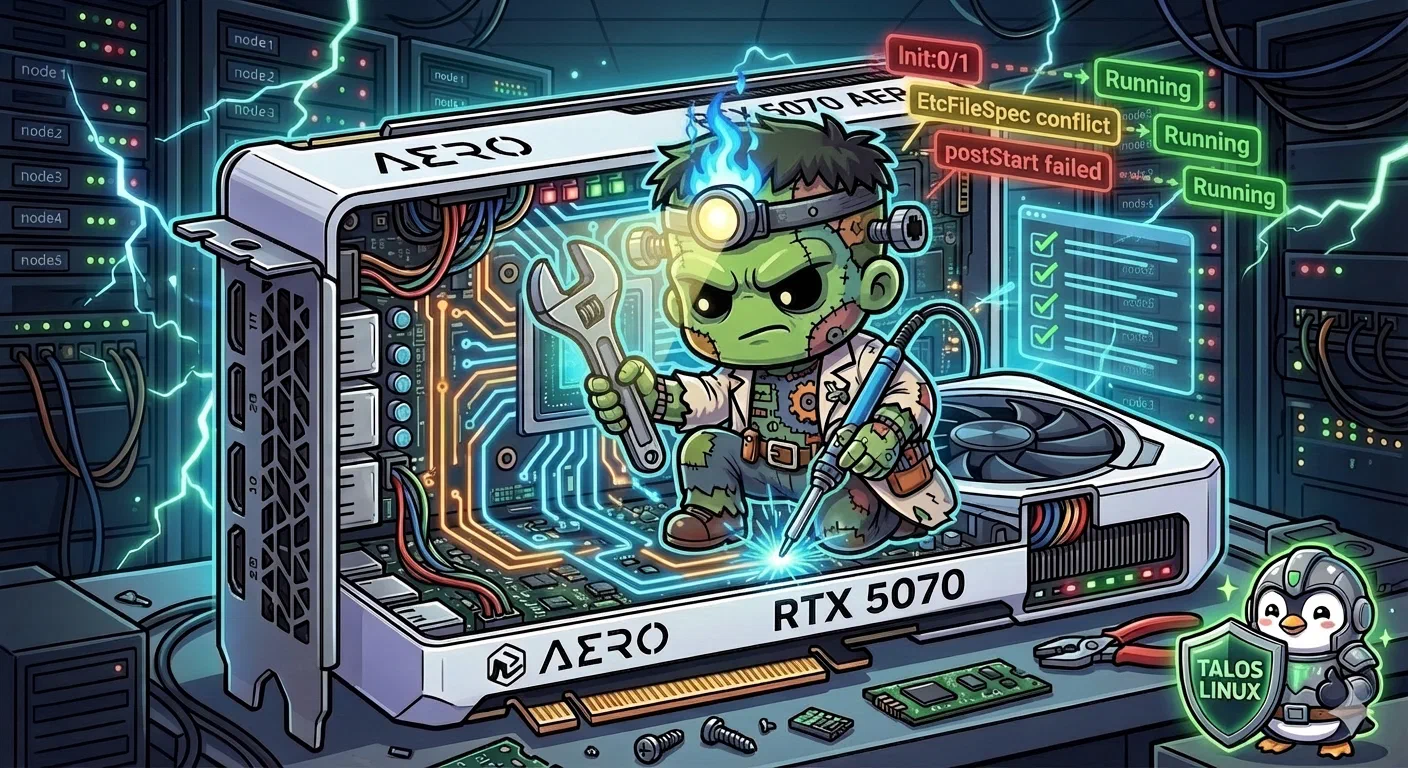
GPU Containers on Talos — The Validation Fix
Layer 4 deployed the NVIDIA GPU Operator. Layer 10 deployed Ollama. Between those two milestones lay four distinct issues that kept every GPU container stuck — first at Init:0/1, then ContainerCreating, then crashing in a 3-second loop. Each issue was specific to the Talos Linux intersection with the NVIDIA stack, and each had to be solved in sequence before a single model ran.
    flowchart TD
  subgraph Talos[Talos Linux — Immutable OS]
    SE[System Extensions<br/>driver + toolkit]
    MP[Machine Config Patches<br/>via Omni]
  end
  subgraph GPUOp[NVIDIA GPU Operator]
    VP[Validator Pods]
    DP[Device Plugin]
    FD[Feature Discovery]
  end
  subgraph Kubelet
    CRI[containerd CRI]
    RT[runc runtime<br/>nvidia runtime]
  end
  subgraph Pod[GPU Pod — Ollama]
    PH[postStart hook]
    CO[ollama serve]
  end

  SE -->|no marker files| VP
  VP -->|stuck Init:0/1| DP
  MP -->|EtcFileSpec conflict| CRI
  CRI -->|missing base_runtime_spec| RT
  RT -->|ContainerCreating| PH
  PH -->|nvidia exec fails| CO
  CO -->|CrashLoopBackOff| PH
Issue 1: Validation Markers
After the GPU Operator deployed on gpu-1, every operator pod — device-plugin, feature-discovery, dcgm-exporter, validator — got stuck in Init:0/1. Waiting for init containers that check for validation marker files:
/run/nvidia/validations/driver-ready
/run/nvidia/validations/toolkit-ready
These files are created by the GPU Operator’s own driver and toolkit containers. But on Talos, the driver and toolkit are baked into the immutable OS as system extensions. The operator’s driver and toolkit are disabled (driver.enabled: false, toolkit.enabled: false). Nobody creates the validation files.
The fix: a DaemonSet that creates and maintains the marker files on GPU nodes:
# apps/gpu-operator-extras/manifests/validation-markers.yaml
apiVersion: apps/v1
kind: DaemonSet
metadata:
  name: nvidia-validation-markers
  namespace: gpu-operator
spec:
  selector:
    matchLabels:
      app: nvidia-validation-markers
  template:
    spec:
      nodeSelector:
        nvidia.com/gpu.present: "true"
      hostNetwork: true
      containers:
        - name: marker
          image: busybox:1.37
          command: ["/bin/sh", "-c"]
          args:
            - |
              mkdir -p /run/nvidia/validations
              while true; do
                touch /run/nvidia/validations/driver-ready
                touch /run/nvidia/validations/toolkit-ready
                sleep 30
              done
          volumeMounts:
            - name: run-nvidia
              mountPath: /run/nvidia
      volumes:
        - name: run-nvidia
          hostPath:
            path: /run/nvidia
            type: DirectoryOrCreate
The 30-second loop matters. /run is a tmpfs on Talos — files there disappear on reboot or containerd restart. Without the loop, a containerd restart clears the markers and blocks the operator pods.
Also disable the operator’s built-in validator (more complex logic that also breaks on Talos):
kubectl label node gpu-1 nvidia.com/gpu.deploy.operator-validator=falseIssue 2: Machine-Specific containerd Patches
With the operator running, Ollama gets scheduled to gpu-1 but stuck at ContainerCreating. The container is running inside containerd (crictl shows CONTAINER_RUNNING) but kubelet cannot track it.
GPU containers on Talos need the nvidia runtime set as default:
# /etc/cri/conf.d/20-customization.part on gpu-1
[plugins."io.containerd.cri.v1.runtime"]
  cdi_spec_dirs = ["/var/cdi/static", "/var/cdi/dynamic"]
  [plugins."io.containerd.cri.v1.runtime".containerd]
    default_runtime_name = "nvidia"
  [plugins."io.containerd.cri.v1.runtime".containerd.runtimes.nvidia]
    base_runtime_spec = "/etc/cri/conf.d/base-spec.json"
This config lives in a Talos machine config patch applied via Omni. The problem: Layer 5 had deployed a cluster-wide Container Device InterfaceA vendor-neutral spec for describing a device — a GPU, say — so a container runtime can inject it without a bespoke plugin per vendor. containerd patch creating the same file path (/etc/cri/conf.d/20-customization.part) with CDI directory config only. When both patches target the same file with op: create, Talos hits:
resource EtcFileSpecs.files.talos.dev already existsThe node enters a 35-minute reboot loop. Container Runtime InterfaceThe contract between the kubelet and whatever actually runs containers — containerd on Talos. It also decides the log format on disk, which is why CrowdSec has to be told which runtime it is parsing. never registers. The node becomes NotReady.
The fix: replace the cluster-wide CDI patch with machine-specific patches, each scoped by omni.sidero.dev/cluster-machine label. Each node gets one patch that covers everything that file needs:
# patches/phase05-mini-config/05-mini1-cdi-containerd.yaml
metadata:
    id: 303-mini1-cdi-containerd
    labels:
        omni.sidero.dev/cluster-machine: ce4d0d52-6c10-bdc9-746c-88aedd67681b
spec:
    data: |
        machine:
            files:
                - path: /etc/cri/conf.d/20-customization.part
                  op: create
                  content: |
                      [plugins."io.containerd.cri.v1.runtime"]
                        cdi_spec_dirs = ["/var/cdi/static", "/var/cdi/dynamic"]
mini nodes get CDI dirs only. gpu-1 gets CDI dirs plus the nvidia default runtime plus the base runtime spec — all in one patch, one file. No conflict.
Ordering: delete the cluster-wide patch first, then apply machine-specific ones. Both existing simultaneously on any node triggers the conflict.
Issue 3: base_runtime_spec for nvidia Runtime
With machine-specific patches and nvidia default runtime set, GPU pods still stuck at ContainerCreating. Non-GPU pods on the same node work perfectly. The difference in containerd CRI config:
runtimes:
  nvidia:
    runtimeType: io.containerd.runc.v2
    options: {BinaryName: /usr/local/bin/nvidia-container-runtime}
    baseRuntimeSpec: ""                          # missing
  runc:
    runtimeType: io.containerd.runc.v2
    baseRuntimeSpec: /etc/cri/conf.d/base-spec.json  # present
The runc runtime has a baseRuntimeSpec pointing to Talos’s Open Container InitiativeThe body behind the standard image and runtime formats. "OCI registry" means any registry speaking that standard, not a specific vendor's. base spec. The nvidia runtime has an empty one. The base spec contains the OCI process and Linux namespace config that kubelet expects — without it, kubelet cannot track the container lifecycle.
The fix: add base_runtime_spec = "/etc/cri/conf.d/base-spec.json" to the nvidia runtime config in the Talos patch. After a reboot, GPU pods get IPs and PodReadyToStartContainers flips to True.
Issue 4: PostStart Hook + nvidia exec
Ollama finally starts — detects the GPU, reports 15.9 GiB Video RAMMemory on the GPU itself. Both the model weights and the KV cache live here, which makes it the binding constraint on what a single card can serve. — and immediately crashes. CrashLoopBackOff with exit code 0.
The Helm chart generates a postStart hook that pulls models:
while ! /bin/ollama ps > /dev/null 2>&1; do sleep 5; done
/bin/ollama pull qwen3.5:9b
On Talos with the nvidia system extension, the nvidia-container-cli OCI hook runs during container exec and fails with ERROR: init 250 result=11. This error is non-fatal for the main process (Ollama starts and detects the GPU), but it causes the postStart hook’s exec to fail. Kubernetes kills the container when a postStart hook fails.
Logs look normal except for FailedPostStartHook. The container exits cleanly (code 0) 2-3 seconds after starting.
The fix: remove the model pull from Helm values. Models are pulled after the pod is running:
# apps/ollama/values.yaml
ollama:
  models:
    pull: []
kubectl exec -n ollama deploy/ollama -- ollama pull qwen3.5:9bModels persist on the Longhorn PersistentVolumeClaimA Kubernetes request for durable storage. The pod names a claim and the storage layer — Longhorn on Frank — binds real disk behind it, so the data outlives the pod., so they survive restarts.
The Result
$ kubectl exec -n ollama deploy/ollama -- ollama ps
NAME          ID              SIZE      PROCESSOR    CONTEXT    UNTIL
qwen3.5:9b    6488c96fa5fa    8.6 GB    100% GPU     4096       24 hours from now
Full GPU inference. The stack — LiteLLM gateway, Ollama, NVIDIA device plugin, containerd nvidia runtime, Talos system extensions — is operational.
Talos + NVIDIA Gotchas Summary
| Issue | Symptom | Fix |
|---|---|---|
| Validation markers | GPU Operator pods stuck Init:0/1 | DaemonSet creating marker files in a loop |
| EtcFileSpec conflict | Node enters 35-min reboot loop | Machine-specific patches, one op: create per file per node |
| Missing base_runtime_spec | GPU pods stuck ContainerCreating | Add base_runtime_spec to nvidia runtime config |
| PostStart hook + nvidia exec | Container killed after 2-3 seconds | Remove postStart model pull, use kubectl exec |
Recovery Path
| Symptom | Cause | Fix |
|---|---|---|
| GPU Operator pods stuck Init | Validation markers missing | Check DaemonSet running; verify /run/nvidia/validations/ exists |
| Node NotReady + reboot loop | EtcFileSpec resource conflict | Delete cluster-wide patch, apply machine-specific, wait for reboot |
| GPU pods stuck ContainerCreating | base_runtime_spec missing for nvidia runtime | Verify containerd CRI config on node |
| Pod exits with FailedPostStartHook | nvidia exec OCI hook fails | Remove postStart hook from Helm values |
Missteps
| What Happened | Why It Was Wrong | How We Fixed It | Commit |
|---|---|---|---|
| No validation markers on Talos — GPU Operator assumes its own driver/toolkit containers create marker files, but Talos provides them as system extensions with those containers disabled | Talos immutable OS vs operator’s mutable-filesystem assumptions | DaemonSet that creates and maintains marker files in a loop | 965d2609 |
Cluster-wide CDI patch conflicts with gpu-specific nvidia patch — both target the same file path with op: create; Talos cannot merge them | Two ConfigPatches racing for the same EtcFileSpec resource | Machine-specific patches scoped by cluster-machine label, one file per node per patch | bb5456d5 |
| nvidia runtime missing base_runtime_spec — kubelet cannot track container lifecycle without OCI base spec | containerd config left baseRuntimeSpec: "" for the nvidia runtime | Added base_runtime_spec to nvidia runtime block | bb5456d5 |
| postStart model pull fails on Talos — nvidia OCI hook errors on exec, Kubernetes kills container | postStart hook failure is fatal per K8s spec, even if the main process is healthy | Removed postStart hook, pull models on first request via LiteLLM | 7c88dcc4 |
References
- AI Workloads on Talos Linux — Siderolabs blog
- NVIDIA GPU Operator — Official docs
- Container Device Interface (CDI) — Cloud Native Computing FoundationThe foundation that hosts Kubernetes and most of the projects around it. "CNCF project" is a statement about governance, not quality or maturity. spec
- Talos Containerd Config — Talos docs