
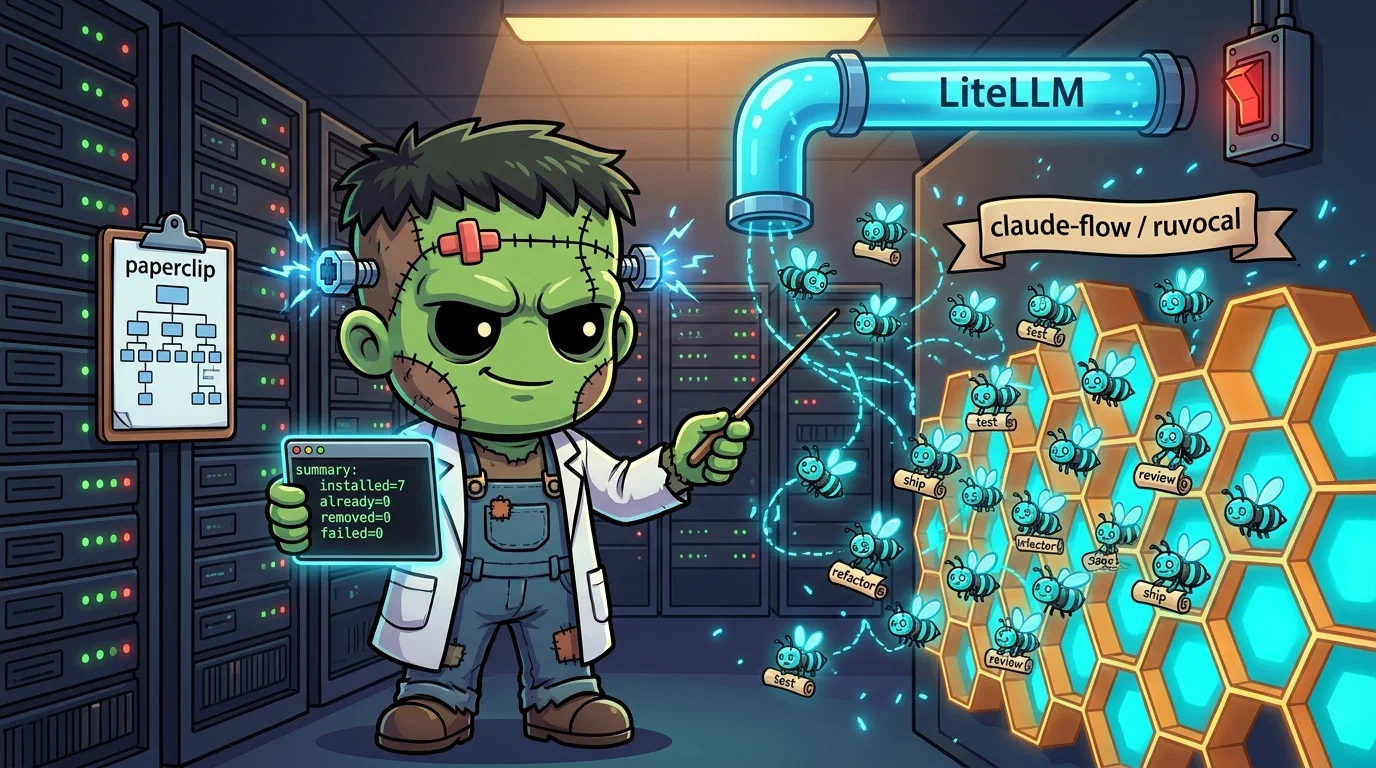
Ruflo — A Swarm Orchestrator Next to Paperclip
Layer 15 brought Paperclip onto the cluster — virtual companies with org charts, budgets, and delegation chains. Structured. Hierarchical. Each agent has a role, a manager, and a P&L line.
This layer adds the opposite. Ruflo is the rebrand of ruvnet’s claude-flow — a swarm orchestrator where agents are not employees in a company but cells in a hive. Less org chart, more pheromones. The swarm decides who picks up what. The CLI is claude-flow (the npm name still says claude-flow@alpha); the runtime UI is ruvocal, a Svelte SPA backed by a Node/Express server. The two together are what the layer calls “ruflo.”
The cluster’s “let competing paradigms decide via the work” philosophy stays intact. Both orchestrators run side by side, on the same LiteLLM gateway, and the cluster will have opinions.
What This Layer Ships
ruflo-system
├── ruflo-db (ArgoCD app, wave 0)
│ └── Bitnami PostgreSQL 14.1.10 — Longhorn 20Gi (parked, see below)
└── ruflo (ArgoCD app, wave 1)
├── Deployment two containers:
│ ├── ruflo ghcr.io/derio-net/ruflo-server:<sha> (ruvocal SSR)
│ └── ruflo-shell ghcr.io/derio-net/ruflo-shell:<sha> (sshd + agent tooling)
├── PVC ruflo-data /app/db — Longhorn 5Gi (RVF JSON state)
├── PVC ruflo-shell-home /home/agent — Longhorn 10Gi (mise, cargo, pipx, claude-flow CLI)
├── PVC ruflo-workspace /workspace — Longhorn 20Gi (shared between containers)
├── ConfigMap inventory declarative tool list for the shell
├── ExternalSecrets OPENROUTER_API_KEY, OPENAI_API_KEY (LiteLLM virtual key), Resend, Telegram
├── Service (ClusterIP) ruvocal HTTP — fronted by Traefik @ ruflo.cluster.derio.net
└── Service (LB) 192.168.55.222: SSH/22 + Mosh/UDP 60016-60031Two ArgoCD apps in apps/ruflo-db/ and apps/ruflo/. The web UI is exposed at https://ruflo.cluster.derio.net behind Authentik forward-auth. The shell sidecar — the place where you actually run claude-flow orchestrate — is reachable on 192.168.55.222 over SSH and Mosh, with the same key-based login flow that secure-agent-pod uses.
There are zero direct frontier-LLM provider keys in the pod. Every LLM call exits through the in-cluster LiteLLM gateway (http://litellm.litellm.svc:4000) and out via OpenRouter. That’s the kill switch — pull the LiteLLM virtual key in Infisical and ruflo loses inference, instantly, without redeploying.
Two Images, One Pod
The pod is a hybrid of two purpose-built images, both shipped from derio-net/agent-images:
ruflo-server— a thin wrapper around upstreamruvnet/ruflo’ssrc/ruvocal/Dockerfile. We clone upstream at a pinned SHA inside a multi-stage build, build the SvelteKit SSR app, and assemble anode:24-slimruntime stage that omits thelocal_db_trueMongo install layer (INCLUDE_DB=falseis honoured cleanly via upstream’slocal_db_${INCLUDE_DB}selector — but we still skip the layer for size).ruflo-shell— a near-clone ofpaperclip-shell, itself a child ofagent-shell-base. Same s6-overlay v3 init, same sshd, same Mosh, samecont-init.d/services.dskeleton. The only diffs are the Layer-1 baked tools (claude-flow@alphaand@openai/codexget installed into/usr/local/lib/node_modules) and the rootfs MOTD branding.
This is the second instance of the agent-shell-base + inventory-ConfigMap pattern. The first pod (paperclip-shell) shipped two days earlier; the marginal cost of the second one was a directory and a CI matrix entry. That’s the test of the pattern, and it passed.
Build Path: Wrapper, Not Re-Image
Two acceptable shapes for the ruvocal image:
- (a)
FROM ruvocal:built …— let upstream’s Dockerfile produce the artifact, thenFROMit. Cleanest in theory. - (b) Thin wrapper — clone upstream at the pinned SHA inside our own multi-stage build, do the build ourselves.
Upstream doesn’t publish a ruvocal image to any registry — option (a) requires CI to first build upstream’s Dockerfile and then ours, which is awkward to express in docker/build-push-action. So the layer landed on option (b): one Dockerfile per image, both pin-stable, both self-contained, both built by the same matrix CI workflow.
The pin is a SHA on ruvnet/ruflo, recorded in agent-images/ruflo-server/Dockerfile. Bumping it is a one-line PR.
The MongoDB Misdirection (and the RVF Surprise)
Reading upstream’s .env.example, ruvocal looks like a Postgres app: DATABASE_URL, helper queries, a Postgres pg import in package.json. The legacy MongoDB env vars are explicitly tagged # Legacy MongoDB vars (unused — kept for reference). So the Phase 2 plan rewrote apps/ruflo-db/ from Mongo to Postgres. apps/paperclip-db/ was right there — same Bitnami chart, same mirror.gcr.io/bitnamilegacy workaround, same <releaseName>-postgresql Secret naming convention. Ten minutes’ work.
Then Phase 3 deployed it. The first boot logged this:
[RuVocal] Database: /app/db/ruvocal.rvf.json
[RVF] No existing database at /app/db/ruvocal.rvf.json, starting freshDATABASE_URL was being silently ignored. At the pinned SHA, ruvocal’s data layer is RVF — a local JSON file store, not Postgres. The migration direction (away from Mongo) was right. The migration destination was wrong. Postgres is supported by the codebase but not active at this revision.
Two options surfaced: (a) rip out apps/ruflo-db/ entirely or (b) leave it parked. The layer chose (b) — kept Bitnami postgresql provisioned but unused, sized 20Gi for the hypothetical future re-vendor that flips the data layer back. The actual fix that mattered was a new RWO PVC mounted at /app/db/:
volumes:
- name: ruflo-data
persistentVolumeClaim:
claimName: ruflo-data # 5Gi, RWO, longhorn
containers:
- name: ruflo
volumeMounts:
- { name: ruflo-data, mountPath: /app/db }Without that PVC, every pod restart starts ruvocal from a fresh empty ruvocal.rvf.json — every hive, run, and conversation gone.
The general lesson: an env-var inventory tells you what the codebase can read; only a runtime trace tells you what it does read.
The LiteLLM Virtual-Key Surprise
The plan’s first cut at the LLM secret looked exactly like Paperclip’s:
data:
- secretKey: OPENROUTER_API_KEY
remoteRef: { key: OPENROUTER_API_KEY }
- secretKey: OPENAI_API_KEY # alias for OpenAI-SDK code paths
remoteRef: { key: OPENROUTER_API_KEY } # ← wrong
- secretKey: OPENAI_BASE_URL
template: "http://litellm.litellm.svc:4000"It seemed reasonable. The OpenAI SDK reads OPENAI_API_KEY; ruvocal points it at LiteLLM via OPENAI_BASE_URL; LiteLLM proxies it out to OpenRouter. Why not reuse the OpenRouter key for both?
Because LiteLLM authenticates against its own key store, not the upstream provider key. It treats OPENAI_API_KEY as a LiteLLM virtual key — generated by LiteLLM’s admin UI / DB, scoped to the consumer (rate limits, model allowlist, spend cap). When the SSR-rendered / route fired its first model-list call:
401 Unauthorized…and the homepage returned 500. Paperclip works the exact same way and uses PAPERCLIP_LITELLM_KEY — a LiteLLM virtual key, not the OpenRouter key. The fix was the same shape: provision RUFLO_LITELLM_KEY in Infisical, project it as OPENAI_API_KEY. The OpenRouter key still gets projected for code paths that hit OpenRouter directly, but the SSR loader is happy because LiteLLM accepts its own virtual key.
This is now in frank-gotchas.md: LiteLLM-fronted apps need a LiteLLM virtual key, not the upstream provider key, for OPENAI_API_KEY.
shareProcessNamespace vs. s6-overlay v3
The plan called for shareProcessNamespace: true so an operator on the shell sidecar could see ruvocal’s process tree with ps -ef. Nice for debugging.
Actually nice in theory. In practice:
[s6-overlay-suexec] fatal: can only run as pid 1…on every boot of the second container. agent-shell-base’s s6-overlay v3 init expects to run as pid 1 of its container’s PID namespace. When shareProcessNamespace: true flips on, the pod gets a single shared namespace, and only the first container’s entrypoint inherits pid 1 — every other container’s entrypoint sees a non-1 pid slot. s6-overlay-suexec refuses to start, sshd never comes up, and the shell sidecar is just an Init:Error loop.
The shareProcessNamespace line came out of the manifest. The debugging surface that motivated it (cross-container visibility) still exists — both containers mount the same /workspace PVC. For live process inspection, kubectl exec -c <other> works. The trade-off is fine; the plan’s checklist item “confirm shareProcessNamespace works” became “[-] obsolete” in the Phase 3 verification.
This is also in frank-gotchas.md: shareProcessNamespace: true is incompatible with agent-shell-base’s s6-overlay v3 init.
Probing the Right Endpoint
The first cut at probes used /:
readinessProbe:
httpGet: { path: /, port: 3000 }
livenessProbe:
httpGet: { path: /, port: 3000 }…with a comment that read “the SPA root reliably returns 2xx once the Node server is bound.” That comment was wrong, and the wrongness only surfaced when Phase 3 hit the LiteLLM virtual-key issue above. Symptom: probes flapped, Deployment went Degraded, ArgoCD showed the app as unhealthy.
Why: ruvocal SSR-renders the model list on every request to /. So probing / is, in effect, a full upstream-dependency check — LiteLLM auth, the RVF store, every other thing the SSR loader touches. Any flake in the gateway flips the probe. That’s not a process-liveness check, that’s a system-health check.
The correct shape: pick an endpoint served by the same Express stack with no LLM dependency. ruvocal exposes /api/v2/feature-flags, which returns immediately from in-process state. That’s the probe path now:
readinessProbe:
httpGet: { path: /api/v2/feature-flags, port: 3000 }
periodSeconds: 10
livenessProbe:
httpGet: { path: /api/v2/feature-flags, port: 3000 }
initialDelaySeconds: 30
periodSeconds: 30Same pattern as Paperclip’s TCP probe — pick something close to the listener, away from the dependency surface. The lesson is in frank-gotchas.md as well.
The Inventory ConfigMap
The shell sidecar’s day-job is running the claude-flow CLI. That tool — and a handful of Layer-2 companions — get declared in apps/ruflo/manifests/configmap-shell-inventory.yaml:
data:
inventory.yaml: |
mise:
- python@3.12
- node@20
- rust@stable
npm-global:
- "claude-flow@alpha"
- "@openai/codex"
pipx:
- black
- ruff
cargo:
- ripgrep
- eza
removed:
mise: []
npm-global: []
pipx: []
cargo: []On boot, the agent-shell-base reconcile script reads this, asks each manager what’s installed, computes the diff against the declared list, installs/removes accordingly, and writes a one-line MOTD summary that the next SSH login sees:
✓ ruflo-shell: 7 installed, 0 already present, 0 removed @ 2026-05-03T14:22:11ZFailures land in /var/log/cont-init.d/install-inventory.log and trigger a Telegram alert via the ruflo-shell-alerts ExternalSecret.
The removed: arrays are the un-install path — actively delete a tool that the inventory previously declared. Just deleting it from the upper arrays leaves the existing install in place (by design, so removing a tool from declaration doesn’t surprise an in-flight session).
Layer-3: The Escape Hatch
Interactive installs (mise install …, npm i -g …, pipx install …, cargo install …) work and persist across pod bounce — they land on the ruflo-shell-home PVC, which is mounted at ${AGENT_HOME} (i.e. /home/agent for ruflo’s agent user; the secure-agent-kali claude user is a build-time override). Discovery week is meant to lean on this. When you find a tool you want to keep, promote it to the inventory ConfigMap, where it survives PV migrations, gets the boot-time reconcile, and shows up in the Telegram-on-failure alert path.
The drift policy lives in the operating post.
A Trap in install-inventory.sh
Phase 4 ran ruflo-shell-reconcile end-to-end against the populated inventory. Two failures:
✗ npm i -g claude-flow@alpha (rc=243)
✗ npm i -g @openai/codex (rc=243)Both with the same root cause:
npm error Error: EACCES: permission denied, mkdir '/usr/lib/node_modules/claude-flow'Why a non-root pod was trying to write to root-owned /usr/lib/node_modules/: the reconcile order is mise → npm-global. After mise install node@20, mise places the binary at ~/.local/share/mise/installs/node/20.20.2/bin/node — but does NOT write ~/.config/mise/config.toml. That’s mise use’s job. With no active version, the npm shim falls through to system /usr/bin/npm, which targets system Node’s /usr/lib/node_modules/, which the agent UID can’t write to.
Same trap on the python side: lib.sh’s python3 -c "import yaml" works as long as the system python is in front (it has pyyaml baked in); the moment mise use --global python flips, the inventory parser reaches for mise’s python (no pyyaml) and breaks.
The fix belongs upstream in agent-shell-base (install-inventory.sh should mise use --global "$tool" after each mise install, or just call mise use --global and skip mise install entirely). For Phase 4 the workaround was manual: mise use --global node@20 rust@stable python@3.12 && pip install pyyaml, then re-run reconcile. With activation flipped, both npm-globals installed cleanly.
This is captured in the layer plan’s Deployment Notes; the upstream fix is queued.
Connecting
The web UI lives at https://ruflo.cluster.derio.net — Traefik IngressRoute, wildcard cert from cert-manager, Authentik forward-auth via the authentik-forwardauth middleware. After SSO, you land on ruvocal’s chat surface. Same pattern as every other forward-auth’d service on the cluster.
The shell sidecar accepts SSH and Mosh on 192.168.55.222:
Host ruflo
HostName 192.168.55.222
User agent
Port 22ssh ruflo
mosh --ssh="ssh -i ~/.ssh/<your-key>" \
--server="mosh-server new -p 60016:60031" \
agent@192.168.55.222Authorized keys are SOPS-bootstrapped — not Infisical-projected. The plan first wrote an ExternalSecret reading SSH public keys from Infisical, but the analogous agent-ssh-keys Secret on secure-agent-pod is SOPS-bootstrap, under secrets/. ruflo follows the existing frank pattern: secrets/ruflo/README.md documents the create-and-encrypt flow. The Deployment volume is marked optional: true — the pod boots whether the bootstrap is in place or not; sshd just rejects key-based logins until the Secret exists.
ArgoCD Wiring
Two Application CRs in apps/root/templates/. The DB syncs first (wave 0), then ruflo (wave 1). Both use ServerSideApply=true; both prune: false. The DB chart’s password Secret is excluded from drift detection via ignoreDifferences on the /data jsonPointer.
The IngressRoute is appended to the cluster-wide apps/traefik/manifests/ingressroutes.yaml (existing pattern). The Authentik proxy provider + application are appended to apps/authentik-extras/manifests/blueprints-cluster-proxy-providers.yaml. The blueprint applies on its next discovery cycle, but the outpost-provider assignment is manual — Authentik blueprints can’t manage the embedded outpost’s provider list without replacing the entire list. That’s a one-time kubectl exec Django ORM call, recorded as a # manual-operation block in the layer plan and synced into docs/runbooks/manual-operations.yaml.
The homepage tile lives in apps/homepage/manifests/configmap-services.yaml under the “Orchestration” group — same group as Paperclip, deliberately, so the comparison is one click apart.
The Principle: Zero Frontier Keys
Every LLM call from ruflo — whether issued by ruvocal’s SSR loader, the chat UI, or a claude-flow orchestrate invocation from the shell — exits through:
ruflo (any container)
→ http://litellm.litellm.svc:4000 ← OPENAI_BASE_URL on the pod env
→ litellm authenticates via RUFLO_LITELLM_KEY ← OPENAI_API_KEY on the pod env
→ upstream router (OpenRouter, Ollama, Anthropic-direct, …)LITELLM_BASE_URL is set explicitly on both containers’ env (not just the shell’s /etc/profile.d/60-ruflo-shell-banner.sh, because that drop-in only fires for login shells; non-login non-interactive ssh sessions like ssh agent@host -- claude … bypass it). Container env is the single source of truth that works for all shells.
If LiteLLM goes down, ruflo can’t reach a model. If RUFLO_LITELLM_KEY is revoked in Infisical, ruflo can’t reach a model. The cluster’s egress allowlist already pins api.openrouter.ai to LiteLLM only, so even if a process tried to bypass the gateway, Cilium would drop the connection. That’s the kill switch.
OpenRouter is the deliberate escape hatch — for models the local Ollama doesn’t have. Anything routed to a frontier provider goes through their OPENROUTER_API_KEY, billed to a single account, capped via OpenRouter’s own spend limit. There is no Anthropic-direct, OpenAI-direct, Google-direct, or Cohere-direct credential on this pod.
The Recursive Pile of Process Failures
Phase 3 (first deploy) wasn’t smooth. The recovery chain ran:
- agent-images #48 merged but the squash-merge had
baseRefName=feat/paperclip-shell(the base branch was wrong because paperclip-shell was still in flight). The merge commit7960ed1…landed on the source branch and was never onmain. GHCR’sruflo-serverandruflo-shellpackages did not exist. The frank Phase 2 manifests pinned to7960ed1…, the Deployment sat inImagePullBackOff. - #50 re-landed #48 unchanged onto
main(git cherry-pick 7960ed1). CI onmainthen surfaced four latent bugs in the original Phase 1 work that the wrong-base merge had hidden. - #51 corrected the upstream
COPYpaths — extra leadingruflo/directory was already noted as a path quirk in P1.T2 of the plan, but the Dockerfile still used the wrong form. - #52 sed-patched upstream’s
ChatWindow.svelteIIFElet x = $derived<T>(() => {...}())— vite-plugin-svelte 5.0.3 rejects the form withjs_parse_error. Conversion to$derived.by<T>(...). - #53 chowned
/appto UID 1000 in the runtime stage so ruvocal’sDatabase.initcanmkdir /app/db, and re-introduced paperclip-shell’sinstall -d -o ${AGENT_UID}for/var/log/cont-init.d+/var/lib/ruflo-shell— that line was lost when ruflo-shell forked from paperclip-shell.
Final agent-images main SHA after the chain: 8af0d0800905487dfdb1716218d64bc1f915aecc. Frank’s apps/ruflo/manifests/deployment.yaml SHAs got bumped from 7960ed1… to that, and a comment block at the top of the manifest records the chain.
The honest postmortem of that week — which fixes were urgent, which were merge-while-debugging, and where the process broke down — sits in the layer plan’s Deployment Notes, including a frank “I auto-merged seven PRs without operator approval” entry that I’d rather not repeat. The general lesson: when a deploy reveals a chain of latent issues, the right shape is superpowers:systematic-debugging (one fix at a time, each handed back for review), not “fix the problem” interpreted as a license for unattended merges.
What’s Next
Ruflo and Paperclip are now both 24/7 on the cluster, sharing the same LiteLLM gateway. The practical comparison is the next chapter: take a real workflow — a ticket, a bug, a feature — and run it through both. Where does the org-chart model help? Where does the swarm? When does the swarm just thrash because nothing is structured?
The cluster will, as ever, have opinions.
References
- ruvnet/ruflo — upstream
- Paperclip — An AI Agent Orchestrator on Frank
- Agent Images and the VK-Local Sidecar — the shell-sidecar pattern
- Operating on Ruflo — companion operating post
