
CI on the Mirrors: Gitea Actions
On July 19th at around noon, my GitHub Actions free tier died. Not “ran low” —
died: 2,000 of 2,000 minutes consumed, every workflow in the org silently
refusing to queue. The billing API’s daily burn-down reads like a patient
chart, and the last line says 2026-07-19 13 (cum 2000).
I already mirror those repositories to my own Gitea. The obvious question — the one that started this layer — was: isn’t Tekton’s format compatible with Actions, so the workflows can just be reused? The answer is no, and the answer is also the design: Tekton speaks Task/Pipeline CustomResourceDefinitionThe object that teaches the Kubernetes API a new resource type. Install a CRD and the API server starts serving a kind it has never heard of, with validation and RBAC like any built-in., and every Tekton pipeline I run was a hand translation. What IS compatible with GitHub Actions workflow YAML is Gitea Actions — which had been sitting in my Gitea, disabled by default, the whole time.
After this post you can run .github/workflows/*.yml unchanged on a Gitea
mirror, report results back to GitHub PRs as commit statuses, and keep a
parallel GitHub+Gitea period from double-firing anything that mutates.
What you’re standing on
To follow this you need three things already working, each built in an earlier layer:
- A Gitea instance and a webhook-driven mirror chain — GitHub webhooks
reaching a Tekton EventListener that pushes
sync-pr-<N>branches and main updates to the mirror (Building 27). - External Secrets delivering secrets from the store to workloads (Building 09).
- Somewhere to run privileged pods that is not your control plane (mine is pc-1, the Edge-zone worker).
The bill (or: measure before you migrate)
The enhanced billing endpoint gives exact per-repo, per-day line items — the
legacy orgs/{org}/settings/billing/actions endpoint is gone (HTTP 410):
gh api "organizations/<ORG>/settings/billing/usage?year=2026&month=7" \
  | jq '[.usageItems[] | select(.unitType=="Minutes")]
        | group_by(.repositoryName)
| map({repo: .[0].repositoryName, min: (map(.quantity) | add)})'| Repo | Billed (Jul 1–19) | Share |
|---|---|---|
| cnc-fr | 928 min | 46.4% |
| cnc-frd | 721 min | 36.0% |
| cnc-fru | 307 min | 15.3% |
| everything else | 44 min | 2.2% |
Two shapes hide in there. Per-PR CI volume: cnc-frd’s ci workflow is 3
jobs per run (Go tests + a postgres service container, golangci-lint, an image
smoke) — ~670 of those minutes. And a schedule floor: one workflow ran on
a */30 * * * * cron. Each run takes 20 seconds; each run bills a full
minute per job. At 48 runs/day that is ≥1,440 minutes/month — 72% of the free
tier — for doing nothing but checking container pins. Billing rounds per job,
up, always. Measure with run history before assuming which workflow is the
problem; mine ranked #3 in the observed window only because the tier died
before its cron could accumulate.
The architecture
    flowchart LR
  GH[GitHub<br/>PRs live here] -->|webhook| EDGE[edge relay]
  EDGE --> EL[Tekton EventListener]
  EL -->|push sync-pr-N| GITEA[Gitea mirror]
  GITEA -->|job| RUNNER[act_runner + DinD]
  RUNNER -->|commit status| GITEA
  GITEA -->|status webhook| BRIDGE[status bridge]
  BRIDGE -->|same sha| GH
The load-bearing choice: Tekton keeps the jobs it already does (mirror sync, promotion flows) and Gitea Actions runs the workflow-shaped CI near-verbatim. The mirror is push-synced, so the sha on the Gitea side IS the GitHub PR head sha — the status bridge needs no mapping table.
Step 1 — enable Actions in Gitea
One chart value:
# apps/gitea/values.yaml
gitea:
  config:
    actions:
      ENABLED: true
Two traps, both earned:
The pod does not roll. The gitea chart renders config into a Secret
(gitea-inline-config) consumed by an init container at boot. The Secret
syncs; the running pod keeps serving the old app.ini; ArgoCD says
Synced/Healthy throughout. After any config-only values change:
kubectl -n gitea rollout restart deploy/gitea
kubectl -n gitea exec deploy/gitea -- grep -A1 '\[actions\]' /data/gitea/conf/app.ini
# [actions]
# ENABLED = true      ← verify INSIDE the pod, not via the Secret
Instance-enable does not repo-enable. ENABLED: true switches the
subsystem on; existing repositories keep their Actions unit off, and a
workflow on such a mirror produces no run and no error. Enable per repo:
for r in repo-a repo-b; do
  curl -s -X PATCH "$GITEA/api/v1/repos/$ORG/$r" \
    -H "Authorization: token $ADMIN_TOKEN" -H 'Content-Type: application/json' \
    -d '{"has_actions": true}'
done
# verify: each repo shows an Actions tab
Step 2 — the runner (apps/gitea-runner/)
act_runner plus a docker-in-docker sidecar — the only privileged workload in
my fleet, quarantined accordingly: own namespace with PodSecurity
privileged labels (Gitea’s namespace stays restricted), pinned to pc-1,
automountServiceAccountToken: false (a workflow job can reach anything the
DinD daemon can bind-mount, so the pod carries no cluster credentials).
The wiring that matters, from apps/gitea-runner/manifests/deployment.yaml:
containers:
  - name: runner
    image: gitea/act_runner:0.2.13
    env:
      - name: GITEA_INSTANCE_URL
        value: "http://gitea-http.gitea.svc.cluster.local:3000"
      - name: GITEA_RUNNER_REGISTRATION_TOKEN
        valueFrom:
          secretKeyRef:
            name: gitea-runner-token
            key: token
      - name: DOCKER_HOST
        value: "tcp://localhost:2375"
  - name: dind
    image: docker:28.3.2-dind
    securityContext:
      privileged: true
    args: ["--host=tcp://0.0.0.0:2375"]
    env:
      - name: DOCKER_TLS_CERTDIR
        value: ""          # ← without this, dind serves TLS on 2376
                           #   and every job hangs against 2375, forever
Capacity is 2 (runner.capacity in the config ConfigMap) so a Playwright run
and a compose smoke can’t jointly eat a 32GB node. The registration token is
minted inside Gitea and delivered by External Secrets OperatorThe operator that pulls secrets from an external store into Kubernetes Secrets. On Frank it mints short-lived GitHub App tokens, so no long-lived credential is ever committed.:
kubectl -n gitea exec deploy/gitea -- gitea actions generate-runner-token
# → store in your secret store; ESO delivers it as Secret gitea-runner-token
Registration is one-shot state on the PersistentVolumeClaimA Kubernetes request for durable storage. The pod names a claim and the storage layer — Longhorn on Frank — binds real disk behind it, so the data outlives the pod. (/data/.runner): rotating the
token does not re-register an existing runner. To force fresh registration,
scale to 0, delete /data/.runner, scale up.
Step 3 — make the workflows dual-host safe
The same YAML now runs from two servers. Three patterns cover everything; all three are no-ops on the GitHub side, so they merge safely before cutover.
Trigger on the mirror’s PR branches. on: pull_request never fires on a
mirror (there are no PR objects there — the mirror gets sync-pr-<N>
branches). Add them to the push trigger; GitHub never has such branches, so
it never fires there:
on:
  push:
    branches: [main, "sync-pr-**"]
  pull_request:
Token fallback. In Gitea Actions, secrets.GITHUB_TOKEN is a Gitea
token — useless against ghcr.io or the GitHub API. Everywhere a workflow uses
it against github.com:
password: ${{ secrets.STOA_CI_GH_TOKEN || secrets.GITHUB_TOKEN }}
# unset on GitHub → native token, unchanged; set as a Gitea org secret on the mirror
One authority for mutations. Anything that creates PRs, pushes tags, publishes releases, or upserts issues must run from exactly one side while both CIs are live. Gate those jobs on an org variable:
# CI_AUTHORITY guard: run mutations from exactly one side (github|gitea)
if: (vars.CI_AUTHORITY || 'github') == (github.server_url == 'https://github.com' && 'github' || 'gitea')
Unset, everything behaves exactly as before. Cutover day is “flip one org variable”, not “edit five repos again”.
The artifact exception. Official actions/upload-artifact@v4+ refuses
non-github.com servers outright (not currently supported on GHES — their
catch-all for any non-GitHub host), even though Gitea implements the artifact
protocol. Split the step per side; the community fork is the same action with
the host check removed (note: its v4 is a branch ref, not a tag):
# upload-artifact v4+ rejects non-GitHub servers — split per side
- uses: actions/upload-artifact@v7
  if: always() && github.server_url == 'https://github.com'
  with:
    name: report
    path: out/
- uses: christopherhx/gitea-upload-artifact@v4
  if: always() && github.server_url != 'https://github.com'
  with:
    name: report
    path: out/
Step 4 — statuses back to GitHub
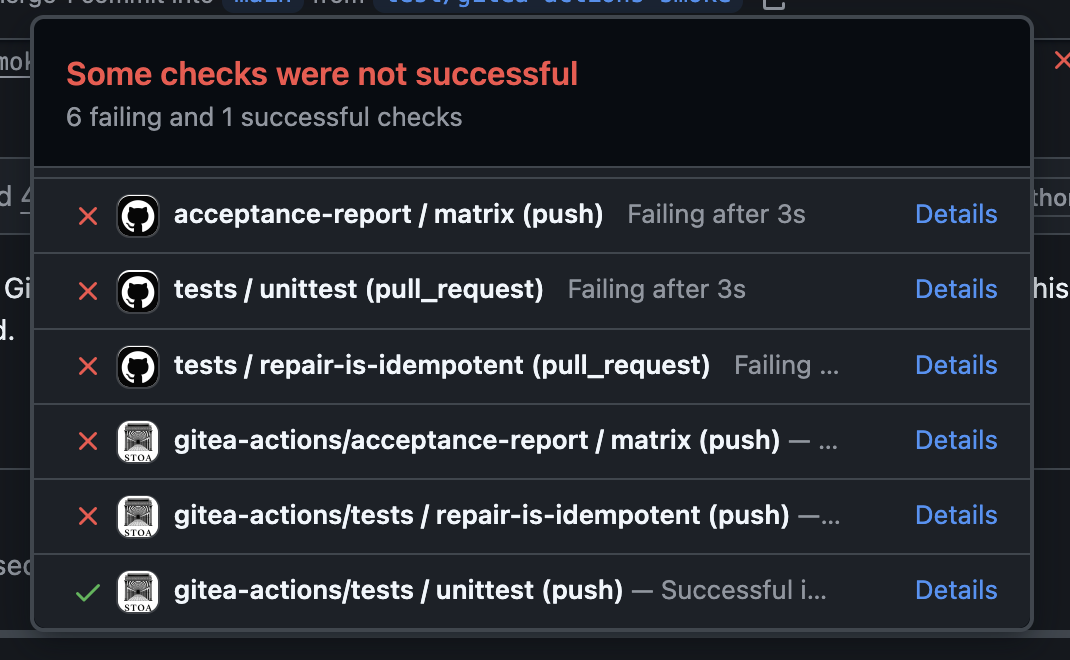
PRs still live on GitHub; CI that doesn’t gate them is decoration. Gitea
emits a status webhook event whenever Actions writes a commit status, so a
small Tekton trigger forwards each one to GitHub — same sha, state vocabulary
passes through unmapped, context prefixed gitea-actions/* so Frank-side
results are distinguishable (apps/tekton/pipelines/stoa-status-bridge.yaml).
Two filters do the real work: only the mirrored org is forwarded, and
Tekton’s own tekton/* dual-status contexts are excluded — GitHub already
gets those directly, and forwarding them again would double-post every CI
result.
Verify the chain
Each link, with its success signature:
# 1. webhook lands (a redelivered pull_request works; action must be
#    opened/synchronize/reopened — 'closed' is filtered by design)
kubectl -n tekton-pipelines logs -l eventlistener=github-listener --tail=5 -f

# 2. mirror branch appears at the PR head sha
curl -s "$GITEA/api/v1/repos/$ORG/$REPO/branches/sync-pr-12" | jq -r .commit.id
# == the PR head sha, exactly

# 3. the run executes  →  $GITEA/$ORG/$REPO/actions

# 4. the bridge forwarded it
kubectl -n tekton-pipelines get pipelinerun | grep stoa-status-bridge
# stoa-status-bridge-xvdrf   True   Succeeded

# 5. GitHub shows it
gh api "repos/$ORG/$REPO/commits/$SHA/statuses" \
  --jq '.[] | select(.context | startswith("gitea-actions/")) | [.context,.state] | @tsv'
When it breaks
| Symptom | Cause | Fix |
|---|---|---|
| Runner pod 2/2 but jobs hang “Running” forever | dind serving Transport Layer SecurityThe encryption under HTTPS and most other secure protocols. What a certificate is for, and what fails visibly when the certificate does not match the hostname. on 2376, runner talking plain to 2375 | DOCKER_TLS_CERTDIR: "" + explicit --host=tcp://0.0.0.0:2375 |
| Runner healthy but Offline in Gitea admin | stale one-shot registration on the PVC | scale to 0, delete /data/.runner, scale up |
| Workflow exists on mirror, push arrives, no run, no error | Actions unit off on that repo | PATCH …/repos/{owner}/{repo} {"has_actions": true} |
| Run fails only at the artifact step | official upload-artifact’s GHES rejection | split per side (Step 3) |
| Git changes to EventListener triggers never go live; syncs say Succeeded | see the misstep below | kubectl get <obj> -o json --show-managed-fields — if the applier’s timestamp is stuck in the past, an ignoreDifferences rule is eating your applies |
Explanation: what the migration flushed out
The reason this post has a “when it breaks” table that long is that the rollout surfaced three latent defects — none of them caused by the migration, all of them hidden behind it.
The dormant wiring. Three of my mirror repos turned out not to exist. The Tekton triggers had been in git for a month; the Gitea repos and GitHub webhooks they depended on were never provisioned, so the chain had never carried a single event — and nothing alerted, because a webhook that is never registered never fails. The repos burning the most GitHub minutes were precisely the ones whose Frank-side path was stillborn.
The five-week freeze. Worse: the EventListener changes that were in git
weren’t on the cluster. ArgoCD had reported Succeeded … serverside-applied
on every sync for five weeks while applying nothing — an ignoreDifferences
entry with array-item jq expressions (.spec.triggers[]?…) plus
RespectIgnoreDifferences=true makes ArgoCD carry the live array into
every apply, so updates to that array are discarded, silently, forever. The
decisive probe is managedFields: the applier’s last Apply timestamp was
five weeks old. The fix is to never combine those two features on an array
and to set server-defaulted fields explicitly in git instead. A tripwire
test now guards the rule.
The GHES rejection. Covered in Step 3 — notable mostly because the
failing runs’ logs show every test step green and only the artifact upload
red, which is exactly the shape that tempts you to shrug and move on. Don’t:
on one repo the artifact step ran under if: always() with
if-no-files-found: error, which failed every mirror run outright.
The fourth thing, a week later (added 2026-07-27). Moving CI onto the cluster moved its cost onto the cluster too, in a currency nobody was watching: Kubernetes objects. At roughly 260 PipelineRuns a day against a 7-day retention Time To LiveHow long a value stays valid before it must be fetched again. Sets how long a stale DNS answer or cache entry can keep being wrong after the fix., the cluster accumulated ~1,800 PipelineRuns — and 1,932 of Frank’s 2,124 pods were completed Tekton pods. Three of every four pods on the cluster were dead CI.
Nothing was wrong with that, until it crossed a limit nobody had considered
alongside it. kube_pod_* grew to 108,460 of ~120,000 kube-state-metrics
series, pushing its /metrics payload to 21.6 MiB — past vmagent’s default
-promscrape.maxScrapeSize of 16 MiB. VictoriaMetrics discards an oversized
response whole, so every kube_* series vanished and all 25 kube_*
references in the Grafana alert rules evaluated against nothing. Ironically,
two of them were kube_cronjob_status_last_successful_time — the rule that
reports a CronJob no longer succeeding was among the blinded, while the
PipelineRun Garbage CollectionThe periodic deletion of completed or orphaned objects so they stop consuming storage, quota and monitoring cardinality. On Frank a CronJob does this for Tekton PipelineRuns; Kubernetes separately garbage-collects any resource whose owner has been deleted, which is why a PipelineRun's workspace PVC disappears with it. CronJob had itself started failing.
The fix was two independent changes, deliberately: the scrape cap went to 32MB, and retention went 7 days → 3. The first sweep at the new TTL removed 1,369 of 1,820 PipelineRuns in 100 seconds and took the cluster from 2,124 pods to 656, and the scrape payload from 21.6 MiB to 7.3 MiB. Either change alone would have cleared the blackout; keeping both means alerting does not depend on a CI hygiene setting, and CI hygiene is not load-bearing for observability.
The lesson generalises past Tekton: a migration that changes where work runs also changes what that work costs, in units the destination measures. Full write-up in Operating on Green.
On parallel running. GitHub Actions stays enabled through August; the
free tier resets on the 1st and the parallel week costs a few hundred of the
2,000 minutes. Mutating jobs are single-sided behind CI_AUTHORITY the whole
time. When the observation window closes, one org variable flips, and the
GitHub bill goes to approximately zero — the 20-second pin-check that was
eating 72% of the tier costs 20 seconds of pc-1’s time instead.
The cluster, for its part, notes that it now runs the CI for the org that pays its electricity bill. There are worse arrangements.