

Operating on Authentication
Last updated 2026-07-15 ·a77bf48
This is the operational companion to Unified Auth. That post covers the OpenID ConnectAn identity layer on top of OAuth 2.0: it adds a token saying *who* the user is, not merely what the client may do. Frank's single sign-on speaks it, with Authentik as the provider. provider setup and forward auth proxy configuration. This one is what you type when users can’t log in, the login page loops, or clicking a forward-auth-protected service redirects your browser to http://0.0.0.0:9000 — a bug we shipped and fixed.
Before any of the commands below, source the environment:
source .env          # sets KUBECONFIG, TALOSCONFIG
source .env_devops   # sets OMNICONFIG + service accounts
What Healthy Looks Like
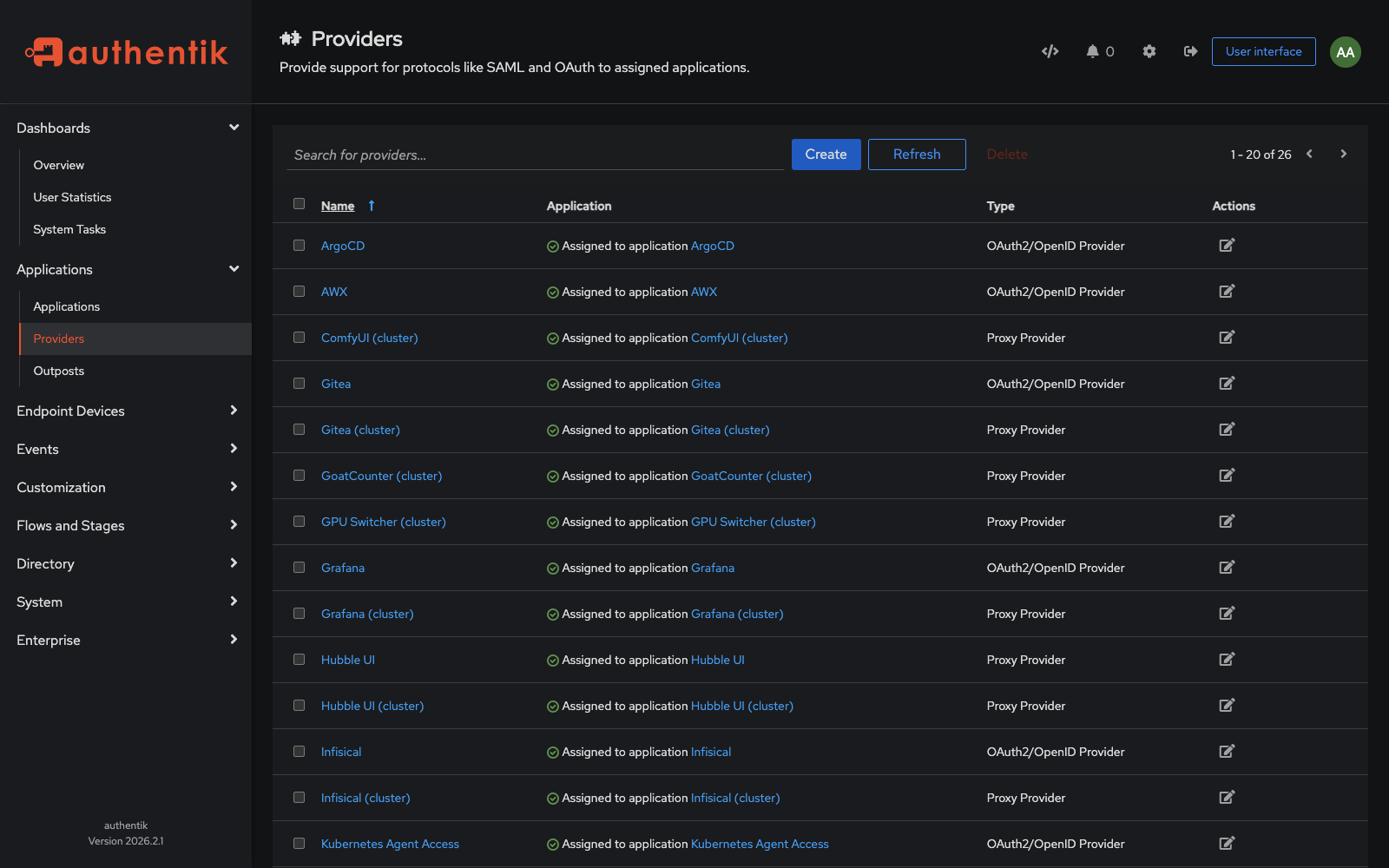
Authentication is healthy when Authentik at 192.168.55.211:9000 is responding, all OIDC providers show valid status in the admin UI, and users can log into ArgoCD, Grafana, and Infisical via Single Sign-OnOne login across many applications. On Frank, Authentik holds the session and Traefik asks it before forwarding a request. without errors. Forward auth passes requests through for Longhorn UI, Hubble UI, and Sympozium without redirect loops.
    graph TD
  USER["User / Browser"] -->|"https://service.frank.derio.net"| TR["Traefik<br/>Ingress"]
  TR -->|"forward-auth"| FA["forward-auth<br/>middleware"]
  FA -->|"OIDC auth"| AK["Authentik<br/>192.168.55.211:9000"]
  AK -->|"JWT token"| FA
  FA -->|"allow"| TR
  TR -->|"JWT"| SVC["Backend Service<br/>ArgoCD / Grafana / Infisical"]
  AK -->|"OIDC provider"| SVC
Verify
Authentik Status
# Check Authentik pods
kubectl get pods -n authentik

# Check server and worker logs
kubectl logs -n authentik deploy/authentik-server --tail=50
kubectl logs -n authentik deploy/authentik-worker --tail=50
API Access
Authentik API requires a Bearer token. Create one via the Django shell:
# Get a shell into the Authentik server
kubectl exec -n authentik deploy/authentik-server -it -- ak shell
from authentik.core.models import Token, TokenIntents, User
user = User.objects.get(username="akadmin")
token, created = Token.objects.get_or_create(
identifier="api-ops",
defaults={"user": user, "intent": TokenIntents.INTENT_API}
)
print(token.key)# List providers via API
curl -s -H "Authorization: Bearer <token>" \
http://192.168.55.211:9000/api/v3/providers/all/ | jq '.results[].name'
# List users
curl -s -H "Authorization: Bearer <token>" \
http://192.168.55.211:9000/api/v3/core/users/ | jq '.results[] | {username, email, is_active}'Steps
Add Users and Groups
# Create a user via API
curl -s -X POST -H "Authorization: Bearer <token>" \
  -H "Content-Type: application/json" \
  http://192.168.55.211:9000/api/v3/core/users/ \
  -d '{"username": "newuser", "name": "New User", "email": "user@example.com", "is_active": true}'

# List groups
curl -s -H "Authorization: Bearer <token>" \
  http://192.168.55.211:9000/api/v3/core/groups/ | jq '.results[] | {name, pk}'
The Authentik admin UI at http://192.168.55.211:9000/if/admin/ is often faster for one-off changes.
Rotate OIDC Client Secrets
- Generate a new secret in Authentik admin UI under the provider settings
- Update the secret in Infisical (the source of truth)
- Force External Secrets OperatorThe operator that pulls secrets from an external store into Kubernetes Secrets. On Frank it mints short-lived GitHub App tokens, so no long-lived credential is ever committed. to resync:
kubectl annotate es <name> -n <ns> force-sync=$(date +%s) --overwrite - Restart the affected service to pick up the new secret
For Grafana specifically, the secret key name must be exactly GF_AUTH_GENERIC_OAUTH_CLIENT_SECRET in the Kubernetes Secret — not client_secret or clientSecret. Authentik sets it one way; Grafana’s envFrom reads it by that exact key.
Manage API Tokens
# List API tokens via Django shell
kubectl exec -n authentik deploy/authentik-server -it -- ak shell
from authentik.core.models import Token
for t in Token.objects.filter(intent="api"):
print(f"{t.identifier}: {t.user.username} expires={t.expires}")Recover
Forward Auth Redirects to 0.0.0.0
If clicking a forward-auth-protected service (e.g., Longhorn, Hubble, the dashboard) redirects the browser to http://0.0.0.0:9000/... instead of https://auth.frank.derio.net/...:
The embedded outpost doesn’t know its own external URL. We fixed this in commit abaae01d by setting AUTHENTIK_HOST in apps/authentik/values.yaml:
global:
  env:
    - name: AUTHENTIK_HOST
      value: "https://auth.frank.derio.net"
After updating the values file, ArgoCD syncs the change. Verify:
# Check that the env var is set on the server pods
kubectl get deploy -n authentik authentik-server \
  -o jsonpath='{.spec.template.spec.containers[0].env[?(@.name=="AUTHENTIK_HOST")].value}'
# Expected: https://auth.frank.derio.net

# Test that forward-auth now redirects correctly
curl -sk -o /dev/null -w "%{redirect_url}\n" https://longhorn.frank.derio.net/
# Expected: https://auth.frank.derio.net/outpost.goauthentik.io/... (not 0.0.0.0)
OIDC Login Loop
If a service redirects back and forth between the login page:
# Check Authentik server logs for OIDC errors
kubectl logs -n authentik deploy/authentik-server --tail=100 | grep -i "oauth\|oidc\|redirect"

# Verify redirect URIs match exactly
curl -s -H "Authorization: Bearer <token>" \
  http://192.168.55.211:9000/api/v3/providers/oauth2/ | jq '.results[] | {name, redirect_uris}'
Common causes:
- Redirect Uniform Resource IdentifierThe general form a URL is a case of. The distinction matters where a scheme identifies something that is not fetchable over the network. mismatch — must be exact, including trailing slash
redirect_urismust be a list in the Authentik 2026.x API (not a single string)- Missing
invalidation_flowin provider config (required in 2026.x)
Forward Auth 403
# Check the forward auth outpost logs
kubectl logs -n authentik -l app.kubernetes.io/component=outpost --tail=50

# Verify the outpost can reach the Authentik server
kubectl exec -n authentik -l app.kubernetes.io/component=outpost -- \
  curl -s http://authentik-server.authentik.svc:9000/api/v3/root/config/
Grafana Secret Key Mismatch
If Grafana shows “login error” after OIDC redirect:
# Verify the secret key name in the K8s Secret
kubectl get secret -n grafana grafana-oidc -o jsonpath='{.data}' | jq 'keys'

# Must contain: GF_AUTH_GENERIC_OAUTH_CLIENT_SECRET
# NOT: client_secret or clientSecret
Token Validation Failures
# Test the OIDC well-known endpoint
curl -s http://192.168.55.211:9000/application/o/<provider-slug>/.well-known/openid-configuration | jq

# Check token endpoint manually
curl -s -X POST http://192.168.55.211:9000/application/o/token/ \
  -d "grant_type=client_credentials&client_id=<id>&client_secret=<secret>"
Missteps
| What we assumed | Why it was wrong | What it cost |
|---|---|---|
| The embedded forward-auth outpost would resolve its own external URL from context | Authentik’s outpost doesn’t know the external-facing hostname without the AUTHENTIK_HOST env var — it defaults to 0.0.0.0:9000 internally. | Every forward-auth-protected service redirected to 0.0.0.0:9000 until abaae01d added the explicit env var. |
| The K8s Secret key name for Grafana OIDC would match what Authentik sends | Authentik sends the secret as a key-value pair, but envFromSecret reads it by the key name GF_AUTH_GENERIC_OAUTH_CLIENT_SECRET — not client_secret or clientSecret. | Grafana’s OIDC login showed a generic “login error” with no useful log message until the key name mismatch was traced. |
| Forward auth works the same way for every protected service | Some services (like the Hermes agent shell dashboard) don’t interact well with Authentik’s forward auth at all — the redirect loop or 403 can’t be fixed with config alone. | Dashboard access was switched to basic auth instead (commits 7b3ad79f, 8438ec39). |
Quick Reference
| Command | What It Does |
|---|---|
kubectl get pods -n authentik | Check Authentik pod status |
kubectl logs -n authentik deploy/authentik-server | Server logs |
kubectl logs -n authentik deploy/authentik-worker | Worker logs |
kubectl exec -n authentik deploy/authentik-server -it -- ak shell | Django admin shell |
curl -H "Authorization: Bearer <token>" .../api/v3/core/users/ | List users via API |
curl .../api/v3/providers/oauth2/ | List OIDC providers |
curl .../.well-known/openid-configuration | Test OIDC discovery |