
Skip to content
Operating The Frank Papers — Research, Dossiers, and Publishing

Operating The Frank Papers — Research, Dossiers, and Publishing

This is the operational companion to Building The Frank Papers. That post explains why there’s a third series and what the dossier gate is for. This one is the cookbook: scaffold a paper, get the dossier to pass, write the prose, generate the cover, ship.

What “Ready to Write” Looks Like

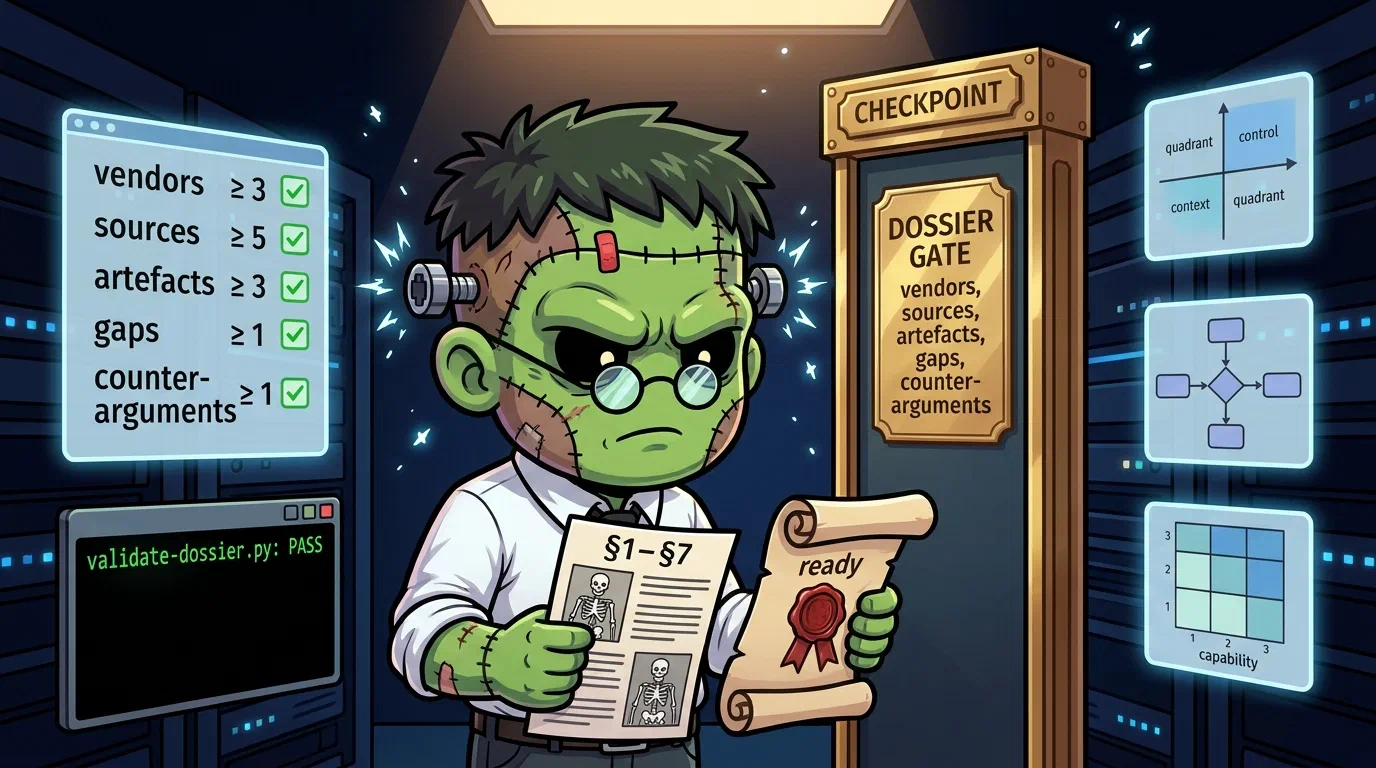
A Paper is ready to write when all of the following are true:

  • blog/content/docs/papers/NN-slug/index.md exists and has the §1–§6 skeleton with series: papers frontmatter.
  • docs/papers-dossiers/NN-slug/dossier.md exists.
  • python scripts/validate-dossier.py docs/papers-dossiers/NN-slug/dossier.md exits 0.
  • The dossier’s status: field is ready (set by the human author after reviewing the named gaps and counter-arguments).

Until all four are true, drafting prose is premature. The pre-commit hook will block the commit; the section-skeleton template will not have the Frank-specific context it needs; and the cover-image prompt key won’t exist in blog/prompt_for_images.yaml.

Scaffolding a New Paper

One command creates both halves:

scripts/scaffold-paper.sh <NN> <slug>

NN is the two-digit paper number; slug is kebab-case and matches the layer code wherever possible (e.g. 04-gpu-operators, 13-auth, 10-local-inference).

$ scripts/scaffold-paper.sh 04 gpu-operators
Created blog/content/docs/papers/04-gpu-operators/index.md
Created docs/papers-dossiers/04-gpu-operators/dossier.md

The Hugo bundle lands with:

  • Frontmatter pre-populated (title:, paper_number: 4, series: papers, status: draft, empty tldr, empty tags, empty capabilities, empty references).
  • §1 Stack position, §2 Vendor landscape, §3 Architecture comparison, §4 Operational evidence, §5 Decision rubric, §6 Return to Frank’s choice — each with a placeholder paragraph.
  • Mermaid diagram placeholders in the sections that need them (§1 flowchart LR, §2 the landscape shortcode, §3 per-vendor flowchart TD, §6 the decision tree).
  • A {{< papers/dossier-link >}} placeholder — commented out by default, because single.html injects one automatically (see Don’t render the dossier chip twice below).

The dossier lands with the six required section headers and stub entries:

## Vendors in scope
- name: TODO
  positioning: incumbent
  primary_url: https://example.com

## Primary sources
- title: TODO
  type: vendor-docs
  url: https://example.com
  quoted_passages: ["..."]
  relevance: TODO

## Frank artefacts
- kind: yaml
  path_or_url: TODO
  date: TODO
  demonstrates: TODO

## Diagrams planned
- TODO

## Named gaps
- TODO

## Counter-arguments considered
- TODO

The Dossier Loop

Once scaffold-paper.sh returns, the workflow is: fill the dossier, validate, fix, validate, fix, validate, until clean.

python scripts/validate-dossier.py docs/papers-dossiers/04-gpu-operators/dossier.md

The validator parses sections as YAML blocks under ## headers and checks the gate rules. Exit 0 = pass. On failure it prints each problem on its own line and exits 1.

Common failures and how to read them:

  • Vendors in scope: only 2 entries; need ≥3 — add a third vendor. If you genuinely can’t name three, the topic is too narrow for a landscape paper and probably belongs in a Building deviation instead.
  • Primary sources: only 4 entries; need ≥5 — add a fifth. Allowed type: values: vendor-docs, paper, postmortem, talk, benchmark. A second link from the same vendor counts; a blog post by a vendor counts as vendor-docs, not paper.
  • Source X has invalid type 'documentation' (must be one of …) — fix the type: to one of the allowed values.
  • URL https://… returned non-2xx (or timed out) — the validator does a HEAD then GET fallback against every source URL. Either the URL is wrong, or the source is temporarily unreachable, or the host rejects the validator’s User-Agent. Common offenders: gated postmortem PDFs, vendor docs behind a CDN that doesn’t like HEAD. Verify the URL by hand; if it’s intermittent, rerun.
  • Frank artefacts: only 2 entries; need ≥3 — add a third operational reference. Allowed kind: values: grafana-screenshot, asciinema, yaml, commit, incident. A line in frank-gotchas.md counts as an incident. A commit SHA counts as commit. A YAML manifest path counts as yaml.
  • Named gaps: 0 entries; need ≥1 — name a question the analysis couldn’t answer with the available evidence. “We don’t have data for the vendor’s behaviour at >10k QPS” is a fine gap. “There may be edge cases” is not.
  • Counter-arguments considered: 0 entries; need ≥1 — name the strongest opposing view the paper deliberately engaged with. Required to ship.

Iterate until the validator is clean. Then mark the dossier ready:

# At the top of dossier.md
status: ready

(status: ready is checked by the prose-drafting skill, not the gate itself — it’s the human author’s gesture that the structural work is done and prose can begin.)

The /papers Skill

The repo skill /papers enforces the workflow:

/papers

Invoking it triggers the dossier-gate check, scaffolds if needed, and walks the section skeleton. It will refuse to draft prose until the validator passes. The skill lives at agents/skills/papers/SKILL.md and is loaded via AGENTS.md.

When dispatched to a subagent (e.g. vk pickup for a phase that says “draft Paper 04”), the agent gets the same gate. There is no path that lets a subagent bypass the gate by clever invocation — the pre-commit hook runs on every commit and rejects unstaged dossiers regardless of who staged the index.md.

The Five Shortcodes

All under blog/layouts/shortcodes/papers/. Use them in index.md like:

{{< papers/pullquote source="NVIDIA gpu-operator architecture overview" >}}
Foundational architecture for the incumbent — every other vendor
either re-implements its components or stitches around its absence.
{{< /papers/pullquote >}}

Quick reference:

ShortcodeSection it belongs inWhat it renders
papers/pullquote§3 architectureIndented blockquote with attribution + a tied-back source link
papers/scar§4 operational evidenceCallout box (orange left-border) for a named incident on Frank
papers/capability-matrix§2 vendor landscapeFeature-by-feature grid table styled for .paper-post
papers/landscape§2 vendor landscapeMermaid quadrantChart wrapper — pass title, axes, four q1..q4 labels, and vendors
papers/dossier-link(auto-injected; see below)A chip linking to /docs/papers-dossiers/NN-slug/dossier.md

Example landscape usage:

{{< papers/landscape
  title="Auth landscape — late 2025"
  axes="complexity:openness"
  q1="self-host friendly"
  q2="cloud-first incumbents"
  q3="walled gardens"
  q4="DIY territory"
  vendors="Authentik: [0.35, 0.85]\nKeycloak: [0.7, 0.8]\nAuth0: [0.85, 0.15]"
>}}

The diagram types by section live in agents/rules/repo-papers.md. Use the right one — don’t mix flowchart TD and quadrantChart in §2, and don’t draw a quadrant chart in §3 (that’s for per-vendor architecture comparisons, which want flowchart TD).

Don’t Render the Dossier Chip Twice

single.html automatically injects a footer chip pointing to the paper’s dossier on every Papers page. If you also use {{< papers/dossier-link >}} inline in the body, the chip renders twice.

Two patterns, pick one:

  • Default (recommended): rely on the auto-injected footer chip. Leave the inline shortcode commented out in index.md.
  • Inline: use {{< papers/dossier-link >}} near §1 to make the dossier discoverable above the fold. If you do this, remove the auto-injection for this paper by setting dossier_link_auto: false in frontmatter (it overrides the default single.html behaviour for this page only).

This is captured in agents/rules/repo-papers.md and is the most common authoring footgun.

Cross-Series Linking

The bidirectional discovery surface is single-sourced from the Paper’s frontmatter:

---
title: "GPU Operators — Choosing an Operator for Self-Hosted GPU Workloads"
series: papers
paper_number: 4
related_building: "docs/building/04-gpu-compute"
related_operating: "docs/operating/04-gpu-compute"
---

What this gives you:

  • On Paper 04papers-forwardlinks.html reads the two related_* paths from frontmatter and renders forward chips at the top of the article: 🔧 Hands-on: Building — GPU Compute / Operating on GPU Compute.
  • On Building 04 and Operating 04papers-backlink.html iterates where .Site.Pages "Params.series" "papers", matches their related_* paths against the current page’s path, and renders a chip: 🔬 Decision-level view: Paper 04 — GPU Operators.

The chips appear automatically the moment the Paper is built. You do not edit Building 04 or Operating 04 to make them appear.

If a chip doesn’t render after you publish:

  1. Double-check the related_building and related_operating paths in the Paper’s frontmatter. They are relative to blog/content/docs/building/04-gpu-compute, no leading slash, no .md.
  2. Confirm Hugo built without errors: cd blog && hugo --buildDrafts 2>&1 | grep ^ERROR.
  3. Confirm the target Building/Operating page exists at exactly that path. A typo in the slug silently produces no backlink.

Cover Image Generation

Every Paper gets a per-paper cover image generated by Gemini, following the established pipeline:

  1. Write the prompt. Append a new entry to blog/prompt_for_images.yaml under the # --- Papers Series Covers --- section:

    - key: paper-04-gpu-operators
      output: blog/content/docs/papers/04-gpu-operators/cover.png
      description: "Paper 04 — GPU Operators (Frank weighing operator architectures)"
      prompt: >-
        Frank the server-hardware Frankenstein monster examining a row of
        candidate GPU operators … wearing his thin black necktie and round
        reading glasses [Papers signature]. EXACTLY ONE FIGURE.
        ABSOLUTELY NO TEXT.

    The Papers visual signature is thin black necktie + round reading glasses — the consistent reader cue that they’re on a Papers cover, not a Building or Operating one.

  2. Generate.

    source .env_common
    .venv/bin/python scripts/generate-all-images.py --only paper-04-gpu-operators

    The script auto-picks the papers master reference from .reference-pool/papers/reference-papers.png — that’s what pins Frank’s face shape, the no-nose constraint, and the visible Frankenstein stitches. Without it Gemini drifts (no-nose becomes a nose, the green skin loses contrast, the character sheet softens). Pass -r path.png to override for a one-off run. Add 1–2 paths to the entry’s references: field in blog/prompt_for_images.yaml to stack additional anchors from .reference-pool/papers/subjects/. (Per-series references replaced the single blog/static/images/reference.png on 2026-05-23 — see PR #380.)

  3. Review the output. Open cover.png. If Frank is wrong (e.g. shirt blends with skin, duplicate Frank, mangled text on a sign), regenerate. The Gemini model returns variation per call, so the same command often fixes a near-miss.

  4. On 503 from Gemini: the model is shared and occasionally returns 503 UNAVAILABLE. Retry with a 20–60 second backoff. Multi-image batches with --only key-a,key-b are useful when generating multiple Papers covers in sequence.

The series assets are banner-papers.png (thin title strip shown above every Papers page) and tile-papers.png (16:9 landing-page card thumbnail). The banner lives at blog/assets/images/ — banners must be Hugo assets/ resources so the image-optimization pipeline can emit WebP from them; the tile stays at blog/static/images/. They’re regenerated only when the series visual signature changes, not per paper.

Building and Previewing

Standard Hugo workflow with --buildDrafts to include in-progress papers:

cd blog && hugo server --buildDrafts --port 1313

Open http://localhost:1313/docs/papers/. The section landing lists all Papers (including drafts). Each Paper renders with the Mermaid Frank theme, the .paper-post CSS scope, the auto-injected dossier chip, and the forward-link chips (if related_building / related_operating are set).

To verify cross-linking:

  • Visit the matching Building post (/docs/building/04-gpu-compute/). The 🔬 Decision-level view chip should appear at the top.
  • Visit the matching Operating post. Same chip.

If neither appears, see Cross-Series Linking above.

For the final pre-publish check:

cd blog && hugo --buildDrafts 2>&1 | tee /tmp/hugo-build.log | tail -10
grep -cE "^ERROR" /tmp/hugo-build.log

Expected: zero errors. The most common Phase 0 break was a malformed shortcode call — {{< papers/landscape title="…" axes="…" >}} with mismatched quotes inside the vendors argument. Fix the quote escaping; rerun.

Publishing

When the prose is ready, drafting is done, and the cover image is in:

  1. Set draft: false and status: published in frontmatter.
  2. Commit the bundle (blog/content/docs/papers/NN-slug/index.md, cover.png, any inline images) and the dossier (docs/papers-dossiers/NN-slug/dossier.md) and the prompt entry (blog/prompt_for_images.yaml) in a single commit.
  3. Push to main. The Hop cluster Caddy + CI pipeline picks it up; production is live ~2 minutes later.
  4. Verify: curl -s https://blog.derio.net/frank/docs/papers/NN-slug/ | grep -i "<paper title>".

The dossier ships with the paper, on the same SHA. Anyone reading the paper a year from now can git show HEAD:docs/papers-dossiers/NN-slug/dossier.md and see the sources, gaps, and counter-arguments the author was working from. That’s the gate’s whole point — the receipts are versioned with the prose.

Promoting and Reordering

Papers publish in decision-weight order, not paper-number order. paper_number is fixed at scaffold time (it maps to the layer code) but publish_order and weight in frontmatter control where the Paper appears in the section listing.

To move Paper 13 above Paper 04 in the listing:

# Paper 13 frontmatter
weight: 5  # lower than Paper 04's weight
publish_order: 2  # explicit reading order

Hextra orders section listings by weight ascending. The paper-number stays 13 in URLs and frontmatter — only the listing rank changes.

Renaming or Archiving a Paper

If a Paper is renamed after publish:

# Hugo bundle
git mv blog/content/docs/papers/04-gpu-operators blog/content/docs/papers/04-gpu-stack
# Dossier
git mv docs/papers-dossiers/04-gpu-operators docs/papers-dossiers/04-gpu-stack
# Update the prompt key in blog/prompt_for_images.yaml
sed -i.bak 's/paper-04-gpu-operators/paper-04-gpu-stack/g' blog/prompt_for_images.yaml
rm blog/prompt_for_images.yaml.bak
# Add a Hugo alias for inbound links
echo 'aliases: ["/docs/papers/04-gpu-operators/"]' >> blog/content/docs/papers/04-gpu-stack/index.md
# Commit; the dossier path lives at the new slug

The aliases array makes Hugo emit a <meta http-equiv="refresh"> from the old URL — search engines and shared links keep working.

Archiving (e.g. a Paper that’s been superseded) is the same shape but with draft: true and a final commit explaining why. Don’t delete the bundle — the dossier is part of the historical record.

Common Failures Cheat Sheet

SymptomCauseFix
git commit blocked: DOSSIER GATE: no dossier foundPaper index.md staged with no matching dossier filescripts/scaffold-paper.sh <NN> <slug> to create the dossier; fill and validate
git commit blocked: validator failureOne of the gate rules failedRead the validator output; fix that specific section
Dossier chip renders twice on a PaperInline shortcode + auto-injection both firePick one (see Don’t render the dossier chip twice)
Cross-link chip doesn’t appearrelated_building / related_operating path typo or pointing at a non-existent pageFix path in Paper frontmatter; rebuild
Mermaid diagram doesn’t theme correctlyPage missing body.paper-post classConfirm series: papers in frontmatter — the class is gated on that
Cover image is green-on-green FrankPrompt forgot to specify shirt colourAdd explicit “white dress shirt, not green” to the prompt; regenerate
Banner shows duplicate FrankGemini drift on prompts that don’t say “EXACTLY ONE FIGURE”Add the constraint; regenerate
hugo --buildDrafts errors on shortcode parseQuote escaping in papers/landscape vendors argumentUse \n for line breaks; escape inner quotes carefully

References

  • Building The Frank Papers — Research Infrastructure for a Third Series — the companion building post
  • agents/rules/repo-papers.md — canonical reference (frontmatter schema, dossier format, diagram types by section)
  • agents/skills/papers/SKILL.md/papers skill (enforces the workflow)
  • scripts/scaffold-paper.sh — scaffold a paper + dossier pair
  • scripts/validate-dossier.py — dossier gate validator
  • .githooks/pre-commit — the gate that fires on staged Papers files