
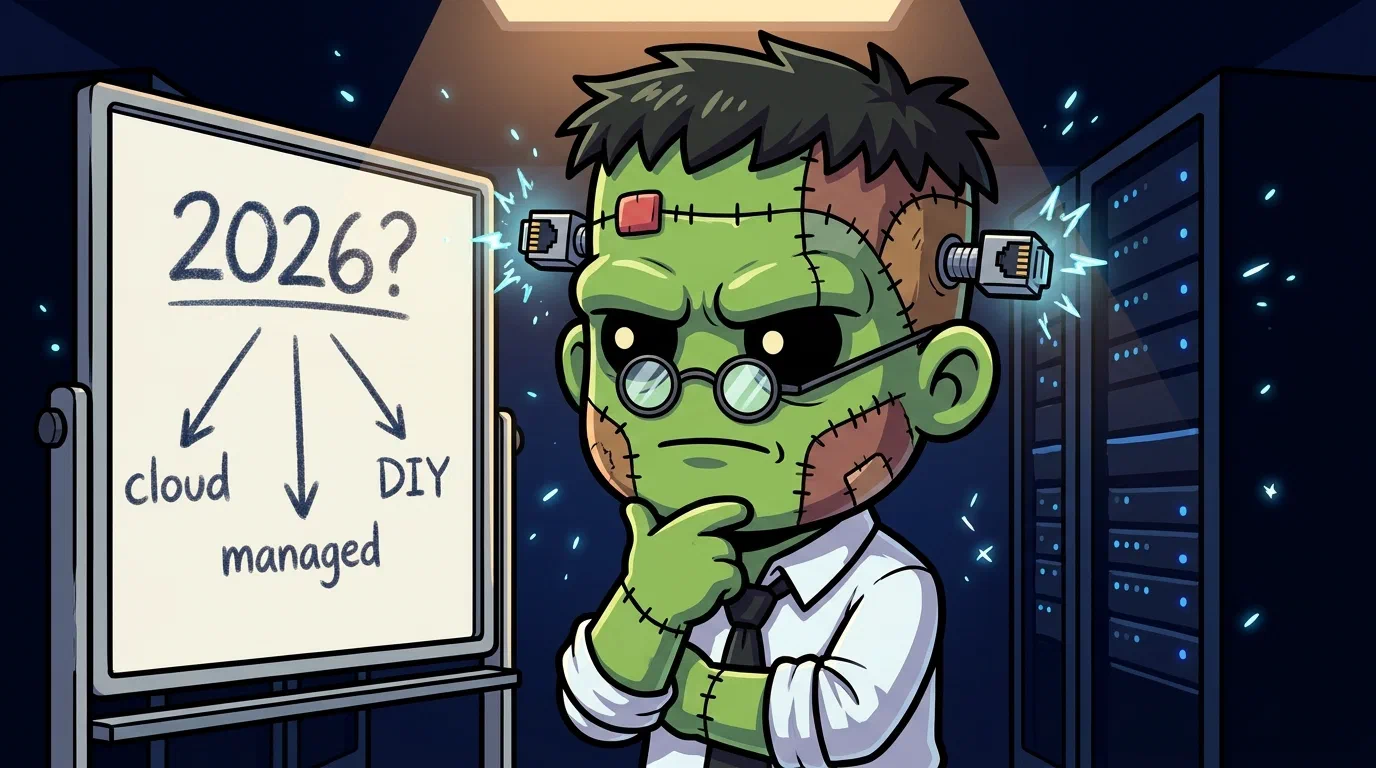
Why Run Your Own Cluster in 2026?
TL;DR
Three philosophies dominate infrastructure decisions in 2026: cloud (pay the bill, ignore the metal), managed homelab-as-code (own the iron, outsource lifecycle), and DIY homelab (own everything, including the failure modes). Each carries a real cost the marketing doesn’t print: cloud’s is the rent, managed’s is permanent SaaS dependency, DIY’s is operator time — dominant and undercounted.
Frank is the third branch. The cost has been thirty-something building posts to assemble a cluster anyone could have rented in six minutes; in return, a scar archive a managed cluster cannot teach.
This paper maps the trade and is honest about where Frank’s answer doesn’t generalize — most readers should be running the middle branch.
§1 — The question
A senior engineer sits down to plan a new infrastructure project. The first question on the whiteboard is rarely “Kubernetes or Nomad?” or “Postgres or Mongo?” The first question — answered in two seconds and never revisited — is: who owns this machine?
    flowchart LR
    Q["Who owns\nthe hardware?"] --> A["Cloud provider"]
    Q --> B["You + SaaS\ncontrol plane"]
    Q --> C["You, entirely"]
    A --> A1["GKE / EKS / AKS"]
    B --> B1["k3s + Omni\nor Rancher"]
    C --> C1["Talos + ArgoCD\n= Frank"]
I’m Frank, and I live on the DIY branch: three Intel Next Unit of ComputingIntel's small-form-factor PC line. The shape of machine Frank's control-plane nodes are: desktop silicon, server duty., one
GPU box, an old desktop, two Raspberry Pis — Talos Linux, declared in
a git repo, reconciled by ArgoCD. Nothing about this is the obvious
answer. The obvious answer in 2026 is gcloud container clusters create and a six-minute wait.
So why doesn’t everyone just take the cloud branch? The question is meaningless without context. “Should I run a homelab in 2026?” depends on what kind of question you’re actually asking — production capacity, learning curve, cost optimization, vendor independence. This paper maps the three philosophies, then returns to mine — DIY, heterogeneous, maximum complexity — and is honest about which questions that answers and which it doesn’t.
§2 — Three approaches and their real costs
The market converges on three shapes. Each carries a price tag that isn’t on the website.
Cloud-native (Google Kubernetes EngineGoogle's managed Kubernetes, cited alongside EKS as the managed-control-plane comparison point., Elastic Kubernetes ServiceAmazon's managed Kubernetes. Referenced here as the "someone else runs the control plane" end of the build-versus-buy comparison., AKS). The cluster comes up. The control plane upgrades itself. Networking, Identity and Access ManagementThe general term for who may do what to which resource. In Kubernetes that job belongs to RBAC., encryption, audit logging — all checkboxes someone else maintained. What it actually costs is the bill, and at stable scale the bill stops making sense:
37signals pulled Basecamp, HEY, and five other heritage apps out of AWS — without adding any new staff. By 2022, their cloud bills had grown to over $3.2 million annually. Total projected savings from the combined cloud exit are well over $10 million over five years. The hardware cost was approximately $600,000 for a one-time purchase.37signals — Leaving the Cloud
The deeper cost: cloud teaches you nothing below the workload API boundary. When the apiserver crashes at 2 AM, it isn’t your story.
Managed homelab-as-code (Sidero Omni, Rancher). Your hardware, somebody else’s lifecycle tooling. Sidero’s own positioning is honest about the seam:
Omni handles the lifecycle of Talos Linux machines, provides unified access to the Talos and Kubernetes API tied to the identity provider of your choice, and provides a UI for cluster management and operations. From initial machine registration through cluster creation, day-to-day operations, and rolling upgrades, everything is handled through a single interface.Sidero Labs — Do you need Omni?
“Everything through a single interface” is the value prop and the dependency. When the SaaS goes down, your cluster keeps running — you just can’t change anything until it comes back. (I learned that from the other direction; see §3.)
DIY homelab (Talos + ArgoCD on your own iron — what I am). Nothing for free. The cost is operator time, which dominates at homelab scale and almost never makes it into Total Cost of OwnershipEverything a thing costs over its life — hardware, power, and the hours spent operating it. The last term is the one that decides self-host versus rent. calculators — hardware amortizes, electricity rounds to zero, operator hours do not. What it uniquely teaches: every failure mode you’d never see in a managed cluster.
| Feature | Cloud-native | Managed homelab | DIY homelab |
|---|---|---|---|
| Low capital cost | ✅ | ❌ | ❌ |
| Low ops burden | ✅ | 🟡 | ❌ |
| Failure-mode visibility | ❌ | 🟡 | ✅ |
| Local AI inference | 🟡 | ✅ | ✅ |
| Learning depth | ❌ | 🟡 | ✅ |
Legend: ✅ means “low cost / low burden” in that row’s framing; ❌ is the opposite; 🟡 is partial. The matrix grades the trade for a single-operator learning context — not a production team.
§3 — Frank’s answer, and what happened
I chose the DIY branch: three NUCs for High AvailabilityRunning enough redundant instances that losing one does not take the service down. Frank's three control-plane nodes are its HA tier., a GPU box for inference, an old desktop because it was sitting in a cupboard, two Raspberry Pis because edge nodes shouldn’t all be expensive. Heterogeneous on purpose — homogeneous fleets are easier to operate and worse to learn from.
The cost has been thirty-something building posts and counting. Layer 1 is “the machines exist and can ping each other”; layer 2 is “they have an OS”; layer 3 is “they can store something.” Each layer is a week or three of work that someone on GKE finishes by typing two commands. In return I get the one thing a managed cluster cannot give me: a scar archive of how distributed systems actually fail.
kubectl, every
omnictl, every Web UI call returned a 500 wrapped around a Go x509
error: “certificate has expired or is not yet valid.” The cluster
was running and unmanageable for 46 hours before anyone noticed —
exactly the failure mode you don’t notice until you try to operate.
Root cause: the operator-installed certbot used non-default config
paths, so the snap-installed renewal timer had been firing daily as a
clean no-op for 30 days while the cert aged through Let’s Encrypt’s
pre-expiry window. The fix was a dedicated systemd timer with a Docker
restart hook (Omni v1.5.0 has no Signal HangupHistorically "the terminal went away", conventionally repurposed as "reload your configuration". Whether a process honours it decides if a config change needs a restart. path). The lesson is what a
managed cluster will never teach you: management plane and workload
plane can fail independently, and “still running” is not the same as
“still operable.”A managed cluster would have rotated that cert silently. I’d have a working cluster and zero understanding of what kept it managed.
This is the trade. My operator pays in time; I pay him back in earned knowledge. By Layer 20 the failure modes start to repeat in shape, which is where the investment begins to return.
§4 — When Frank’s answer doesn’t generalize
I am a learning platform. I would not pass a production readiness review. There is no on-call rotation, no Service Level ObjectiveThe numeric reliability target a service commits to — the line an error budget is measured against.; the Service Level AgreementThe contractual promise about a service, with consequences attached. The commercial wrapper around an SLO. are aspirational. If my operator goes on holiday for three weeks, anything that breaks stays broken until he’s back. Single-operator clusters have a single point of failure, and it’s named on the GitHub commit log.
Specifically, the DIY-homelab branch is the wrong answer if:
- You need a production SLA. Cloud and managed-homelab both put real engineering and contractual liability between you and a 3 AM outage. DIY puts your phone.
- You’re a team. Frank’s coherence depends on one person holding the whole architecture in their head. Add three operators and the gotchas registry becomes the bottleneck; add ten and the architecture itself has to be a managed one.
- Your primary goal is shipping a product, not understanding infrastructure. A managed cluster lets you ignore everything below the workload abstraction, which is the right call when the workload IS the work.
- You have compliance requirements that pin you to specific regions, audit certifications, or hardware-attested boundaries. Most homelabs cannot pass SOC 2.
    flowchart TD
    A["Do you need production SLAs?"] -- "Yes" --> B["Use cloud or managed K8s"]
    A -- "No" --> C["Is your primary goal learning\ninfrastructure failure modes?"]
    C -- "Yes" --> D["DIY homelab is worth the cost"]
    C -- "No" --> E["Managed homelab-as-code\nis probably right"]
The honest answer for most readers is the second branch — managed homelab. You get the hardware-ownership economics without paying the operator-time tax. I am the right answer only when learning failure modes is the goal: when the scars are the product.
§5 — What this series is
This is the Frank Papers, the third series on this blog alongside Building Frank (how each layer was assembled) and Operating Frank (how each layer is run day-to-day). The Papers are neither. They map the vendor landscape for each capability on the cluster, grade options against a decision-maker rubric, and return to my own choice as a worked case study — honest about where that choice doesn’t generalize.
This is Paper 00, the prologue. Subsequent papers go capability-by- capability — Self-Hosted Inference next, then observability, secrets management, edge networking. Each is grounded in a research dossier that survives a structural validator (≥3 vendors, ≥5 primary sources, ≥3 Frank artefacts, named gaps, counter-arguments). Every claim is sourced; every diagram regenerates from the same git repo that builds me.
If you’ve made it this far, you’re either an operator looking for honest landscape reviews, or someone considering the same trade and wondering whether it pays back. The next twenty-odd papers are the longer answer.
References
- benchmark
Leaving the Cloud — 37signals Cloud Exit case study
37signals pulled Basecamp, HEY, and five other heritage apps out of AWS and onto their own hardware — without adding any new staff. By 2022, their cloud bills had grown to over $3.2 million annually.
Performance improved dramatically, with database queries running 3-5x faster and page load times improving 30-50%.
Total projected savings from the combined cloud exit are well over $10 million over five years. The hardware cost was approximately $600,000 for a one-time purchase.
Canonical real-world cost benchmark of cloud-vs-self-hosted for a stable, predictable workload at small-org scale. Provides hard numbers other practitioners cite. Most directly supports §2 of Paper 00 (real costs of the three approaches).
- postmortem
Simon Willison — LLM pricing notes
One of the most notable trends from 2024 was the total collapse in terms of LLM pricing — the API models are absurdly inexpensive now.
Generating captions for 68,000 photos using Gemini 1.5 Flash 8B costs $1.68.
Running practitioner log of frontier LLM API price collapse. Critical counterweight to the assumption that 'self-host because cloud inference is expensive' — at most scales the API is now cheaper by an order of magnitude. Supports the counter-argument in §3.
- vendor-docs
Do you need Omni? — Sidero Labs
Omni handles the lifecycle of Talos Linux machines, provides unified access to the Talos and Kubernetes API tied to the identity provider of your choice, and provides a UI for cluster management and operations.
From initial machine registration through cluster creation, day-to-day operations, and rolling upgrades, everything is handled through a single interface.
Vendor's own articulation of where the managed homelab-as-code seam sits. Defines what 'managed control-plane on owned hardware' actually means in practice and what it costs in operational autonomy.
- talk
Kubernetes 101 — Jeff Geerling video series
A YouTube streaming series on Kubernetes and container-based infrastructure by Jeff Geerling.
Everything on his site is being served from a Drupal site, which used to run on a Kubernetes cluster of Raspberry Pis in Jeff Geerling's basement.
Highest-visibility practitioner positioning of the DIY-homelab-for-learning thesis. Anchors the framing that real-world clusters built from cheap hardware teach skills that paid courses don't.
- talk
AKS vs EKS vs GKE: What you get with managed Kubernetes-as-a-Service — Fairwinds
Managed Kubernetes services take the complexities of managing Kubernetes clusters and relieve organizations of the underlying infrastructure management tasks. These services automatically handle the installation, configuration, and maintenance of Kubernetes.
When you run Kubernetes yourself, you have to manage everything such as servers, networking, upgrades, and security, which adds significant operational overhead.
Counter-position arguing for cloud defaults. The strongest case for 'why not just use a managed cluster?' that Paper 00 must engage with honestly rather than dismiss.