

eBPF Networking Without a Service Mesh
TL;DR
Six options dominate Kubernetes networking in 2026 — Cilium, Calico,
kube-proxy + iptables, Istio, Linkerd2, and the cloud-managed Virtual Private CloudAn isolated network inside a cloud provider. The rented equivalent of the LAN Frank's nodes share. Container Network InterfaceThe plugin contract Kubernetes uses to give pods networking. Cilium is Frank's CNI; swapping it changes how every packet in the cluster is handled. —
and they split on two axes: kernel/eBPF vs userspace sidecars, and
structured flow observability vs reactive kubectl describe.
Frank runs Cilium. eBPF kube-proxy replacement on Talos, L2 LBIPAM,
Hubble for flow observability, no service mesh. The scars came in the
seams: an Fully Qualified Domain NameA hostname written out completely, right down to the root — the difference between `grafana` and `grafana.cluster.derio.net`. Which one resolves depends on search domains. policy whose Berkeley Packet FilterA tiny in-kernel virtual machine. Its extended form (eBPF) is how Cilium implements networking, policy and load balancing without iptables. rules persisted in the kernel for hours
after deletion, an lbipam.cilium.io/ips annotation that left a Service
<pending> for 41 days without sharing-key, half an hour spent
hunting a feature gate Cilium 1.17 had already shipped on.
Frank’s answer does not generalize. Solo dev → kube-proxy. Enterprise mesh → Istio. AWS-native → VPC CNI.
§1 — The capability
A packet leaves Pod A on one node. It needs to arrive at Pod B on a different
node. Some controller decides whether the two pods are allowed to talk at
all. Something programs the kernel — or programs userspace — to forward the
packet between two virtual interfaces, possibly across a tunnel, possibly
through an L4 load-balancer if the destination is a Service. Something
later — maybe — produces a log entry that says “Pod A sent 3.2 MiB to Pod B
between 14:02 and 14:03”. And every layer of this stack charges some kind of
tax: CPU per packet, memory per endpoint, sidecar resources per pod,
operator hours per incident.
That is the capability under examination. Not “networking” in the abstract — Kubernetes already has the Pod-to-Pod-IP-reachability contract, the Service abstraction, and the CNI interface. The capability is who carries the packet, who enforces the policy, who tells you what just happened, and what tax do they charge for any of it?
    flowchart LR
    P["Pods"] --> CNI["CNI plugin"]
    CNI --> KP["kube-proxy or replacement"]
    CNI --> NP["NetworkPolicy enforcement"]
    CNI --> LB["L4 LoadBalancer (LBIPAM / BGP / cloud LB)"]
    CNI --> OBS["Flow observability"]
    CNI -.-> MESH["Service mesh (optional)"]
The six jobs the network layer does — pod-to-pod routing, the Service abstraction (kube-proxy or replacement), NetworkPolicy enforcement, L4 external load-balancing, flow observability, optional mTLS — are not all the same job. Some vendors treat one or two as primary and let the others fall out of the design; others assume a service mesh is in place and build everything on top of its sidecar proxies. The vendor space splits on which jobs are primary and which dependencies are mandatory.
I run Cilium. That choice was not made on the merits in the abstract; it was made on the merits of being on Talos bare metal, needing an L2 LoadBalancer without MetalLB, wanting flow observability without sidecars, and being unwilling to add a service mesh solely for retries-and-mTLS on a six-node cluster. Other clusters have other geometries, and an honest review of the landscape has to admit that.
§2 — The landscape
Six options dominate eBPF networking and service-mesh on Kubernetes in
2026, and they split on two axes. The horizontal axis is data-plane
technology — userspace sidecar proxies on the left (every pod gets a
Helper), kernel / eBPF on the right (the data plane is the kernel itself).
The vertical axis is observability surface — reactive kubectl describe
and iptables -L only at the bottom, structured flow logs and L7 traces
at the top.
quadrantChart

        title eBPF networking — 2026
        x-axis "Userspace sidecar" --> "Kernel / eBPF"
        y-axis "Reactive only" --> "Structured observability"
        quadrant-1 "Kernel · Observable"
        quadrant-2 "Userspace · Observable"
        quadrant-3 "Userspace · Reactive"
        quadrant-4 "Kernel · Reactive"
        "Cilium": [0.85, 0.80]
        "Calico": [0.70, 0.45]
        "kube-proxy + iptables": [0.55, 0.05]
        "Istio": [0.10, 0.85]
        "Linkerd2": [0.15, 0.75]
        "AWS VPC CNI": [0.40, 0.40]
| Feature | Cilium | Calico | kube-proxy + iptables | Istio | Linkerd2 | AWS VPC CNI |
|---|---|---|---|---|---|---|
| eBPF data plane | ✅ | ✅ | ❌ | ❌ | ❌ | ❌ |
| kube-proxy replacement | ✅ | ✅ | ❌ | ❌ | ❌ | ❌ |
| Built-in L4 LoadBalancer | ✅ | ❌ | ❌ | ❌ | ❌ | 🟡 |
| NetworkPolicy enforcement | ✅ | ✅ | 🟡 | ✅ | 🟡 | 🟡 |
| L7 policy (HTTP / gRPC) | ✅ | ❌ | ❌ | ✅ | 🟡 | ❌ |
| Flow-level observability | ✅ | 🟡 | ❌ | ✅ | ✅ | 🟡 |
| Mutual TLS between pods | 🟡 | ❌ | ❌ | ✅ | ✅ | ❌ |
| Works on bare metal | ✅ | ✅ | ✅ | ✅ | ✅ | ❌ |
| OSS / no contract required | ✅ | ✅ | ✅ | ✅ | ✅ | ✅ |
The matrix grades the options on eBPF data plane, kube-proxy replacement, built-in L4 LoadBalancer, NetworkPolicy enforcement, L7 policy, flow-level observability, mTLS, bare-metal support, and licensing. The kube-proxy-replacement and mTLS columns do the most work — they’re the ones that determine whether you need any of the sidecar-mesh vendors at all.
Cilium optimises for fusing the data plane and the observability surface in the kernel. The cilium-agent on each node compiles eBPF programs from Kubernetes objects and loads them into the kernel; the same agent feeds Hubble with flow events from the same BPF code paths.
The Cilium agent compiles configuration into eBPF programs that are loaded into the kernel and runs the related management tasks like updating BPF maps.Cilium — Component Overview
The trade is that L7 inspection only works for the protocols Cilium’s parser supports (HTTP, gRPC, Kafka, DNS) — for anything more exotic, you either bypass L7 policy or fall back to a sidecar mesh.
Calico is the other eBPF-capable option. It started as the original NetworkPolicy implementation and has accumulated data planes: iptables, eBPF, and (more recently) VPP. Border Gateway ProtocolThe routing protocol the internet runs on, also used inside clusters to advertise service addresses to physical routers — the alternative to the L2/ARP approach Frank uses. peering for bare-metal pod-IP routability is its differentiator; it can advertise pod Classless Inter-Domain RoutingThe `10.0.0.0/8` notation for an address range — the number after the slash is how many leading bits are fixed. Pod, service and LoadBalancer ranges are all expressed this way. directly to upstream routers in a way Cilium can but does not lead with. The trade is that Calico’s observability surface is thinner than Cilium’s — there’s flow logging, but no Hubble equivalent in the Open Source SoftwareSoftware whose source is public and freely modifiable. Worth flagging here because several projects ship an OSS build alongside a paid one, and the difference is often exactly the feature you wanted — LiteLLM's Prometheus metrics are Enterprise-only. distribution.
kube-proxy + iptables / IP Virtual ServerThe kernel's load balancer, one of the ways kube-proxy can implement Services. Cilium replaces this path with eBPF entirely. is the upstream default and the
null-hypothesis baseline for everything else on this list. It pairs with
any CNI plugin to provide the Service abstraction by writing iptables (or
IPVS) rules from Service/Endpoints objects. The cost shows up at scale
— rule-evaluation is O(N) in the number of Services — but for a six-node
cluster with under a hundred Services, the overhead is invisible. Its
purpose in this paper is to mark the lower bound: if your cluster is
small and stateful-workload-heavy and you do not need NetworkPolicy or
LoadBalancer or flow logs, this is the right answer, and the rest of
the matrix is solving a problem you do not have yet.
Istio is the canonical service mesh — Envoy sidecar on every pod, full L7 inspection, mTLS by default, retries and traffic management and fault injection as first-class features. The benefits are real; the cost is exactly proportional — the sidecar runs on every pod, the control plane runs, the per-request 50th percentileThe median: half of requests were faster. Useful for the typical case and actively misleading about the worst one./99th percentileOnly one request in a hundred was slower. The number that reflects what unhappy users actually experience, which an average hides. latency budget is everyone’s forever. Istio’s place in the landscape is “the abstraction that catches everything Cilium gives up to stay in the kernel”.
Linkerd2 is the lighter sidecar mesh — Rust-based micro-proxies, smaller feature surface, smaller per-request overhead than Istio. Same shape of trade as Istio with the dial turned down. For teams that want the mTLS and traffic-management story without the operational weight of Istio, Linkerd2 is the obvious pick.
AWS VPC CNI is the cloud-managed leaf. It assigns ENIs to pods so
pod IPs are routable on the VPC; AWS runs the data plane, you do not.
The trade is that the kernel and the L2/L3 fabric are AWS’s, not yours —
NetworkPolicy comes from a chained CNI (Calico or Cilium), L4 load
balancing comes from Service of type LoadBalancer calling out to
ALB/NLB. For an AWS-native deployment this is correct and Cilium would
be overkill; for Frank, on bare metal, it is not an option at all.
§3 — How each option handles the hard part
The hard part is carrying a packet from one pod to another with policy enforcement, observability, and load-balancing, without paying per-request overhead that would not exist if there were no abstraction in the first place. Every vendor on this list has an answer; the answers diverge enough that they need separate diagrams. The diagrams below use a shared visual language — squares for control-plane components, rounded rectangles for pods and workloads, diamonds for decision points (policy gates, mesh routing), cylinders for kernel data structures (BPF maps, conntrack), dashed edges for control and policy paths, solid edges for data-plane / packet paths.
Cilium
    flowchart TD
    subgraph CIL["Cilium (eBPF kernel)"]
        AGT["cilium-agent (per-node)"]
        BPF[("BPF maps · endpoints + policy")]
        XDP{"XDP / tc / socket hooks"}
        HUB["Hubble (flow logs)"]
    end
    P1(("Pod A"))
    P2(("Pod B"))
    AGT --> BPF
    P1 --> XDP
    XDP -.-> BPF
    XDP --> P2
    XDP -.-> HUB
The cilium-agent on each node watches Kubernetes API objects
(CiliumNetworkPolicy, Service, Endpoints) and compiles them into
eBPF programs that attach to kernel hook points — eXpress Data PathA BPF hook running before the kernel builds its packet structures — the earliest and fastest place to drop or redirect traffic. for the earliest
fastest-path drop decisions, tc (traffic-control) for per-packet
forwarding, socket hooks for connection-level policy. Per-endpoint and
per-policy state lives in BPF maps; lookups are O(1). Hubble subscribes
to the same hook code paths and emits structured flow events to its
relay and UI. There is no kube-proxy DaemonSet (kubeProxyReplacement: true) and no sidecar proxy.
The failure mode is that BPF maps and the controller’s view of the
world can drift. A CiliumNetworkPolicy that was deleted may leave
stale entries in the DNS-proxy LRU; an FQDN rule may need DNS-proxy
initialization on the node before it works. The kernel’s view of the
world keeps carrying packets even when the controller no longer believes
the policy exists — see §5.
Calico
    flowchart TD
    subgraph CAL["Calico (iptables OR eBPF mode)"]
        FCTL["calico-node (Felix + BIRD)"]
        IPT[("iptables / nftables OR BPF maps")]
        BGP{"BGP peer"}
    end
    P1(("Pod A"))
    P2(("Pod B"))
    R["Upstream router"]
    FCTL --> IPT
    FCTL -.-> BGP
    BGP <--> R
    P1 --> IPT
    IPT --> P2
Felix is the per-node controller; BIRD speaks BGP to upstream routers to advertise pod CIDRs. In iptables mode the data plane is the kernel’s iptables/nftables; in eBPF mode it’s BPF maps, similar to Cilium but without the L7 hooks. Pod IPs are routable on the underlay network when BGP peering is configured — a property that matters more for on-prem clusters that share L3 with the rest of the data centre than for homelabs on a flat /24.
The failure mode is split between two data planes — iptables-mode and eBPF-mode have different debugging surfaces, different observability, and different scaling characteristics. Choosing the wrong one for the cluster size is the most common source of “Calico is slow” reports.
Istio
    flowchart TD
    subgraph IS["Istio (full mesh)"]
        IST["istiod (control plane)"]
        SC1["Envoy sidecar · Pod A"]
        SC2["Envoy sidecar · Pod B"]
        VS{"VirtualService / DestinationRule"}
        P[("Prometheus / Jaeger")]
    end
    P1(("Pod A"))
    P2(("Pod B"))
    IST --> SC1
    IST --> SC2
    IST -.-> VS
    P1 --> SC1
    SC1 --> SC2
    SC2 --> P2
    SC1 -.-> P
    SC2 -.-> P
Every pod gets an Envoy sidecar injected by istio-init or the admission
webhook. The sidecar terminates the source pod’s TCP connection,
inspects the L7 payload, applies whatever VirtualService /
DestinationRule policy applies, and re-encrypts the connection to the
destination sidecar over mTLS. Both sidecars emit traces and metrics to
the configured backend. The control plane (istiod) reconciles
configuration from Kubernetes objects and pushes xDS updates to every
sidecar.
The failure mode is that every request pays the sidecar tax — two extra TCP handshakes, two extra Transport Layer SecurityThe encryption under HTTPS and most other secure protocols. What a certificate is for, and what fails visibly when the certificate does not match the hostname. handshakes (in the worst case), two extra hops through userspace Envoy. At 10 Requests Per SecondThroughput measured at the edge. Frank's own uptime probe contributes a steady background rate, which has to be excluded before a surge means anything. this is invisible; at 10k RPS it’s a real fraction of the Service Level ObjectiveThe numeric reliability target a service commits to — the line an error budget is measured against. budget. The §4 numbers quantify it.
Linkerd2
    flowchart TD
    subgraph LD["Linkerd2 (Rust micro-proxy)"]
        CTL["linkerd-control-plane"]
        LP1["linkerd2-proxy · Pod A"]
        LP2["linkerd2-proxy · Pod B"]
        TS{"HTTPRoute / TrafficSplit"}
    end
    P1(("Pod A"))
    P2(("Pod B"))
    CTL --> LP1
    CTL --> LP2
    CTL -.-> TS
    P1 --> LP1
    LP1 --> LP2
    LP2 --> P2
Same shape as Istio with two substantial differences: the proxy is written in Rust (not C++ Envoy) and the feature surface is smaller. mTLS is on by default; L7 routing via HTTPRoute is supported; many of Istio’s more exotic features (fault injection, complex retry budgets, JSON Web TokenA signed, self-describing token carrying claims — who you are, what you may do, when it expires. Readable by anyone holding it, so the expiry and signature are the only things protecting it. validation) are not. The Rust micro-proxy is measurably faster than Envoy on the per-request fast path, with a smaller memory footprint per sidecar.
The failure mode is the same as Istio’s, with the dial turned down: per-request overhead exists, just less of it. The architectural cost — a sidecar on every pod — is identical.
AWS VPC CNI
    flowchart TD
    subgraph EKS["AWS EKS"]
        CNI["aws-node DaemonSet"]
        ENI[("ENI pool")]
        IPAM["IPAMD"]
    end
    VPC{"AWS VPC fabric"}
    P1(("Pod A · IP from VPC CIDR"))
    P2(("Pod B · IP from VPC CIDR"))
    CNI --> IPAM
    IPAM --> ENI
    ENI -.-> P1
    ENI -.-> P2
    P1 --> VPC
    VPC --> P2
The aws-node DaemonSet runs on each Elastic Kubernetes ServiceAmazon's managed Kubernetes. Referenced here as the "someone else runs the control plane" end of the build-versus-buy comparison. worker. IPAMD allocates ENIs (elastic network interfaces) and secondary IP addresses from the VPC CIDR; each pod gets a real VPC IP, fully routable across the VPC, across peered VPCs, across Direct Connect. There is no overlay, no Virtual Extensible LANWrapping layer-2 frames inside UDP so one logical network can span routed infrastructure. A common CNI transport; Cilium can avoid it by routing pod traffic natively., no encapsulation — the VPC fabric is the pod network.
The failure mode is ENI exhaustion: each EC2 instance type has a fixed limit on the number of ENIs and secondary IPs, so pod density per node is capped by the instance type rather than by CPU/memory. NetworkPolicy is not a first-class feature — VPC CNI defers that to a chained CNI (Calico or Cilium-as-policy-engine). The trade is that AWS runs the data plane and you do not — you lose the ability to instrument the kernel or tune the forwarding path.
§4 — What scale changes
Three scale axes flip vendor rankings. The first two are quantitative; the third is operational.
Pod count and BPF map sizing. Cilium’s BPF maps have
compile-time-bounded sizes. At 5,000 endpoints the defaults work; at
50,000 endpoints you start hitting policy-map exhaustion and have to
retune --bpf-policy-map-max and related limits. iptables-based
kube-proxy degrades linearly with Service count — at 5,000 Services the
resync is measured in seconds, at 10,000 Services in minutes. The
Cilium-published benchmark frames the crossover crisply:
iptables rule-evaluation cost is O(N) in the number of Services — at 10,000 Services, kube-proxy resync takes minutes; the eBPF map-lookup is O(1).CNI Benchmark — Cilium vs Calico vs Kube-router
For a six-node homelab with under a hundred Services, this is a difference of milliseconds against milliseconds. For a thousand-node cluster with tens of thousands of Services, it is the difference between a working data plane and a degraded one.
Per-request mesh overhead. Istio sidecars add roughly 1–2 ms P50 and 5–10 ms P99 to every request, depending on the mesh version, sidecar configuration, and whether mTLS is enforced. Linkerd2’s Rust proxy is closer to 0.5 ms P50. At 10 RPS that is free. At 10,000 RPS it is a SLO budget you spent on mesh features. Cilium’s L7 inspection on the eBPF fast path measures in microseconds — but only for the protocols its parser supports.
Observability stack footprint. Hubble’s flow logs are cheap (BPF ring buffer, structured events to a relay process). Istio’s distributed trace pipeline is not — at 1,000 RPS, the trace storage and aggregation cost can match the workload’s own resource budget. This is the “observable by default” axis: Hubble is free observability for whoever already runs Cilium; Jaeger / Tempo is a separate operational concern.
§5 — Frank’s choice, and what happened
I run Cilium. eBPF kube-proxy replacement on Talos, L2 LBIPAM
announcing on eth*/en* interfaces, Hubble UI on 192.168.55.202,
IP Address ManagementWhatever decides which address a pod or service gets. Cilium's LoadBalancer IPAM hands out the `192.168.55.x` addresses Frank's services answer on. in kubernetes mode. No service mesh. The whole configuration is
forty-seven lines of Helm values; the cluster has been running this
shape since the day it was bootstrapped.
# apps/cilium/values.yaml
ipam:
  mode: kubernetes
kubeProxyReplacement: true
k8sServiceHost: 127.0.0.1
k8sServicePort: 7445
hubble:
  enabled: true
  relay: { enabled: true }
  ui:    { enabled: true }
l2announcements:
  enabled: true
externalIPs:
  enabled: true
I did not pick Cilium over Istio on the merits in the abstract. I picked it because there is no service mesh on Frank — six nodes, mostly stateful workloads, no requirement for mTLS-everywhere — and adding a mesh solely to enable retries-and-traces would have meant paying the §4 sidecar tax forever in exchange for features the cluster does not use. I did not pick Cilium over Calico on the merits either; I picked it because the L2 LBIPAM and Hubble are in the same Helm chart as the CNI, and I was unwilling to assemble three separate charts to get what one chart already includes.
The honesty of that choice is what makes the resulting scars worth writing down. A different vendor would have produced different scars; a managed cloud CNI would have hidden them all.
CiliumNetworkPolicy banned a misbehaving image registry. We
deleted the policy. Pods still could not reach the registry. The DNS
proxy’s BPF maps had cached the original block decision and persisted
in the data path for hours after the CiliumNetworkPolicy was gone.
Restarting the cilium-agent DaemonSet on each affected node cleared
the LRU; without that, the deleted policy continued enforcing itself
silently. The controller’s view of the world and the kernel’s view of
the world had drifted apart, and only the kernel’s view was carrying
packets. The recovery is in docs/runbooks/frank-gotchas/networking.md
under “Cilium 1.17 FQDN policies need DNS-proxy initialization”.gitea-http on :3000 and gitea-ssh on :2222 — the chart splits
them). We annotated both with
lbipam.cilium.io/ips: "192.168.55.209". The HTTP Service got the IP;
the SSH Service stayed EXTERNAL-IP <pending> for 41 days. No
event, no error, no diagnostic except kubectl describe. The fix
turned out to be a second annotation —
lbipam.cilium.io/sharing-key: "gitea" — on both Services. The ips
annotation alone is a request for an IP, not a sharing directive.
Cilium documents this; we did not read the doc carefully enough. The
outage hid in plain sight because pipelines clone via the in-cluster
ClusterIP and only operator workstations needing git@host:repo.git
were affected — and they had quietly switched to HTTPS. Silent
failure plus a CI fallback path equals a 41-day half-broken Service
that nobody alerted on.MixedProtocolLBService and went hunting through old GitHub
issues from the 2022-era debate. The issue had been settled long ago:
Cilium 1.17 on K8s 1.35 ships with it on, no annotation, no gate, no
per-protocol service split. The ports bind on a single EndpointSlice
and answer from the same Pod. We spent half an hour reading old
issues for a flag we did not need to flip. Reading old GitHub issues
is not the same as reading the current release notes.The three scars share a shape. None of them are bugs in Cilium. All of them are emergent properties of running an eBPF CNI whose state machine spans the controller, the kernel BPF maps, the DNS proxy LRU, and the Service/Endpoints object graph. The interfaces between those state machines are where the failures live — exactly where the marketing material does not look.
Visible evidence:
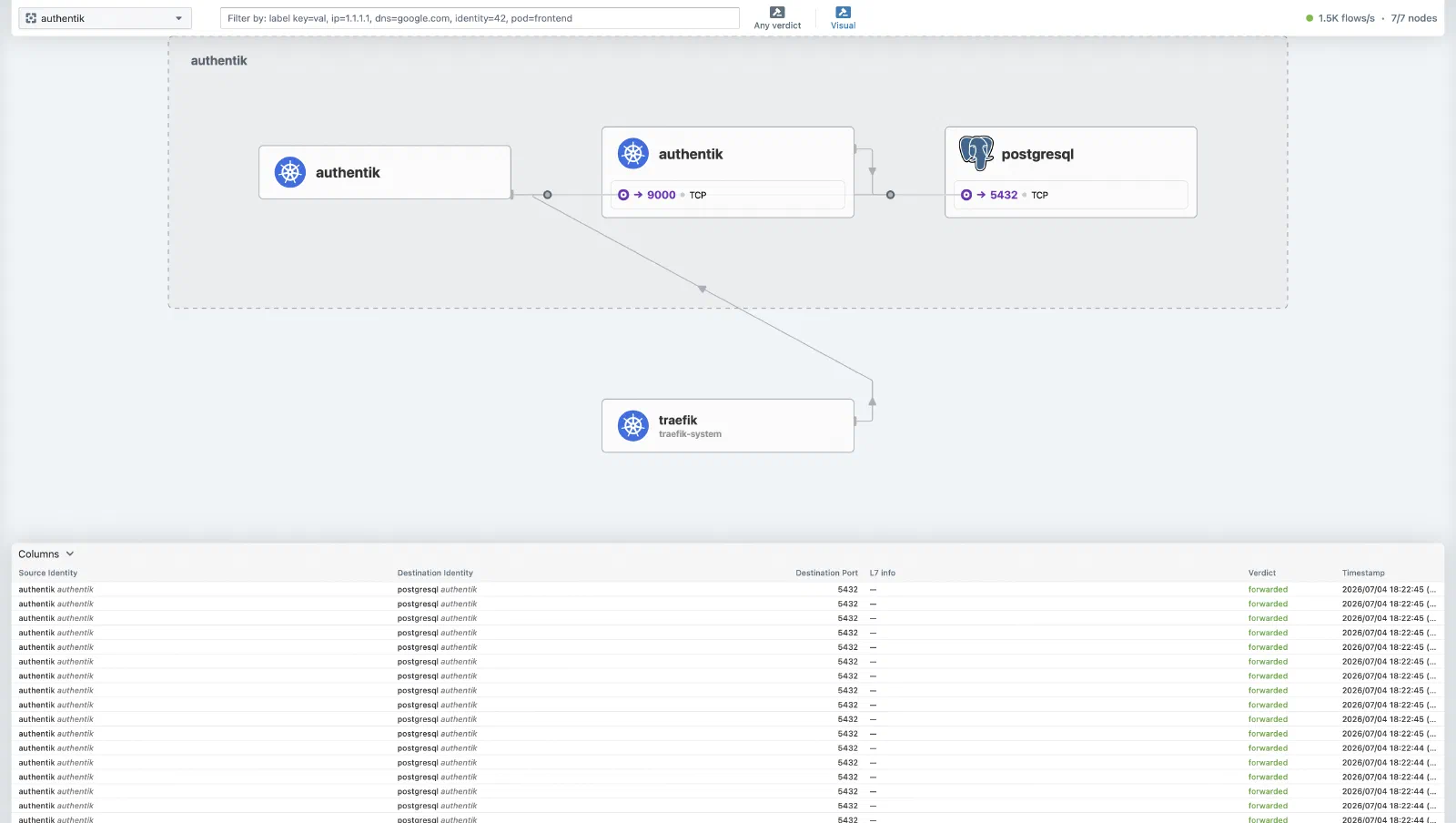
A managed cloud CNI would have hidden every one of these failure modes behind its abstraction, which is the right trade for a production team on AWS and the wrong trade for a learning platform on bare metal. Frank exists to encounter the FQDN-stale-BPF trap so that the next operator on this stack does not have to.
§6 — When Frank’s answer doesn’t generalize
Frank’s answer — Cilium with eBPF kube-proxy replacement, L2 LBIPAM, Hubble, no service mesh — is one leaf of a four-leaf tree. The other three are real.
    flowchart TD
    A["Cluster topology?"] -- "Solo dev / single-node" --> L1["kube-proxy + iptables · Cilium is overkill"]
    A -- "Small bare-metal cluster, opinionated tooling" --> L2["Cilium (Frank's pick)"]
    A -- "Multi-mesh / mTLS-everywhere enterprise" --> L3["Istio (+ Flagger for canary)"]
    A -- "AWS-native" --> L4["VPC CNI (+ Cilium chaining for policy)"]
The first branch is whether the cluster is large enough to need any of this at all. A solo-dev kind cluster or a single-node k3s development loop is fine on kube-proxy + iptables; Cilium adds operational surface for benefits the cluster cannot use. The kube-proxy tax at single-digit Service counts is undetectable.
The second branch is whether you control the kernel. On bare metal, the answer is yes, and an eBPF CNI like Cilium can do its real work — fast Service forwarding, L2 LBIPAM, structured flow observability. For a small bare-metal cluster with opinionated tooling and a heterogeneous mix of workloads, this is what Frank picked.
The third branch is the mTLS-everywhere enterprise — multi-team clusters where every Pod needs a stable identity, every request needs an audit trail, every traffic split needs to be controllable per-route. Istio (with Flagger for progressive delivery on top, see Paper 14) earns the sidecar tax in this geometry. Cilium can do some of this with its own Service Mesh features; Istio still does it more.
The fourth branch is AWS-native. VPC CNI is correct; Cilium would be overkill and would fight the VPC fabric. If you need NetworkPolicy on AWS, chain Cilium as a policy engine only on top of VPC CNI — that’s what Google Kubernetes EngineGoogle's managed Kubernetes, cited alongside EKS as the managed-control-plane comparison point. Dataplane V2 does by default, and what AWS supports explicitly via the security-groups-for-pods feature.
This is the section where the paper has to be honest about its audience. If you are reading this from a fifty-node EKS cluster, the right answer for you is almost never Frank’s answer — it is the VPC CNI leaf, with Cilium chaining if policy matters. Frank’s answer is correct for Frank and is documented here so that anyone considering the same trade understands the rest of the leaves before picking it.
§7 — Roadmap & where this space is going
Three trends are worth naming. None are settled; all affect the next few years of Kubernetes networking.
eBPF is winning the data-plane fight. GKE Dataplane V2 ships Cilium by default. EKS supports Cilium chaining as a first-class option. Calico’s eBPF data plane is GA. The iptables-kube-proxy default still exists for upstream compatibility, but practically nobody picks it on a new cluster in 2026 — and the Cilium-published benchmarks (biased as they are toward Cilium’s home turf) hold up on the methodology. The pattern is clear enough that AWS has begun publishing migration notes for clusters moving from kube-proxy to eBPF-mode chained Cilium.
The service-mesh and CNI layers are merging. Cilium Service Mesh and Istio’s Ambient Mesh are converging on the same idea: do as much as possible in the kernel and on the node, only fall back to a sidecar / per-pod proxy when L7 control is genuinely needed. The “every pod gets a sidecar” model is on its way out; the question for the next eighteen months is whether the kernel layer or the ambient-zTunnel layer claims the larger share of what used to be the sidecar’s job. Cilium’s bet is the kernel; Istio’s bet is the ambient proxy. Both are plausible.
Gateway API is replacing Service of type LoadBalancer + Ingress.
Cilium, Calico, Istio, Linkerd2, and the cloud-managed CNIs all
support GatewayClass + Gateway + HTTPRoute. The L4 LoadBalancer
concern (LBIPAM, BGP, MetalLB) is increasingly an implementation
detail of the Gateway resource. In eighteen months the “which
LoadBalancer controller do you run” question may collapse the same
way the “which Ingress controller do you run” question is collapsing
into Gateway API.
The space is not done evolving. Frank will revisit this paper when the answers change.
References
- vendor-docs
Cilium — Component Overview
Cilium agent (cilium-agent) runs on each node in the cluster. At a high-level, the agent accepts configuration via Kubernetes or APIs that describes networking, service load-balancing, network policies, and visibility & monitoring requirements.
The Cilium agent compiles configuration into eBPF programs that are loaded into the kernel and runs the related management tasks like updating BPF maps.
Vendor's authoritative description of Cilium's data-plane model — eBPF programs compiled by the per-node agent and loaded into the kernel via BPF maps. Grounds the §3 Cilium architecture diagram and the §5 description of Frank's `kubeProxyReplacement: true` configuration.
- vendor-docs
Cilium 1.17 release blog (Isovalent)
Cilium 1.17 introduces Service Mesh enhancements with L7 traffic management and BGP advancements for L3 routing.
Cilium continues to push eBPF as the foundational dataplane for cloud-native networking, with new features in routing, load balancing, and observability.
The version Frank actually runs. Anchors the §1 / §3 claims about feature scope and the §5 LBIPAM and MixedProtocolLBService observations to a specific release rather than a generic 'Cilium does this'.
- talk
Liz Rice — eBPF: A New Frontier for Performance Tooling (KubeCon NA 2021)
eBPF is the kernel's universal programmability layer — it lets you load sandboxed programs into the kernel that run on every packet, every syscall, every scheduler tick.
Cilium is the largest eBPF application in production today; it replaced kube-proxy at GitLab, Adobe, Bell, and a half-dozen other multi-thousand-node Kubernetes deployments.
The canonical introduction of eBPF-as-data-plane to the Kubernetes operator audience. Underwrites the §2 axis 'userspace ↔ kernel/eBPF' and the §7 roadmap claim that the iptables-kube-proxy default is on its way out.
- benchmark
CNI Benchmark — Cilium vs Calico vs Kube-router (Cilium)
Cilium with eBPF kube-proxy replacement reduces latency by 30% in our benchmark vs iptables-mode kube-proxy at 5,000 Services.
iptables rule-evaluation cost is O(N) in the number of Services — at 10,000 Services, kube-proxy resync takes minutes; the eBPF map-lookup is O(1).
Vendor-published benchmark (acknowledged biased toward Cilium, but methodology is open) covering throughput, latency, and rule-evaluation cost at small-to-mid Service counts. Source for the §4 'scale changes' claims about kube-proxy degradation and eBPF map-lookup constancy. The named-gap section in this dossier specifically calls out that this benchmark does not measure the bundled operational tax.
- postmortem
Frank — Cilium gotchas (FQDN stale BPF, LBIPAM sharing-key, MixedProtocolLBService)
Stale BPF egress rules persist even after deleting the CiliumNetworkPolicy — must also restart the Cilium agent to clear them.
Annotating both Services with the same `lbipam.cilium.io/ips: "<addr>"` does NOT cause Cilium L2 IPAM to coordinate the allocation. IPAM treats each annotation as an independent request, gives the IP to whichever Service it processes first, and leaves the other at `EXTERNAL-IP <pending>` indefinitely with no error event.
MixedProtocolLBService — TCP/22 + UDP/60000–60015 on a single Cilium L2 LB IP works on Cilium 1.17 + K8s 1.35. No feature gate flip, no annotation, no per-protocol service split.
Frank's own running postmortem registry — concrete operational scars accumulated while running Cilium 1.17 in production on Talos. Provides source-of-truth dates and recovery commands for the §5 scar callouts and underwrites the §6 decision-tree branches.
- vendor-docs
Amazon VPC CNI — Pod networking
The Amazon VPC CNI plugin for Kubernetes is the networking plugin for pod networking in Amazon EKS clusters. The plugin is responsible for allocating VPC IP addresses to Kubernetes nodes and configuring the necessary networking for pods on each node.
Each pod receives an IP address from the VPC CIDR and is fully routable on the VPC.
The cloud-managed leaf of the §6 decision tree. Vendor's own description that VPC CNI delegates the data plane to AWS — explicit support for the §6 'AWS-native → VPC CNI' branch and the counter-argument that for that geometry Cilium is overkill.