

GitOps at Small Scale
TL;DR
GitOps on Kubernetes is a four-jobs-in-one bundle — reconcile, drift- detect, gate write access, audit — and the six contenders in 2026 (ArgoCD, Flux v2, Jenkins X, cloud-managed GitOps, Spinnaker, just bash + kubectl) trade differently on bundling and on push vs pull.
Frank runs ArgoCD with the App-of-Apps pattern — one root Application reconciles 30+ leaves. The scars came from the seams: an out-of-bounds symlink that locked the entire comparison engine, root re-templating reverting live spec patches, manual syncs blowing the 256KB annotation ceiling.
Frank’s answer does not generalize. Solo + one app → just bash. One small cluster → ArgoCD or Flux, on team culture. Multi-cluster → Flux or cloud-managed. Heavy CD pipeline → keep it, layer GitOps on top.
§1 — The capability
The cluster is a folder. That is the GitOps premise, stripped to its
load-bearing claim: the desired state of every workload, every
ConfigMap, every Application Custom ResourceAn object of a type Kubernetes did not ship with, added by a CRD. Frank's ArgoCD Applications, Rollouts and Tekton Pipelines are all CRs., lives in a Git repository, and
something inside the cluster watches the repo and reconciles the
difference. Push code; the cluster catches up. Edit the cluster by
hand; the reconciler erases your edit. The audit trail is git log.
That is the capability. The diagram below is the stack position.
    flowchart LR
    G[("Git repo (main)")] --> R["Reconciler"]
    R --> K{{"Kubernetes API"}}
    K --> W["Workloads"]
    R -.-> D["Drift detector"]
    R -.-> A["Audit trail"]
    CI["CI / build pipeline"] --> G
GitOps does four things at once, and the diagram lies a little by
drawing them as separate arrows: (1) it reconciles declared state to
live state; (2) it detects drift — anything in the cluster that does
not match the repo; (3) it gates write access to production — only
commits to main can change the cluster; (4) it creates an audit
trail by construction, because every change is a commit by a named
author with a timestamp and a message. Each of those four jobs has a
single-purpose tool that does it better than a reconciler. The
reconciler’s claim is that buying all four with one decision is worth
giving up the best-in-class version of each.
The vendor landscape splits on whether you buy the all-four bundle and on whether the reconciler runs inside the cluster (pull-mode) or outside it (push-mode). That is the question the rest of this paper addresses. It is not a question about CI/CD in general — CI/CD predates GitOps by a decade. It is a question about who watches Git, and where they live.
§2 — The landscape
Six options dominate GitOps on Kubernetes in 2026, and they split cleanly on two axes. The horizontal axis is licensing — open source on the left, commercial-with-contract on the right. The vertical axis is bundling philosophy: a single application that does the whole job (opinionated), or a kit of controllers you compose yourself (unbundled).
quadrantChart

        title GitOps reconcilers — 2026
        x-axis OSS --> Commercial
        y-axis Unbundled --> Opinionated
        quadrant-1 "Opinionated · Commercial"
        quadrant-2 "Opinionated · OSS"
        quadrant-3 "Unbundled · OSS"
        quadrant-4 "Unbundled · Commercial"
        "ArgoCD": [0.20, 0.30]
        "Flux v2": [0.15, 0.20]
        "Jenkins X": [0.30, 0.75]
        "Cloud-managed GitOps": [0.80, 0.80]
        "Spinnaker": [0.25, 0.70]
        "Just bash + kubectl": [0.10, 0.10]
| Feature | ArgoCD | Flux v2 | Jenkins X | Cloud-managed GitOps | Spinnaker | Just bash + kubectl |
|---|---|---|---|---|---|---|
| Pull-mode reconciler | ✅ | ✅ | ✅ | ✅ | ❌ | ❌ |
| First-party web UI | ✅ | 🟡 | ✅ | ✅ | ✅ | ❌ |
| Helm native | ✅ | ✅ | ✅ | ✅ | 🟡 | 🟡 |
| Kustomize native | ✅ | ✅ | 🟡 | ✅ | 🟡 | 🟡 |
| Multi-cluster fan-out | ✅ | ✅ | ✅ | ✅ | ✅ | ❌ |
| Drift notifications | ✅ | ✅ | 🟡 | ✅ | ❌ | ❌ |
| OSS / no contract required | ✅ | ✅ | ✅ | ❌ | ✅ | ✅ |
| Opinionated all-in-one | ❌ | ❌ | ✅ | ✅ | ✅ | ❌ |
The matrix grades the options on the four jobs from §1 plus the licensing and opinionation axes. Read it row-by-row: the “pull-mode reconciler” column is the one that decides whether the option is GitOps at all under the OpenGitOps definition, not just CI/CD with a Git source.
Pulled Automatically: Software agents automatically pull the desired state declarations from the source. Continuously Reconciled: Software agents continuously observe actual system state and attempt to apply the desired state.OpenGitOps Principles v1.0.0
ArgoCD is the most-deployed option in the category. The argument for it is the UI, the App-of-Apps composition pattern, and the controller’s pragmatic handling of edge cases (post-sync hooks, sync waves, prune policies). The argument against is that it ships as one application — one Helm release reconciles the world — and once you have committed to it, you have committed to its model of what a sync looks like. There is no Lego.
Flux v2 is the inverse trade. It ships as a kit — source-
controller fetches Git, kustomize-controller renders Kustomize,
helm-controller renders Helm, image-automation-controller bumps
image tags. Each is a small reconciler with a single responsibility,
and you wire them together. The UI is a third-party concern (Weave
GitOps was the canonical answer, now stewarded by community forks);
the cluster comes with flux CLI and kubectl.
Jenkins X is the opinionated answer for app teams. It bundles
GitOps with Tekton-based CI, preview environments per pull request,
ChatOps via Slack, and a jx CLI that abstracts the whole pipeline.
The trade is exactly that opinionation: when the Jenkins X model
fits the team’s workflow, it fits beautifully; when it does not, the
abstractions become walls.
Cloud-managed GitOps is the hyperscaler answer. Anthos Config Management on GCP, Azure Arc with GitOps add-ons on Azure, Elastic Kubernetes ServiceAmazon's managed Kubernetes. Referenced here as the "someone else runs the control plane" end of the build-versus-buy comparison. GitOps add-ons (Flux or ArgoCD, vendor-deployed) on AWS. The trade is identical to managed Postgres: the operational tax goes to the cloud vendor; the per-month bill arrives.
Spinnaker is the push-mode foil. It predates GitOps as a label — Netflix open-sourced it in 2015, before “GitOps” was named — and its model is pipelines push to clusters, not clusters pull from Git. Spinnaker still fits modern teams, especially in multi-region deployments where the pipeline-as-source-of-truth model maps neatly to “deploy this canary to us-east first.” It does not satisfy the OpenGitOps definition, and that is fine; it is doing a different job.
Just bash + kubectl in CI is the null hypothesis. CI runs
kubectl apply -f manifests/ on push to main. There is no
reconciler, no drift detector, no audit trail beyond git log
itself. The cluster does not pull anything; CI pushes. This option
is correct surprisingly often — see §6 — and the paper takes it
seriously rather than dismissing it.
§3 — How each option handles the hard part
The hard part of GitOps is continuous reconciliation: not the initial apply, but the next apply, and the next, and the next, against a live cluster that may have drifted since the last sync. Each vendor has a different answer; this section lays them out side-by-side with one diagram per vendor in a shared visual language — squares for control-plane components, cylinders for data on disk, hexagons for clients (kubectl, the K8s API), solid edges for the apply hot path, dashed edges for reconcile and drift-detect paths.
ArgoCD
    flowchart TD
    subgraph AC["ArgoCD"]
        R["argocd-repo-server"]
        A["argocd-application-controller"]
        S["argocd-server (UI / API)"]
        DB[("Redis · cache")]
    end
    G[("Git repo")]
    K{{"Kubernetes API"}}
    G --> R
    R --> A
    A --> K
    A -.-> K
    S --> A
    A --> DB
ArgoCD is three controllers in a trench coat. The repo-server clones Git and renders manifests (Helm template, Kustomize build, plain YAML, or one of several third-party plugins); the application-controller compares rendered manifests against live cluster state and applies the diff; the argocd-server exposes the UI and the API. Redis caches rendered manifests so the repo-server does not re-clone on every reconcile. The reconcile cadence is 3 minutes by default — long enough that a hand-edit will survive for about a minute and a half on average before being reverted, short enough that you cannot accidentally hide a manual change for the afternoon.
The App-of-Apps composition pattern is ArgoCD’s distinguishing feature. A single root Application CR templates every other Application CR via a Helm chart; the root reconciles itself, which means adding a new workload to the cluster is one file plus one values entry, and the reconciler does the rest. Frank’s whole 30+ Application tree falls out of one chart.
Flux v2
    flowchart TD
    subgraph FX["Flux v2 (GitOps Toolkit)"]
        SC["source-controller"]
        KC["kustomize-controller"]
        HC["helm-controller"]
        IC["image-automation-controller"]
        ST[("PVC · artifact cache")]
    end
    G[("Git repo")]
    K{{"Kubernetes API"}}
    R[("OCI registry")]
    G --> SC
    R --> SC
    SC --> ST
    SC --> KC
    SC --> HC
    KC --> K
    HC --> K
    IC --> G
Flux’s answer is don’t ship one application; ship a Lego kit. The source-controller is the only thing that talks to Git or Open Container InitiativeThe body behind the standard image and runtime formats. "OCI registry" means any registry speaking that standard, not a specific vendor's.; it publishes immutable artifacts (tar.gz of rendered manifests) which the other controllers consume. The kustomize-controller and the helm-controller both reconcile from that artifact — they do not re-fetch Git themselves. The image-automation-controller closes the loop by writing image tag bumps back to Git on its own schedule.
The composition discipline is genuinely better for some deployments — multi-tenant clusters with strict per-tenant blast radius, or teams that already have strong Kustomize culture. The trade is that the friendly UI Flux had through Weave GitOps is now a community concern, and the operational model is more like “running four controllers” than “running an app”.
Jenkins X
    flowchart TD
    subgraph JX["Jenkins X"]
        TK["Tekton pipelines"]
        BC["boot-controller"]
        LH["lighthouse (ChatOps)"]
        PR["preview-controller"]
    end
    G[("Git repo")]
    K{{"Kubernetes API"}}
    GIT[("Pull request")]
    G --> BC
    GIT --> LH
    LH --> TK
    TK --> K
    TK --> PR
    PR --> K
    BC --> K
Jenkins X bundles GitOps with everything around it — Tekton for
CI, Lighthouse for ChatOps, a preview controller that spins up an
ephemeral environment per pull request. The reconciliation loop is
real (boot-controller is the GitOps reconciler), but the brand
identity of Jenkins X is the bundle — and the bundle’s audience
is app-team developers who want preview environments and merge-to-
production with a /lgtm comment, not platform engineers who want
to compose primitives.
Cloud-managed GitOps
    flowchart TD
    subgraph CM["Cloud-managed GitOps"]
        OP["cloud control plane"]
        A["managed reconciler\n(GKE Config Sync / Azure Arc / EKS add-on)"]
    end
    G[("Git repo")]
    K{{"Kubernetes API"}}
    G --> A
    A --> K
    OP --> A
The reconciler runs in the cluster the same way it would for OSS ArgoCD or Flux; the difference is that the operator’s runtime configuration, upgrades, and Service Level AgreementThe contractual promise about a service, with consequences attached. The commercial wrapper around an SLO. all belong to the cloud vendor. Anthos Config Management on Google Kubernetes EngineGoogle's managed Kubernetes, cited alongside EKS as the managed-control-plane comparison point. is essentially Config Sync (a Google-developed Kustomize reconciler) plus Policy Controller for admission rules; Azure Arc with GitOps add-ons can install Flux or ArgoCD on any Kubernetes cluster the Arc agent reaches. The data path is the same; the bill is different.
Spinnaker
    flowchart TD
    subgraph SP["Spinnaker (push-mode)"]
        OR["orca · pipeline orchestrator"]
        CL["clouddriver"]
        DE["deck · UI"]
        EC["echo · webhooks"]
    end
    G[("Git repo (manifests)")]
    CI["CI build"]
    K{{"Kubernetes API"}}
    CI --> OR
    G -.-> OR
    OR --> CL
    CL --> K
    DE --> OR
    EC --> OR
Spinnaker is the foil. It is pipeline-first: a build artifact (image tag, manifest version) triggers a pipeline that orchestrates a deployment, possibly across multiple clusters or regions. There is no continuous reconciliation loop in the OpenGitOps sense; if you hand-edit the cluster after a deployment, Spinnaker will not notice until the next pipeline run. That is the trade. Spinnaker fits teams whose model of production is “we deploy in waves” — canary in us-east, observe, promote to us-west, observe, promote globally — and where the pipeline is the audit trail, not the Git repo.
§4 — What scale changes
Three scale axes flip vendor rankings. The first two are quantitative; the third is organisational.
Application count per cluster. ArgoCD’s App-of-Apps pattern has
an unhappy interaction with the Kubernetes API’s
metadata.annotations ceiling. Every resource carries
kubectl.kubernetes.io/last-applied-configuration, and any single
annotation greater than 262144 bytes is rejected. A chart-bundled
Grafana dashboard ConfigMap can reach 240 KB of JSON without
trying; render one of those through a manually-triggered sync that
does not pass ServerSideApply=true and the apply fails with a
Too long: may not be more than 262144 bytes admission error. The
controller’s polling-loop sync honours spec.syncPolicy.syncOptions
correctly; only manual operations break the rule.
Manually-triggered syncs do NOT inherit spec.syncPolicy.syncOptions … any chart-bundled CM larger than ~250KB … fails with metadata.annotations: Too long: may not be more than 262144 bytes.Frank — ArgoCD gotcha registry
Cluster count. Single-cluster, single-team: ArgoCD and Flux are
both comfortable; the choice is preference. Multi-cluster fan-out
(5+ clusters): ArgoCD’s ApplicationSet controller and Flux’s
generator chain (OCIRepository + Kustomization per tenant) start
to diverge in operational cost. ApplicationSet is centralised — one
ApplicationSet generates Applications for every cluster — and that
centralisation IS a feature when you want global rollouts and a
liability when one cluster is in a different network partition.
Flux’s per-cluster model treats every cluster as independent, which
maps cleanly to the “fleet of edges” pattern and badly to the
“global config rollout” pattern.
Drift-detection cadence. ArgoCD polls every 3 minutes by
default; Flux’s interval field defaults to 60 seconds and is
configurable per Kustomization. The interesting question is not
“which is faster” but what is the smallest drift window your team
can detect and act on? Sub-minute drift detection is only useful
if somebody is watching alerts; if drift is checked manually each
morning, anything below 24 hours is equivalent.
The community consensus on the ArgoCD-vs-Flux choice is not folklore — it shows up explicitly in practitioner threads:
We picked Flux because we wanted everything to be a CR and we didn’t want a separate UI service running. We picked ArgoCD because we wanted the UI and the App-of-Apps pattern.r/kubernetes — ArgoCD vs FluxCD thread
§5 — Frank’s choice, and what happened
Frank chose ArgoCD. One root Application reconciles every leaf —
30+ Applications at last count, from Cilium and Longhorn at the
infrastructure layer to OpenRGB at the cosmetic-fun layer. The
declarative-everything principle is enforced by construction: if it
is not in apps/, it is not on the cluster, and ArgoCD will revert
your hand-edits within the sync window.
The honesty of that choice is what makes the resulting scars worth writing down. A managed-GitOps offering would have hidden some of them. The “just bash + kubectl” baseline would have hidden all of them by erasing the reconciler.
ComparisonError for the entire repo. Not the affected Application
— the entire GitOps loop. Commit 024ab58 moved .claude/skills
to agents/skills and left a symlink behind that pointed two levels
up (../../agents/skills), which escapes the repo root. ArgoCD’s
repo-server refused to generate manifests for any source in the
repo until the symlink was fixed. Self-heal could not fire because
comparison itself was failing; the cluster ran on the last-known-good
cache for fourteen hours before anyone noticed. The fix was one
character (one .. removed). find . -type l -lname '*../../..*'
after every symlink commit is now muscle memory.syncPolicy live to suspend selfHeal
during a validation test. Within the root’s sync window, the
App-of-Apps re-templated the leaf Application from
apps/root/templates/<app>.yaml and Server-Side ApplyKubernetes applying changes field by field, with each manager owning the fields it sets. Frank uses it everywhere — without it, large resources blow the annotation size limit the old client-side path depends on.-reverted the patch. The
leaf came back exactly as the chart rendered it, including
selfHeal: true. The fix was not to fight the parent harder; the
fix was to understand that live spec mutations against
ArgoCD-managed Application CRs are not durable — they are reverted
within the sync window unless you also pause the parent or commit
to git. There is no third option.kubectl patch application … --type=merge -p '{"operation":{"sync":...}}' runs the sync client-side with
kubectl apply, which injects
kubectl.kubernetes.io/last-applied-configuration into every
resource. A chart-bundled Grafana dashboard ConfigMap at 241 KB
blew the 262144-byte annotation ceiling. The controller’s
polling-loop sync honoured spec.syncPolicy.syncOptions correctly;
only the manual patch broke. ServerSideApply=true and
RespectIgnoreDifferences=true now go into every manual operation
payload by reflex, not by checklist.The three scars share a shape. None of them are bugs in ArgoCD; all of them are emergent properties of the App-of-Apps pattern under adversarial-from-its-own-tooling conditions. A symlink commit looks inert to a code reviewer; the root Application’s re-templating is documented but not noisy; the manual-patch syncOptions inheritance is a paragraph in the docs you read once and then forget. The reconciler does not make the system harder to reason about; it makes the consequences of reasoning errors visible — which is the entire reason Frank runs it.
Visible evidence:
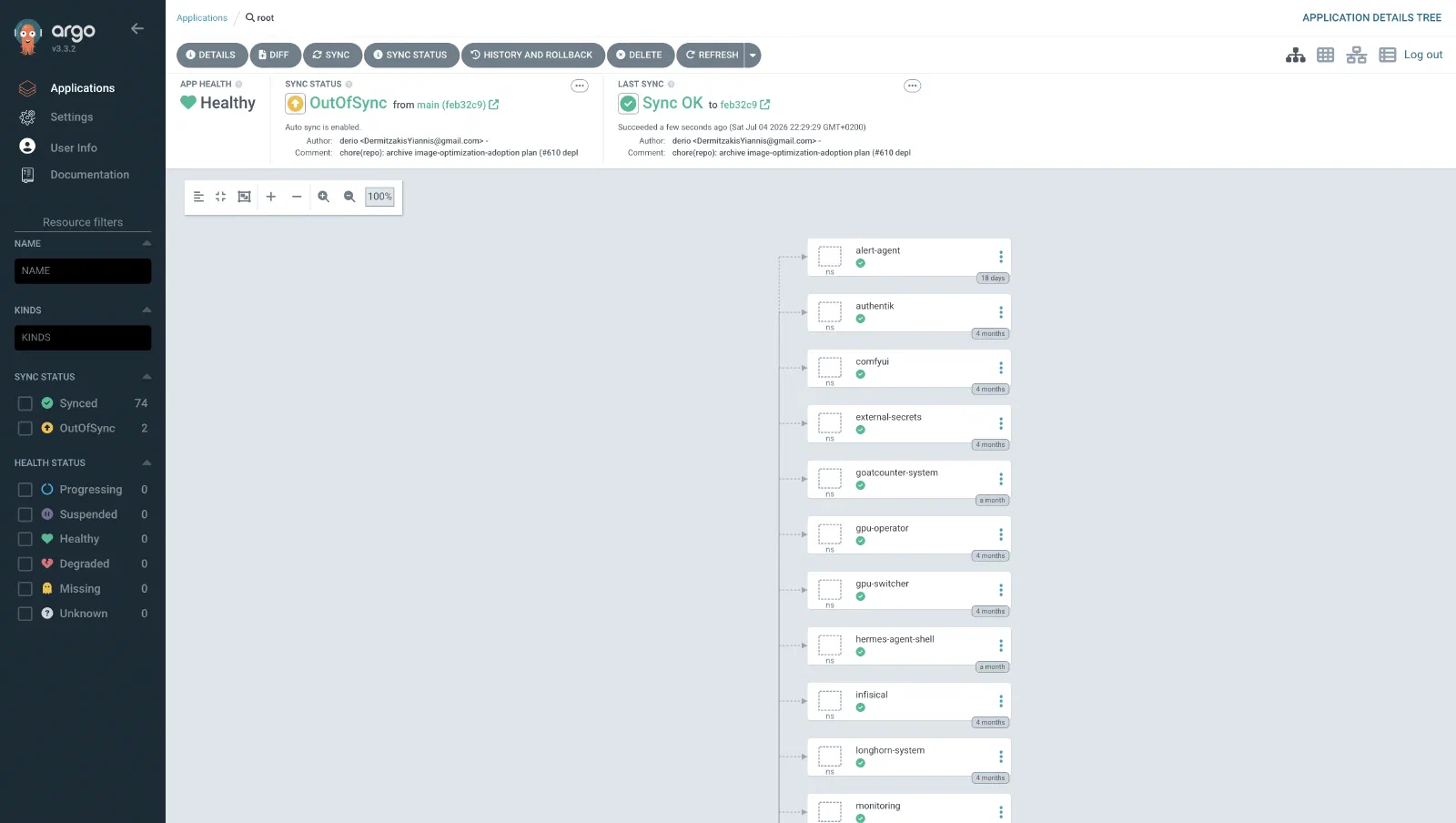
A managed-GitOps product would have absorbed the symlink incident
into its support team’s queue; a pure-CI kubectl apply flow would
not have noticed the symlink at all (you cannot break a comparison
engine you do not have). The trade Frank made is to live with
reconcilers loud enough to make every drift visible, including the
drift you accidentally introduced.
§6 — When Frank’s answer doesn’t generalize
Frank’s answer — ArgoCD with the App-of-Apps pattern on one ≤10-node cluster — is one leaf of a four-leaf tree. The other three are real.
    flowchart TD
    A["How many clusters?"] -- "1 small cluster, 5–20 apps" --> B["Team familiar with ArgoCD?"]
    B -- "Yes" --> L1["ArgoCD App-of-Apps (Frank's pick)"]
    B -- "No, Flux culture" --> L2["Flux v2"]
    A -- "Multi-cluster, multi-team" --> L3["Flux v2 or cloud-managed GitOps"]
    A -- "Solo, one small app" --> L4["Just bash + kubectl in CI"]
    L1 -.-> P["Heavy existing CD pipeline?"]
    L2 -.-> P
    P -- "Yes (Tekton/Spinnaker)" --> PX["Keep existing CD, layer GitOps reconciler on top"]
The first branch is cluster count. Solo developer running a single
small app — Frank’s contention is that “just bash + kubectl” wins.
The reconciler exists to catch drift, and drift only matters when
more than one person (or one person across many sessions) is
editing the cluster. A solo developer with strong commit discipline
does not need a reconciler; they need a Makefile.
At one small cluster with 5–20 apps and a small team, the question is what GitOps culture does the team already have? If the team has Flux fluency, Flux is the right answer; if the team has ArgoCD fluency or no GitOps fluency, ArgoCD’s UI carries the onboarding cost more cheaply. Both reach the destination; they take different routes.
At multi-cluster fan-out, the trade flips: Flux’s per-cluster model or cloud-managed GitOps (Anthos Config Management, Azure Arc) pay back the centralisation cost differently from ArgoCD’s ApplicationSet model.
The dashed branch — “heavy existing CD pipeline” — is a fifth-leaf override on the pipeline-investment axis. A team that already runs Tekton or Spinnaker probably should not throw it away; they should layer a GitOps reconciler on top. ArgoCD plays this role gracefully (a reconciler in front of any pipeline); Spinnaker plays it poorly (Spinnaker IS the pipeline).
This is the section where the paper has to be honest about its audience. If you are reading this from a single-cluster team considering “should we even bother”, the answer is probably yes, because the discipline of committing every cluster change is load-bearing. If you are reading from a multi-cluster team with existing Spinnaker pipelines, the answer is not the way Frank does it. The right answer is the leaf with your name on it.
§7 — Roadmap & where this space is going
Three trends are worth naming. None of them are settled; all of them affect the next few years of GitOps on Kubernetes.
OCI-native GitOps. Both ArgoCD and Flux v2 now support OCI registries as the source of truth, not just Git. The implication is real: Git for source code, OCI for rendered manifests, with the reconciler watching both. The decoupling matters for compliance teams that want signed artifacts — a Kustomize build pipeline can sign its output, push the bundle to OCI, and the reconciler enforces “this cluster runs what was signed”, not “this cluster runs what appeared in main.” Expect this to become the default by 2028.
ApplicationSets and dynamic generation. ArgoCD ApplicationSets
and Flux’s generator chain (ImagePolicy, file-based generators)
are converging on the same shape: programmatically generate
Applications from a list — a cluster matrix, a file glob, a list
of pull-requests. The “Application as value, not template” pattern
is becoming the default for multi-tenant platforms, and it will
push smaller-scale ApplicationSets into single-cluster usage too,
even where they were originally overkill.
GitOps plus signed images plus admission control. The
reconciler enforces “what’s in Git.” The signer enforces “what’s in
this Git is what was built.” Admission control (Kyverno, Gatekeeper,
Sigstore policy-controller) enforces “what is running was signed.”
These three layers are converging on a single supply-chain story
that GitOps can plausibly own end-to-end by 2027 — cosign +
ratify + ArgoCD’s signature field are already the building
blocks. The interesting question is which reconciler treats the
supply-chain story as a first-class concern rather than an
integration.
The space is not done evolving. Frank will revisit this paper when the answers change.
References
- vendor-docs
Argo CD — Architecture
Argo CD is implemented as a Kubernetes controller which continuously monitors running applications and compares the current, live state against the desired target state (as specified in the Git repo).
The application controller is a Kubernetes controller which continuously monitors running applications and compares the current, live state against the desired target state. It detects OutOfSync application state and optionally takes corrective action.
Vendor's own articulation of ArgoCD's reconciliation model — pull-mode controller that compares declared state against live state continuously. Anchors the §3 architecture diagram for ArgoCD and underwrites the §1 capability definition.
- vendor-docs
Flux — Core Concepts
Flux is a tool for keeping Kubernetes clusters in sync with sources of configuration (like Git repositories and OCI artifacts), and automating updates to configuration when there is new code to deploy.
Flux is constructed with the GitOps Toolkit, a set of composable APIs and specialized tools for building Continuous Delivery on top of Kubernetes.
Definitive description of the GitOps Toolkit composition model — Flux is unbundled by design, where ArgoCD ships as a single application. Anchors the §2 axis (unbundled vs opinionated) and the §3 Flux architecture diagram.
- paper
OpenGitOps Principles v1.0.0
Declarative: A system managed by GitOps must have its desired state expressed declaratively.
Versioned and Immutable: Desired state is stored in a way that enforces immutability, versioning and retains a complete version history.
Pulled Automatically: Software agents automatically pull the desired state declarations from the source.
Continuously Reconciled: Software agents continuously observe actual system state and attempt to apply the desired state.
The CNCF/OpenGitOps working-group definition of what GitOps actually is. The four principles are load-bearing for §1 (the capability definition) and §6 (the decision-tree leaf where the 'just bash + kubectl' option fails Principle 3 and 4).
- talk
GitOps — Operations by Pull Request (Alexis Richardson, Weaveworks, 2017)
By using Git as our source of truth and operations toolkit, we can keep declarative descriptions of all of our infrastructure and applications under version control.
Our Git repository is the source of truth for what we want our system to look like. Our diff tools and convergence operators are how we get there.
The original Weaveworks blog post that named the practice. Cited as the historical origin of the GitOps label (the term predates both ArgoCD and Flux v2). Used in §1 to ground the capability in its 2017 articulation.
- postmortem
Frank — ArgoCD gotcha registry (symlink ComparisonError, manual-syncOptions-inheritance, root re-templating)
ArgoCD's repo-server refuses to generate manifests for any source in a repo that contains a symlink resolving above the repo root. Self-heal can't fire because comparison itself fails, so the cluster silently runs on the last-known-good cache indefinitely.
Manually-triggered syncs do NOT inherit spec.syncPolicy.syncOptions ... any chart-bundled CM larger than ~250KB ... fails with metadata.annotations: Too long: may not be more than 262144 bytes.
Root App-of-Apps re-templates leaf Application specs on every sync. Any live mutation to a leaf is reverted within the root's sync window.
Frank's running postmortem registry for ArgoCD — concrete operational scars accumulated while running the App-of-Apps pattern in production for this learning platform. Provides the source-of-truth dates and recovery commands for the §5 scar callouts and underwrites the §6 decision-tree branches with real failure modes.
- benchmark
ArgoCD vs FluxCD — r/kubernetes practitioner thread
ArgoCD has the better UI by far. Flux is more modular and feels more Kubernetes-native, but the UI gap is real.
We picked Flux because we wanted everything to be a CR and we didn't want a separate UI service running. We picked ArgoCD because we wanted the UI and the App-of-Apps pattern.
Practitioner-level head-to-head capturing the community consensus on the trade Frank made. Not a controlled benchmark, but representative of the decision shape for the ≤10-node single-cluster case the paper actually addresses.