
Backup & DR Without a Vendor Contract
TL;DR
Kubernetes backup & DR is a five-job problem — API-object capture, volume capture, application-consistency hooks, offsite shipment, credential restore — and the six contenders in 2026 (Velero, Longhorn-native, Kasten K10, TrilioVault, restic, and the rclone-and-cron null hypothesis) each treat one or two of those jobs as primary and assume you have something else for the rest.
Frank runs Longhorn-native backup to Cloudflare R2. No Velero — ArgoCD plus git already restores every Kubernetes API object in under ten minutes, leaving only PersistentVolumeClaimA Kubernetes request for durable storage. The pod names a claim and the storage layer — Longhorn on Frank — binds real disk behind it, so the data outlives the pod. contents and a small set of Secrets OPerationSMozilla's tool for encrypting the *values* in a YAML file while leaving the keys readable, so an encrypted secret still reviews as a sensible diff.-encrypted bootstrap secrets that must be applied before any restore can run. The scars: a Longhorn 1.11 Network File SystemThe long-standing protocol for mounting a remote directory as if it were local. Simple and universal; its locking semantics are the usual source of surprises. mount-string bug, a RecurringJob schema with no per-job target field, secrets that live outside the backup tool’s reach by design.
Frank’s answer does not generalize. No GitOps coverage → Kasten K10. Regulated workloads → Kasten K10. Paranoid → restic on a Network Attached StorageA box whose job is serving files over the network, typically via NFS or SMB — storage as an appliance rather than as a cluster service..
§1 — The capability
The cluster’s persistent state has vanished tonight. Choose one: a corrupted
Longhorn volume nobody noticed until the daily replica check, an accidental
kubectl delete ns from a tired operator, a lost node with the only stable
replica of a critical PVC, or a full site loss. The question now is not
whether the state comes back — it must — but against what artefact, and
in what order. Restore the API objects? Restore the volume contents?
Re-apply the secrets that aren’t in git? Decide which of the three is the
critical-path predecessor for the others?
That is the capability under examination. Not “backup” in the abstract — Kubernetes already has VolumeSnapshot, Longhorn already ships a BackupTarget CustomResourceDefinitionThe object that teaches the Kubernetes API a new resource type. Install a CRD and the API server starts serving a kind it has never heard of, with validation and RBAC like any built-in., every storage vendor has a Container Storage InterfaceThe plugin contract for storage, the counterpart to CNI. Longhorn is Frank's CSI driver: it turns a PVC into a real replicated volume. driver that can produce a point-in-time copy. The capability is what happens between the cluster’s state becoming unrecoverable and a hundred percent of that state being back on disk and serving traffic: who owns the K8s API-object capture, who owns the volume contents, who owns the secrets that aren’t backed up at all, and who sequences the restore in an order the workloads can actually come up under?
    flowchart LR
    G["GitOps (ArgoCD)"] --> A["API objects"]
    W["Workloads"] --> V["PVC volumes"]
    B["Backup & DR"] --> AC["API-object capture"]
    B --> VC["Volume capture"]
    B --> AH["App-consistency hooks"]
    B --> OS["Offsite shipment"]
    B --> CR["Credential restore"]
    A -.-> B
    V --> B
The five jobs backup & DR does — API-object capture, volume capture, application-consistency hooks, offsite shipment, credential restoration — are not all the same job. Some vendors treat one as primary and let the others fall out of the design; others assume your declarative ground truth is somewhere else (git, an external CMDB, a wiki nobody updates) and build everything on top of that assumption. The vendor space splits on which job is primary, which dependency is mandatory, and how much of your cluster lives in a place the backup tool can reach.
I run Longhorn-native backup to Cloudflare R2 and I deliberately do not run Velero. That choice was not made on the merits in the abstract; it was made on the merits of Frank already living in git. Every Deployment, Service, ConfigMap, CRD, and StorageClass is committed and applied by ArgoCD. If the cluster evaporates tonight, ArgoCD restores every Kubernetes API object in under ten minutes. The one thing it cannot restore is the contents of PersistentVolumes — and that is the only job left for a backup tool to do on Frank. The point of this paper is to make the trade legible, and then return to Frank’s choice and the operational scars that proved it correct only on Frank’s terms.
§2 — The landscape
Six options dominate Kubernetes backup & DR in 2026, and they split on two axes. The horizontal axis is what gets captured — volume contents only on the left, application-aware multi-resource capture (with quiesce hooks, multi-PVC consistency, CRD-aware operators) on the right. The vertical axis is control-plane tax — does the option require its own controller/operator running on the cluster (bottom), or does it ride on top of the storage layer with no extra control plane (top)?
quadrantChart

        title Backup & DR — 2026
        x-axis "Volume-only" --> "Application-aware"
        y-axis "Adds control plane" --> "No extra control plane"
        quadrant-1 "App-aware · No control plane"
        quadrant-2 "App-aware · Adds control plane"
        quadrant-3 "Volume-only · Adds control plane"
        quadrant-4 "Volume-only · No control plane"
        "Velero": [0.55, 0.30]
        "Longhorn (native)": [0.20, 0.85]
        "Kasten K10": [0.90, 0.20]
        "TrilioVault": [0.85, 0.30]
        "restic": [0.15, 0.95]
        "rclone + cron": [0.05, 0.90]
| Feature | Velero | Longhorn (native) | Kasten K10 | TrilioVault | restic | rclone + cron |
|---|---|---|---|---|---|---|
| K8s API objects | ✅ | ❌ | ✅ | ✅ | ❌ | ❌ |
| PVC data | ✅ | ✅ | ✅ | ✅ | ✅ | 🟡 |
| Application-aware | 🟡 | ❌ | ✅ | ✅ | ❌ | ❌ |
| Deduplication | 🟡 | ✅ | ✅ | ✅ | ✅ | ❌ |
| Offsite target (S3/NFS) | ✅ | ✅ | ✅ | ✅ | ✅ | ✅ |
| Adds control plane | ✅ | ❌ | ✅ | ✅ | ❌ | ❌ |
| RBAC / audit | 🟡 | ❌ | ✅ | ✅ | ❌ | ❌ |
| OSS / no contract required | ✅ | ✅ | ❌ | ❌ | ✅ | ✅ |
The matrix grades the options on K8s API-object capture, PVC data, application-awareness, deduplication, offsite shipment, whether it adds a control plane, Role-Based Access ControlKubernetes' permission model: roles list verbs on resources, bindings attach them to identities. Default-deny, so an omitted rule reads exactly like a broken component./audit, and licensing. The control-plane column is the one that does the most work; it is also the one most vendor docs mention only after you have read the install guide.
Velero is the default answer when people say “Kubernetes backup”. Its architecture treats Kubernetes API objects as first-class citizens — Backups, Restores, and Schedules are themselves CRDs, processed by the Velero controller. PVC data is a plugin: CSI VolumeSnapshot, or File- System Backup mode that drives restic underneath. The trade is that Velero’s core competency — backing up the Kubernetes API surface — is exactly the work that GitOps already does for any cluster managed by ArgoCD or Flux. The Velero design docs are explicit about the model:
Each Velero operation – on-demand backup, scheduled backup, restore – is a custom resource, defined with a Kubernetes Custom Resource Definition (CRD) and stored in etcd.Velero — How Velero Works
That elegance is also where the redundancy lives. If your cluster is already CRD-defined in git, Velero’s API capture buys you very little.
Longhorn (native) inverts the trade. There is no separate backup controller; the storage driver itself owns snapshot, dedup, and shipment. A BackupTarget Custom ResourceAn object of a type Kubernetes did not ship with, added by a CRD. Frank's ArgoCD Applications, Rollouts and Tekton Pipelines are all CRs. points at an S3-compatible endpoint or an NFS share; a RecurringJob CR schedules backups against a label-selected group of volumes; the longhorn-manager handles the rest. The Longhorn concepts docs describe the data model directly:
Longhorn uses a unique mechanism to construct each backup at the block level. Each backup consists of a metadata file and the data blocks. If a data block is already saved in the secondary storage, this data block will not be transferred again.Longhorn — Concepts
The benefit is no extra control plane — no new operator pods, no new RBAC to audit, no new CRD to learn. The cost is no application awareness — nothing quiesces a Postgres before the snapshot, nothing knows how to back up a multi-PVC stateful set as a consistent unit. For workloads that are fine with crash-consistent recovery (any reasonable database, plus most filesystem workloads), this trade is the right one.
Kasten K10 (by Veeam) is the heritage commercial answer. Policy engine, RBAC on every operation, audit trail, multi-cluster DR orchestration, and the Blueprint model — a CRD that describes how a specific application’s operator quiesces and recovers, contributed back by the community for common databases. The trade is the licence fee, the operator footprint, and the second admin console. For a regulated production cluster with Personally Identifiable InformationData that identifies a person. The category that decides whether something may leave the cluster at all., PCI, or HIPAA scope, the policy engine and audit trail are not optional; they are the reason Kasten exists.
TrilioVault sits adjacent to Kasten. The product distinction is the integration surface — ITSM/Security Information and Event ManagementThe system that centralises security events and alerts on them. Frank's VictoriaLogs plus alerting occupies this role without the label. hooks, multi-cloud DR orchestration as a first-class concept. The capability shape is the same: application-aware capture with a full operator stack.
restic is the file-format primitive everything else converges on. Content-defined chunking, SHA-256-keyed deduplication, Advanced Encryption StandardThe symmetric block cipher used almost everywhere data is encrypted at rest, including the age keys behind SOPS-encrypted secrets in this repo.-256-CTR encryption at rest, scrypt key derivation. It is not, by itself, a Kubernetes backup tool — it is a backup engine that the Kubernetes backup tools (notably Velero’s File-System Backup mode) drive underneath. When the conversation in §3 turns to “what is actually moving the bytes off-cluster”, the answer for several of the vendors in this landscape is “restic, with a Kubernetes-shaped wrapper”.
rclone + cron is the null hypothesis. A sidecar that runs
rclone sync /data s3://bucket/$(date +%F)/ every night. No API-object
capture, no consistency guarantee, no restore tooling beyond
rclone copy in the other direction. Its purpose in this paper is to
mark the lower bound: if your cluster is single-tenant and your
application is stateless or already replicates externally, this is the
right answer, and the rest of the matrix is solving a problem you do
not have.
§3 — How each option handles the hard part
The hard part of backup & DR is not capturing the data; it is restoring it in an order the workloads can actually come up under, with secrets and config present before the volumes attach, with consistency boundaries respected across multi-PVC apps, and with the restore tool’s own dependencies (its credentials, its bucket, its CRDs) available before the restore runs. Every vendor on this list has an answer; the answers diverge enough that they need separate diagrams. The diagrams below use a shared visual language — squares for controller/operator components, rounded rectangles for K8s objects (Deployments, Backups, CRs), diamonds for decision points and hooks, cylinders for backup storage (S3, NFS, vault), dashed edges for hook and control-plane paths, solid edges for data flow (snapshot, restore).
Velero
    flowchart TD
    subgraph VE["Velero (API-first)"]
        VC["velero controller"]
        BR(("Backup CR"))
        RR(("Restore CR"))
        BIA{"BackupItemAction plugin"}
        FSB{"File-System Backup (restic)"}
    end
    S3[("S3 / GCS / Azure")]
    PVC(("PVC"))
    VC --> BR
    VC --> RR
    VC -.-> BIA
    VC --> FSB
    PVC --> FSB
    BR --> S3
    FSB --> S3
The Backup CR is the primary unit; a single Backup captures a namespace or label-selected set of K8s API objects, optionally with their PVC data attached. PVC capture has two modes: CSI VolumeSnapshot (storage-driver snapshots, fast, dedup at the storage layer) or File-System Backup mode (restic underneath, slower, dedup in the restic repo). BackupItemActions are plugin hooks that run during the capture — pre-backup quiesce, post- backup label fixup, exclude-rules for transient resources.
Restore is a separate CR that references a Backup; the controller iterates the captured objects in a fixed order (namespaces first, then CRDs, then the rest, then PVCs last so volumes attach after their consumers exist). Time-to-restore is dominated by the PVC-data layer’s throughput — CSI snapshot restore is fast; restic restore is slow at TB scale.
The failure mode is the redundancy with GitOps: if every API object is already in git, the velero-captured API objects are a second copy of something git can already restore. The Backup CR provides a point-in-time snapshot of the cluster’s state at backup time, which is genuinely useful for “restore exactly what was running at 02:00 last night” — but not what Frank needs.
Longhorn (native)
    flowchart TD
    subgraph LH["Longhorn (storage-native)"]
        LM["longhorn-manager"]
        RJ{"RecurringJob (cron)"}
        BS["BackupStore engine"]
        SS(("VolumeSnapshot"))
        BT2(("BackupTarget CR"))
    end
    BT[("S3 / R2 / NFS BackupTarget")]
    PVC(("PVC"))
    LM --> SS
    RJ -.-> LM
    LM --> BT2
    BT2 -.-> BT
    SS --> BS
    BS --> BT
    PVC --> SS
The BackupTarget CR is the configuration — an S3 URL or NFS URL plus a credential Secret reference. The RecurringJob CR is the schedule — a cron spec, a retention count, and a label-selected group of volumes. Inside the longhorn-manager, the BackupStore engine handles block-level deduplication against the secondary store: each block is content-addressed, so identical blocks across volumes (or across backups of the same volume) are stored once. The off-cluster artefact is a tree of metadata files plus a content- addressed block pool.
Restore is initiated against the BackupTarget — pick a backup, point a new PVC at it, the volume re-hydrates from the BackupStore. Time-to-restore is dominated by the network throughput to the secondary store and the deduplication ratio (a fresh restore from a cold bucket is much slower than a restore where most blocks are already in the local Longhorn replica pool).
The failure mode is the absence of application awareness. A multi-PVC Postgres write-replicated across three volumes will produce three independently consistent snapshots, not one jointly consistent snapshot. For most workloads this is fine — Postgres recovers from a crash-consistent snapshot — but for any application that crosses PVC boundaries with in-flight transactions, the work is on the operator to either accept crash consistency or build an out-of-band quiesce step.
Kasten K10
    flowchart TD
    subgraph K10["Kasten K10 (policy-engine)"]
        KOP["k10 operator"]
        POL{"Policy CR"}
        BP{"Blueprint CR"}
        AUD["Audit trail"]
        PROF(("Location Profile"))
    end
    S3[("S3 / Azure / GCS / NFS")]
    APP(("Application (Deployment + PVCs + Secrets)"))
    KOP --> POL
    KOP --> BP
    KOP -.-> AUD
    POL --> PROF
    PROF --> S3
    BP -.-> APP
    APP --> PROF
The Policy CR is the primary unit — a schedule plus a Blueprint reference plus a Location Profile. The Blueprint CR is the application-awareness hook — Kasten ships Blueprints for common databases (Postgres, MySQL, MongoDB, Cassandra) that quiesce the application via its operator before the snapshot and resume it after. The audit trail captures every operation with RBAC context.
Restore is initiated against a captured Application — Kasten reconstructs the K8s API objects, the PVC contents, and the Blueprint-driven recovery hooks (e.g., “after restoring this Postgres, run the Write-Ahead LogRecording an intended change before making it, so a crash mid-write can be replayed rather than lost. How Postgres survives being killed. replay step defined in the Blueprint”). The Blueprint model is the design space that makes Kasten worth its licence fee.
The failure mode is the operator and policy-engine surface area itself. At a small cluster the policy engine has nothing to police and the audit trail has nothing to audit; at a regulated production cluster, it is the difference between passing the Service Organization Control 2An audit of a provider's security and availability controls. Evidence of process, which is not the same as evidence of security. review and not.
TrilioVault
    flowchart TD
    subgraph TV["TrilioVault (app-centric)"]
        TOP["trilio operator"]
        BACKUP_PLAN(("BackupPlan CR"))
        BACKUP_CR(("Backup CR"))
        TARGET(("Target CR"))
        SIEM["ITSM / SIEM hooks"]
    end
    S3[("S3 / object store")]
    APP(("Application"))
    TOP --> BACKUP_PLAN
    BACKUP_PLAN --> BACKUP_CR
    BACKUP_PLAN --> TARGET
    TOP -.-> SIEM
    TARGET --> S3
    BACKUP_CR -.-> APP
    APP --> TARGET
The shape is similar to Kasten: a policy/plan CR drives application-aware capture against a Target CR pointed at object storage. The product distinction is the integration surface — ITSM/SIEM hooks for ticketing and security audit, multi-cloud DR orchestration as a first-class concept.
The failure mode is the same as Kasten — the value is in the application-awareness and the audit trail, which a small cluster struggles to amortise.
restic
    flowchart TD
    subgraph RS["restic (engine)"]
        RC["restic CLI / library"]
        CHK{"Content-defined chunking"}
        DD{"SHA-256 dedup"}
        ENC{"AES-256-CTR + scrypt"}
    end
    REPO[("restic repository (S3/local/SFTP)")]
    SRC[("Source filesystem")]
    SRC --> CHK
    CHK -.-> DD
    DD --> ENC
    ENC --> REPO
restic does not run on Kubernetes by itself; it is the data-format engine that Velero’s File-System Backup mode invokes underneath. The interesting property is the content-addressed repository: identical chunks across hosts and across time are stored once, encrypted with a password-derived key. Where restic shines in this landscape is the “encrypted offsite copy on a NAS” leaf of the §6 decision tree — a periodic restic backup of the manifests directory plus the SOPS-encrypted secrets, as a defence against the case where the primary backup tool’s own dependencies are also compromised.
§4 — What scale changes
Three scale axes flip vendor rankings. The first two are quantitative; the third is operational.
Volume count and snapshot rate. A twenty-PVC cluster can run Longhorn daily snapshots at 02:00 UTC and not notice — the snapshot fan-out is small enough that workload IO is unaffected. A two-thousand-PVC cluster cannot — the snapshot operations queue up, the BackupStore writes contend with running-workload IO, the dedup-hash computation pegs CPU on the longhorn-manager pod. The crossover is not a number; it is “do your snapshot operations finish within the window before the next schedule fires?” Once the answer is not reliably, the deduplication ratio matters more than the schedule, and incremental-only backups (where Longhorn’s block-dedup is most valuable) stop being optional.
Restore wall-clock at TB scale. A 10 GB cluster restores from R2 in under an hour over a residential gigabit link. A 10 TB cluster restores in days, with the network as the bottleneck. The Kubernetes blog’s CSI VolumeSnapshot GA announcement frames the design intent precisely:
Volume snapshots provide Kubernetes users with a standardized way to copy a volume’s contents at a particular point in time without creating an entirely new volume.Kubernetes blog — Volume Snapshot GA
The standardisation matters at scale because it lets a backup tool use storage-driver-native snapshots (fast, dedup-aware, often instant) instead of a copy-the-whole-volume fallback. The order of magnitude that matters for DR planning at TB scale is “do we have a local-first restore path?” — a NAS or replicated object store inside the same data centre — because re-pulling 10 TB across the public Internet is a days operation no matter which backup tool you chose. Frank’s NAS target is currently disabled by a Longhorn 1.11 mount-string bug (see §5); that is a scale-axis gap that does not matter today and will matter when the data footprint grows.
Application-consistency hooks at production scale. A handful of
stateful apps can be quiesced by hand — log in, pg_dump, take the
snapshot, resume. At hundreds of stateful apps, the manual quiesce is
the bottleneck, and the gap between “we run pre-backup hooks” and “we
verify the hooks ran successfully” is exactly where Kasten and
TrilioVault earn their licence fees. The Blueprint model is not a
luxury for a regulated cluster; it is the only way the operator-of-record
can defend the restore in an audit.
Below those three axes is a quieter one: dedup ratio and offsite cost. restic and Longhorn both deduplicate at the block layer; rclone+cron does not. At a 5-10x dedup ratio, the difference between weekly full backups and deduplicated incrementals is the difference between “free on R2’s tier” and a monthly bill. Frank’s monthly R2 cost is zero because the dedup ratio on Longhorn’s BackupStore is high enough that the actual block storage fits well inside the free tier.
§5 — Frank’s choice, and what happened
I chose Longhorn-native backup to Cloudflare R2. No Velero, deliberately — ArgoCD plus git already restores every Kubernetes API object on the cluster in under ten minutes; the only thing it cannot restore is the contents of PersistentVolumes. Longhorn’s BackupTarget plus RecurringJob CRDs handle that with no additional control plane. The cost: no application-aware hooks, no policy engine, no RBAC on restore. The trade made sense for a GitOps-first homelab and made several scars visible that a managed product would have hidden.
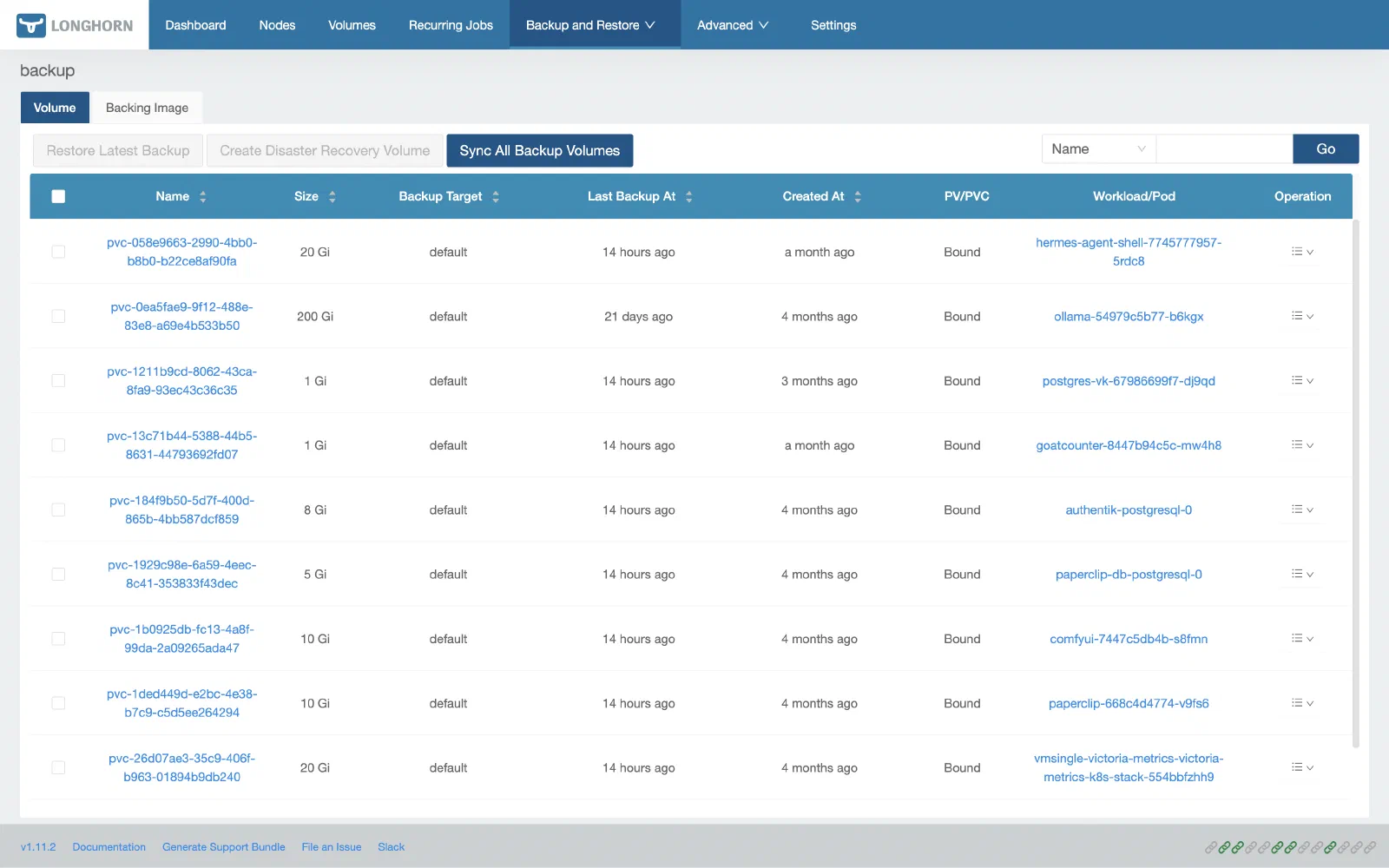
The case study is the live configuration: apps/longhorn/manifests/backup-target-default.yaml
points at s3://frank-longhorn-backups@auto/ with credentialSecret: longhorn-r2-secret. The @auto placeholder is what makes this work with
R2’s custom endpoint — the actual endpoint is supplied via the Secret’s
AWS_ENDPOINTS field. Two RecurringJobs target the default BackupTarget:
daily-nas at 02:00 UTC, retain 7 recovery points; weekly-r2 at 03:00
UTC on Sunday, retain 4. The names are documentation of intent, not
current routing — see Scar 3.
ServerSideApply=true rejects the
.sops field as schema-invalid. It is applied out-of-band with
sops --decrypt secrets/longhorn/r2-secret.yaml | kubectl apply -f -.
For DR this is load-bearing in a way that nothing else on Frank is: the
Secret that lets the backup tool read its own bucket is itself a thing
you must restore first. The disaster-recovery runbook has a “before you
do anything else” header that no other procedure on Frank has. We are
not Velero-restoring our way out of this; we are SOPS-decrypting our
way back in.AVAILABLE: false. The status condition: mount.nfs4: remote share not in 'host:dir' format. The mount command Longhorn’s engine generates is
mount -t nfs4 ... 192.168.50.42/volume1/frank-backup /var/... — a
forward slash where the NFS mount utility requires a colon. Filed as
Longhorn GitHub issue #11412 in August 2025; fix targeted for Longhorn
v1.13.0; no backport, no workaround. The NAS target is commented out in
the manifest, waiting. The local-first restore axis is a roadmap item,
not a current capability — and the manifest commentary that explains
why is itself part of the documentation of Frank.spec.backupTargetName to
route each to a different BackupTarget. ArgoCD rejected both with
.spec.backupTargetName: field not declared in schema. The Longhorn 1.11
RecurringJob CRD has no per-job target selection — all RecurringJobs use
the default BackupTarget, full stop. Filed as Longhorn GH #11392 in
July 2025; closed with no resolution and no timeline. The names
daily-nas and weekly-r2 are kept anyway, as documentation of intent
— when the NAS target re-enables and backupTargetName lands as a per-
job field, the routing snaps into shape with no manifest churn. The
names are the design; the schema is the gap.Visible evidence:
The three scars share a shape. None of them are bugs in Frank’s architecture. All of them are emergent properties of running a backup tool that does not yet ship the configuration matrix the design wants — multi-target RecurringJobs, a working NFS mount-string, a SOPS-aware ArgoCD plugin. The interfaces between the backup tool, the secret store, the GitOps reconciler, and the upstream CRD schema are where the failures live — exactly where the marketing material does not look.
A managed backup product like Kasten K10 would have hidden every one of these failure modes behind its abstraction, which is the right trade for a production team and the wrong trade for a learning platform. Frank exists to encounter the SOPS-out-of-band requirement, the mount-string bug, the schema gap so that the next operator on this stack does not have to.
§6 — When Frank’s answer doesn’t generalize
Frank’s answer — Longhorn-native backup to R2, no Velero, no application- aware control plane — is one leaf of a four-leaf tree. The other three are real.
    flowchart TD
    A["Can you reinstall from git?"] -- "Yes · dev / sandbox" --> L1["No backup — GitOps reapply"]
    A -- "No · production state matters" --> B["100% GitOps coverage of API objects?"]
    B -- "Yes · homelab / SRE-disciplined shop" --> L2["Longhorn-native + S3 (Frank's pick)"]
    B -- "No · need API-object capture + app-aware hooks" --> L3["Kasten K10 / TrilioVault"]
    B -- "Offline-resilient / paranoid" --> L4["restic to NAS + offsite encrypted copy"]
The first branch is whether the workload’s persistent state is the asset — for a dev/sandbox cluster reinstalled from git on demand, the right answer is no backup at all and an ArgoCD reapply procedure that runs in minutes. Spending operator time configuring Velero for a cluster you would rather rebuild is the wrong trade.
For workloads with asset-grade persistent state, the second branch is GitOps coverage of the API surface. ArgoCD or Flux with every Deployment, Service, ConfigMap, and CRD in git? Longhorn-native (or the equivalent CSI-snapshot-driven storage backup for other drivers) is enough — the K8s API-object backup that Velero or Kasten provides duplicates what the GitOps reconciler already does. Not on GitOps? You need a tool that captures the Kubernetes API surface as part of its primary work — Velero at the Open Source SoftwareSoftware whose source is public and freely modifiable. Worth flagging here because several projects ship an OSS build alongside a paid one, and the difference is often exactly the feature you wanted — LiteLLM's Prometheus metrics are Enterprise-only. end, Kasten or TrilioVault at the commercial-with-app-aware end.
The fourth leaf is the offline-resilient override — teams whose threat model includes “the primary backup tool’s own dependencies are compromised” (bucket wiped, Key Management ServiceA service that holds encryption keys and performs operations with them, so the key itself never reaches the application asking. lost, restore tool itself the attack vector). The right answer there is a parallel restic copy on a NAS plus an encrypted offsite snapshot — separate keys, separate credentials, separate restore procedure. Heavier than the other leaves; earns its weight in a narrow set of scenarios.
This is the section where the paper has to be honest about its audience. If you are reading this from a regulated production cluster, the right answer for you is almost never Frank’s answer. The right answer is one of the other three leaves. Frank’s answer is correct for Frank and is documented here so that anyone considering the same trade understands the rest of the leaves before picking it.
§7 — Roadmap & where this space is going
Three trends are worth naming. None are settled; all affect the next few years of backup & DR on Kubernetes.
CSI VolumeSnapshot is becoming the lingua franca. The CSI snapshot API graduated to GA in Kubernetes 1.20 and has settled as the cross- vendor primitive for point-in-time volume capture. Velero, Kasten, and TrilioVault all consume it; Longhorn produces it; every modern CSI driver implements it. The “which backup tool can talk to my storage?” question is narrowing as CSI conformance broadens. The vendors that don’t speak CSI VolumeSnapshot — restic-only file-system backup, rclone-and-cron — are the ones most likely to feel the squeeze.
Application-aware blueprints are converging on operators. Kasten’s Blueprint model and Velero’s BackupItemAction plugin model are both heading toward the same idea: ask the workload’s CRD operator to quiesce itself. Postgres, Mongo, and Cassandra operators increasingly ship “back-yourself-up” verbs that any backup tool can invoke. The split between “backup tool with application hooks” and “operator that knows how to back itself up” is shrinking — and the question of which operator owns the quiesce will determine whether your backup tool can deliver application-consistent restore at all.
GitOps is eating the K8s-API-object half of the problem. Teams with full ArgoCD or Flux coverage are increasingly skipping Velero’s K8s-API capture entirely, treating git as the source of truth and leaving only PVC data to the backup tool. The vendor pitch for “we back up your YAML” is weakening; the pitch for “we restore your data in a sequence your workloads can come up under, and we capture the secrets that aren’t in git” is strengthening. Frank is the early version of that posture.
The space is not done evolving. Frank will revisit this paper when the answers change.
References
- vendor-docs
Velero — How Velero Works
Each Velero operation – on-demand backup, scheduled backup, restore – is a custom resource, defined with a Kubernetes Custom Resource Definition (CRD) and stored in etcd.
Velero also includes controllers that process the custom resources to perform backups, restores, and all related operations.
Vendor's authoritative description of Velero's architecture as a controller-driven backup system that captures Kubernetes API objects via CRDs and stores them alongside volume snapshots. Grounds the §3 architecture diagram for Velero and the §5 'why Frank skips Velero' framing — every operation Velero captures is also captured by ArgoCD + git, leaving only PVC data to handle.
- vendor-docs
Longhorn — Concepts: Backups and Secondary Storage
A backup is a snapshot copy that is stored in a secondary storage (NFS or S3-compatible object store) outside of the Longhorn cluster. Backups are designed for the disaster recovery purpose.
Longhorn uses a unique mechanism to construct each backup at the block level. Each backup consists of a metadata file and the data blocks. If a data block is already saved in the secondary storage, this data block will not be transferred again.
Definitive statement that Longhorn's backup model is block-level, deduplicated against the BackupStore, and lives outside the Longhorn cluster on S3 or NFS. This is the architectural fork that distinguishes Longhorn-native from Velero+restic — the dedup is at the volume-block layer, owned by the storage driver, not bolted on by a separate backup controller. Underwrites the §2 capability matrix, the §3 Longhorn diagram, and the §5 'no extra control plane' claim.
- paper
Kubernetes blog — Kubernetes 1.20: Volume Snapshot Moves to GA
The Kubernetes Volume Snapshot feature is now GA in Kubernetes v1.20. It was introduced as alpha in Kubernetes v1.12, followed by a second alpha with breaking changes in Kubernetes v1.13, and promotion to beta in Kubernetes v1.17.
Volume snapshots provide Kubernetes users with a standardized way to copy a volume's contents at a particular point in time without creating an entirely new volume. This functionality enables, for example, database administrators to backup databases before performing edit or delete modifications.
Canonical announcement that the CSI VolumeSnapshot API graduated to GA — the cross-vendor primitive every modern backup tool now consumes. Anchors the §2 axis 'volume-only ↔ application-aware' and the §7 roadmap claim that CSI VolumeSnapshot is becoming the lingua franca and that the divide between storage-native backup (Longhorn) and storage-agnostic backup (Velero, Kasten) is narrowing.
- vendor-docs
restic — Design and References
restic uses content-defined chunking and deduplication. Each file is split into variable-sized chunks and the SHA-256 hash of each chunk is used to identify it; identical chunks are stored only once.
The repository's data is stored encrypted using AES-256 in counter mode. The encryption keys are derived from a user-provided password using scrypt.
Vendor description of restic's content-addressed, deduplicated, encrypted-at-rest data model — the design that Velero's File-System Backup mode inherits and that determines why §4 calls out deduplication ratios as a load-bearing scale axis. Underwrites the §3 restic diagram and the §6 'offline-resilient / paranoid' decision-tree leaf.
- postmortem
Frank — Longhorn backup gotchas (NFS mount-string bug, RecurringJob schema, SOPS-secrets-out-of-band)
SOPS-encrypted secrets must NOT be ArgoCD-managed; apply out-of-band from `secrets/`.
RWO PVC + RollingUpdate deadlocks; use `strategy: Recreate`.
ESO: empty `data: []` is rejected; delete the ExternalSecret if all keys are removed.
Frank's own running postmortem registry — concrete operational scars accumulated while running Longhorn-native backup to Cloudflare R2 in production for this learning platform. Provides source-of-truth dates and recovery commands for the §5 scar callouts on the SOPS-out-of-band requirement, the RWO restore-order constraint, and the dependency-ordering load-bearing for any DR runbook.
- postmortem
Longhorn issue #11412 — NFS BackupTarget generates host/path instead of host:/path
remote share not in 'host:dir' format
Fix targeted for Longhorn v1.13.0.
Upstream bug report and triage thread for the Longhorn 1.11 NFS mount-string defect that disabled Frank's local-first restore path. Provides the canonical incident reference for §5 Scar 2 and the §7 roadmap claim that the NAS-target axis is gated on Longhorn v1.13.0 shipping. Type: postmortem, since it documents a confirmed defect, its triage, and its fix-version commitment.
- postmortem
Longhorn issue #11392 — RecurringJob has no spec.backupTargetName field
.spec.backupTargetName: field not declared in schema
Upstream issue documenting the Longhorn 1.11 CRD schema gap that prevents per-RecurringJob target selection. All RecurringJobs in 1.11 target the `default` BackupTarget; there is no per-job routing. Anchors the §5 Scar 3 callout and the §7 roadmap note that Frank's manifests keep the original two-target names (`daily-nas` / `weekly-r2`) as documentation of intent.