

Identity for a Heterogeneous Stack
TL;DR
Ten web UIs, three CLIs, and a gRPC service all want to ask the same question: who’s on the other side of this URL? The identity-provider slot has seven serious vendors — Authentik, Keycloak, Authelia, Dex, Zitadel, Pomerium, Ory — split between forward-auth (cookie-validating proxies) and OpenID ConnectAn identity layer on top of OAuth 2.0: it adds a token saying *who* the user is, not merely what the client may do. Frank's single sign-on speaks it, with Authentik as the provider.-native flows, and between homelab weight and enterprise multi-tenancy.
Frank picked Authentik because it does both forward-auth (Longhorn,
Hubble, Zot, Homepage) and native OIDC (Grafana, ArgoCD, Gitea) in one
Helm release. The scars: blueprints can’t assign providers to the
embedded outpost (manual Django Object-Relational MappingA library presenting database rows as objects. Convenient until the generated query is the thing you need to reason about. forever); AUTHENTIK_HOST unset
returns 0.0.0.0 redirects; the 2026.x schema break required
invalidation_flow and Bearer tokens.
Authentik isn’t universal. A small AD-backed team should run Authelia; an enterprise with multi-realm federation should run Keycloak; a service mesh shop should let Pomerium swallow forward-auth entirely. See §6.
§1 — The capability
Before I can show a human anything beyond kubectl port-forward, I have
to answer a question that has nothing to do with workloads: who is on
the other end of this URL? Ten web UIs (Grafana, ArgoCD, Longhorn,
Hubble, Gitea, Zot, Homepage, Paperclip, n8n, Tekton Dashboard), three
CLIs that want OIDC, and a gRPC service that wants client certs — all
of it asking the same question.
The capability is “identity provider” — IdP — and it occupies a specific slot in the stack. Not inside the application. Not inside the ingress controller. Alongside the ingress, intercepting the request before it ever reaches the upstream:
    flowchart LR
    U["User"] --> I["Ingress<br/>(Traefik)"]
    I -->|forward-auth| O["Outpost<br/>(Authentik proxy)"]
    O --> IdP["IdP core<br/>(Authentik server)"]
    I -->|OIDC redirect| App["Native OIDC app<br/>(Grafana, ArgoCD)"]
    App --> IdP
    O --> App2["Opaque web UI<br/>(Longhorn, Hubble)"]
Two interaction patterns, one IdP. OIDC for applications that speak the protocol natively — Grafana, ArgoCD, Gitea — where the app handles the redirect dance itself and the IdP just signs tokens. Forward-auth for everything else — every Helm chart whose authors never wired up OpenID, every dashboard that ships with “admin / admin” or no auth at all. The ingress controller asks the outpost on every request: does this cookie belong to a logged-in human? The outpost answers yes or no; Traefik either forwards the request or redirects to login.
That is the whole capability. Everything else in this paper is about which vendor implements it, and what each one breaks when you push on it.
§2 — The landscape
The IdP space has three centres of gravity and a few outliers. The heavy-enterprise end runs Keycloak — Red Hat’s Cloud Native Computing FoundationThe foundation that hosts Kubernetes and most of the projects around it. "CNCF project" is a statement about governance, not quality or maturity.-incubating product, shipped into more Fortune-500 stacks than any other open-source IdP. The homelab end runs Authelia — small, file-configured, forward-auth- only, glued to Traefik or nginx. The middle is where Authentik lives: an opinionated IdP that does both forward-auth (via an embedded outpost) and OIDC, with a real admin UI and a blueprint system for declarative config. Dex and Zitadel sit slightly off the main axis. Pomerium sits in a different stack position entirely.
IdP landscape — forward-auth ↔ full IdP, homelab ↔ enterprise
quadrantChart

    title Self-hosted IdP landscape — 2026
    x-axis "Forward-auth only" --> "Full IdP"
    y-axis "Single-tenant homelab" --> "Multi-tenant SaaS-grade"
    quadrant-1 "Enterprise IdPs"
    quadrant-2 "Multi-tenant brokers"
    quadrant-3 "Lightweight portals"
    quadrant-4 "Identity-aware proxies"
    "Authelia": [0.10, 0.15]
    "Pomerium": [0.20, 0.55]
    "Authentik": [0.55, 0.45]
    "Dex": [0.65, 0.25]
    "Ory": [0.75, 0.65]
    "Keycloak": [0.85, 0.80]
    "Zitadel": [0.80, 0.90]
The X-axis is the protocol surface — does the vendor implement the forward-auth pattern (Traefik / nginx / Caddy asks “is this cookie valid?” on every request), or is it OIDC-only and assumes every upstream app speaks OpenID natively? Authelia and Pomerium are forward-auth-first; Keycloak, Dex, Zitadel, and Ory are OIDC-only and expect you to front opaque applications with a separate proxy (oauth2-proxy, Pomerium, or — in Authentik’s case — its own bundled outpost).
The Y-axis is the operational shape. Lightweight means “one file, one binary, one Postgres” — Authelia ships this. Multi-tenant means “tenant isolation is a primitive, not a deployment pattern” — Zitadel and Keycloak both. Authentik straddles the middle: a real database, real High AvailabilityRunning enough redundant instances that losing one does not take the service down. Frank's three control-plane nodes are its HA tier., but the multi-tenancy story is “deploy another instance” rather than “create another realm.”
| Feature | Authentik | Keycloak | Dex | Zitadel | Authelia | Ory | Pomerium |
|---|---|---|---|---|---|---|---|
| Forward-auth (opaque apps) | ✅ | ❌ | ❌ | ❌ | ✅ | ❌ | ✅ |
| OIDC provider | ✅ | ✅ | ✅ | ✅ | 🟡 | ✅ | 🟡 |
| SAML | ✅ | ✅ | ❌ | ✅ | ❌ | ❌ | 🟡 |
| Federates upstream IdPs | ✅ | ✅ | ✅ | ✅ | 🟡 | ✅ | ✅ |
| Multi-tenancy | 🟡 | ✅ | ❌ | ✅ | ❌ | ✅ | 🟡 |
| Declarative config (no UI required) | 🟡 | 🟡 | ✅ | ✅ | ✅ | ✅ | ✅ |
The capability matrix is the dossier-row view of the same plot. The takeaway is in the partials: no single vendor is “✅ everywhere.” Authentik gets forward-auth and full IdP but pays for it with manual outpost-provider assignment (§5). Keycloak gets enterprise federation but doesn’t do forward-auth natively. Dex is the cleanest declarative config and the smallest binary — but only because it deliberately refuses to do most of the things an IdP normally does. There is no free lunch.
Virtually every company today uses firewalls to enforce perimeter security. However, this security model is problematic because, when that perimeter is breached, an attacker has relatively easy access to a company’s privileged intranet… The BeyondCorp initiative is moving to a new model that dispenses with a privileged corporate network. Instead, access depends solely on device and user credentials, regardless of a user’s network location.BeyondCorp: A New Approach to Enterprise Security (Ward & Beyer, 2014)
Every IdP-with-outpost in this paper is an implementation of that 2014 paper. Authentik’s embedded outpost, Pomerium-as-product, Cloudflare Access — they all implement the same primitive: an identity-aware reverse proxy that authorises every request, not just the first one. Eleven years later, the pattern has won. The question is no longer whether to put an IdP between user and app — it is which one, and how much operational surface it leaves you to maintain.
§3 — How each option handles the hard part
The hard part is the seam between IdP, ingress, and upstream application. Forward-auth and OIDC are protocols on paper; on a running cluster, they’re a series of moving parts that need to agree on cookies, redirects, session storage, and what to do when one of them restarts mid-flow. This section walks the architecture of each serious contender.
Authentik — IdP + embedded outpost
    flowchart TD
    U["User"] --> P["Outpost<br/>(per-service ProxyProvider)"]
    P -->|cookie absent| L["Login flow"]
    L --> A["Authentik core"]
    A --> S["Session DB<br/>(Postgres)"]
    P -->|cookie present| V["Validate session"]
    V --> S
    V -->|allow| App["Protected app"]
Authentik’s distinguishing feature is the embedded outpost — a
small Go binary that runs inside the same Helm release as the IdP and
acts as the forward-auth target. Traefik’s ForwardAuth middleware
points at the outpost’s /outpost.goauthentik.io/auth/traefik
endpoint; the outpost reads the cookie, validates it against the
Authentik server, and returns 200 (allow) or 302 (redirect to login).
Forward auth uses your reverse proxy (like NGINX, Traefik, or Caddy) to forward authentication requests to authentik before serving the application. Single application mode allows you to protect a single application with a single proxy provider. Domain level mode allows you to protect multiple applications under the same domain with a single proxy provider.Authentik docs — Forward auth (Proxy provider)
Onboarding a new protected service is a four-step move: create a
ProxyProvider blueprint, create an Application that references it,
add an IngressRoute with the authentik-forwardauth middleware,
and — the part nobody warns you about — manually assign the new
provider to the embedded outpost via Django ORM (see §5). Sessions
live in Postgres, so multi-replica HA is trivial; the outpost is
horizontally scalable; OIDC sessions for native apps share the same
Postgres rows.
Keycloak — heavy IdP, no native forward-auth
    flowchart TD
    U["User"] --> X["oauth2-proxy<br/>or Pomerium<br/>(external forward-auth)"]
    X --> KC["Keycloak<br/>(OIDC provider)"]
    KC --> KS["Session store<br/>(Infinispan)"]
    X -->|allow| App["Protected app"]
    UApp["Native OIDC app"] --> KC
Keycloak does not do forward-auth. It does everything else — OIDC, Security Assertion Markup LanguageThe XML-based single sign-on standard that predates OIDC. Still what many enterprise applications support, and only that., System for Cross-domain Identity ManagementThe protocol for provisioning and deprovisioning accounts between systems — the half of identity that OIDC does not cover., identity brokering, multi-realm federation, fine-grained authorisation policies. To protect an opaque web UI, you front Keycloak with oauth2-proxy (or Pomerium) and configure that proxy as the Traefik ForwardAuth target. The proxy speaks OIDC to Keycloak; Traefik speaks forward-auth to the proxy.
Keycloak is an open source software product to allow single sign-on with identity and access management aimed at modern applications and services… An Identity Broker is an intermediary service that connects multiple service providers with different identity providers. As an intermediary service, the identity broker is responsible for creating a trust relationship with an external identity provider in order to use its identities to access internal services exposed by service providers.Keycloak docs — Server Administration Guide
Keycloak’s centre of gravity is brokering — connecting one set of applications to one or more upstream IdPs (corporate AD, social login, another Keycloak realm). The cost is operational weight: a Java Virtual MachineThe runtime Java and Scala compile to. Relevant mostly for its memory behaviour: heap limits and container limits are set separately, and disagreeing is how pods get OOM-killed., an Infinispan cache, a much larger admin UI, and an upgrade story that historically requires migration scripts between major versions. For a single-tenant homelab, this is wildly more IdP than you need. For a multi-tenant business with regulatory federation requirements, it is exactly the right amount.
Dex — federation broker, no users of its own
    flowchart TD
    U["User"] --> App["OIDC client app<br/>(ArgoCD, Vault)"]
    App --> D["Dex"]
    D -->|connector| Upstream["Upstream IdP<br/>(GitHub, LDAP, OIDC)"]
    Upstream --> D
    D --> App
Dex deliberately refuses to store users. Its job is to translate between protocols: speak OIDC to your application, speak Lightweight Directory Access ProtocolThe long-established protocol for querying a directory of users and groups. Still the fallback when an application predates OIDC. or SAML or GitHub-OAuth to the real IdP behind it.
Dex is an identity service that uses OpenID Connect to drive authentication for other apps. Dex acts as a portal to other identity providers through ‘connectors.’ This lets dex defer authentication to LDAP servers, SAML providers, or established identity providers like GitHub, Google, and Active Directory.Dex docs — A federated OpenID Connect provider
This is why every ArgoCD installation ships Dex bundled — ArgoCD needs OIDC to delegate to something, but it doesn’t want to own user management. Dex is the thinnest possible adapter. The trade-off is severe: no password reset flow, no Multi-Factor AuthenticationRequiring more than a password — a second factor from a device you hold. What a compromised password alone should not be enough to defeat. enrolment UI, no admin console. Projects that adopt Dex inevitably grow a “real” IdP behind it the moment they want password policies or per-user MFA — at which point Dex becomes vestigial protocol-translation glue, and you’ve deployed two IdPs to do what Authentik or Keycloak do as one.
Zitadel — cloud-native, multi-tenant from day zero
    flowchart TD
    U["User"] --> Z["Zitadel API<br/>(gRPC + HTTP)"]
    Z --> ZS["Event store<br/>(Postgres / Cockroach)"]
    Z --> App["Native OIDC app"]
    Z --> SAML["SAML 2.0 client"]
Zitadel is the youngest of the open-source IdPs and the only one
designed around a gRPC-first API and event sourcing. Every resource —
user, organisation, project, role — is stored as an immutable event
stream, with the queryable state materialised on top. Multi-tenancy
isn’t a deployment shape; it’s a primitive (Organization) that
nests inside the data model.
Forward-auth is not a first-class pattern — you front Zitadel with oauth2-proxy, same as Keycloak. But where Keycloak’s multi-tenancy is “deploy multiple realms,” Zitadel’s is “one instance, many organisations, isolated by API token scope.” For a SaaS vendor building a multi-tenant product, that is a material architectural advantage. For a single-operator homelab, it’s an irrelevant abstraction tax.
Authelia — forward-auth only, file-configured
    flowchart TD
    U["User"] --> Auth["Authelia"]
    Auth -->|YAML / LDAP| Users["users.yml<br/>or LDAP"]
    Auth -->|session| Redis["Redis<br/>(session store)"]
    Auth -->|allow| App["Protected app"]
Authelia is the antithesis of Keycloak. One Go binary, one YAML config, optional LDAP backend, Redis for distributed sessions, and exactly the forward-auth pattern — nothing else.
Authelia is an open-source authentication and authorization server providing two-factor authentication and single sign-on (Single Sign-OnOne login across many applications. On Frank, Authentik holds the session and Traefik asks it before forwarding a request.) for your applications via a web portal. It acts as a companion of reverse proxies like nginx, Traefik or HAProxy to let them know whether requests should either be allowed or redirected to Authelia’s portal for authentication.TechnoTim — Authelia + Traefik forward-auth
It is the canonical “homelab IdP” — search YouTube for “Traefik SSO” and Authelia is most of the top results. The OIDC provider mode landed recently but is still labelled experimental; for native-OIDC apps you’ll find yourself wishing for Authentik. If the entire job is “put login pages in front of half a dozen opaque web UIs,” Authelia is the right answer and the others are over-engineered.
Pomerium and Ory (briefly)
Pomerium is the closest thing in this list to a Cloudflare Access clone. It is not an IdP — it federates upstream IdPs (Authentik, Keycloak, Google) — but it merges the forward-auth proxy and the authorisation-policy engine into a single binary, with first-class mTLS and service-to-service auth. If you’re already running a service mesh, Pomerium replaces “outpost in front of every service” with “one identity-aware proxy in front of everything.”
Ory (Hydra + Kratos + Keto) is the library-shaped option: composable identity primitives that you assemble yourself. Hydra is the OIDC server; Kratos is user management; Keto is authorisation; Oathkeeper is the policy proxy. The result is the most flexible IdP in this list and the slowest to stand up — every cluster running Ory has built its own integration layer. Self-hosted SaaS vendors run Ory; homelabs almost never do.
§4 — What scale changes
The architectures in §3 all work at homelab scale. The seams they have in common — forward-auth fan-out, session storage, token rotation — change shape under load.
Forward-auth fan-out cost. Every request to a protected application produces a forward-auth call. At Frank’s scale that’s under-10 req/s aggregate across twelve protected web UIs; the outpost load is a rounding error. At enterprise scale — say, 100 req/s per service across 50 services — that’s 5000 forward-auth calls per second, every one of which terminates against the IdP’s session store. The BeyondCorp paper’s original deployment notes describe this fan-out as the dominant cost at Google scale; the standard mitigations (per-edge session caches, longer-lived cookies, JSON Web TokenA signed, self-describing token carrying claims — who you are, what you may do, when it expires. Readable by anyone holding it, so the expiry and signature are the only things protecting it.-as- session) all trade security properties for latency. There is no forward-auth deployment at scale that doesn’t have an opinion about this trade.
Session store as a single point of failure. Authentik and Keycloak put sessions in Postgres. Authelia puts them in Redis. Zitadel puts them in its event store. When that store hiccups, the IdP hiccups; when the IdP hiccups, every protected service starts returning 502 on forward-auth. Frank’s Authentik runs against a single-replica Postgres on Longhorn (ReadWriteOnceA PVC access mode that lets exactly one node mount the volume read-write at a time. It is the reason a RollingUpdate deadlocks: the replacement pod cannot mount the volume until the outgoing pod releases it. PersistentVolumeClaimA Kubernetes request for durable storage. The pod names a claim and the storage layer — Longhorn on Frank — binds real disk behind it, so the data outlives the pod.). It is not HA. A managed cluster would use a managed Postgres with read replicas; a production homelab would replicate Authentik’s Postgres separately. Frank’s design accepts the single point of failure as part of the cost; that decision is reviewable, but it should be a decision.
Token rotation cost. OIDC access tokens are short-lived by convention — 5–15 minutes is typical. Every long-lived browser session refreshes that token on schedule, which means every restart of the IdP triggers a refresh storm seconds after pods come ready. Authentik tolerates this fine at homelab scale; at enterprise scale, the published guidance is to stagger restarts, warm the session cache before traffic switch, and pre-allocate Postgres connections. The Authentik release notes capture this in the recurring “expect a brief auth blip during upgrade” advisory.
These three forces are the reason scaled-out IdPs converge on patterns the homelab versions don’t need: regional session caches, JWT-as-session with short lifetimes, IdP fronting by a CDN that caches the OIDC discovery document. Frank has none of those. Frank also has 12 protected services, not 5000. Scale changes the shape; the small-scale shape is the right one to start from.
§5 — Frank’s choice, and what happened
I picked Authentik. The reason was unsexy: I wanted one IdP that did both forward-auth (for Longhorn, Hubble, Homepage, Zot — every chart that ships without OIDC) and native OIDC (for Grafana, ArgoCD, Gitea, Paperclip — every chart that speaks the protocol). Keycloak plus oauth2-proxy would have worked, but it’s two moving parts where Authentik is one. Authelia would have worked for the forward-auth half but not the OIDC half. Dex would have done OIDC but nothing for the opaque apps.
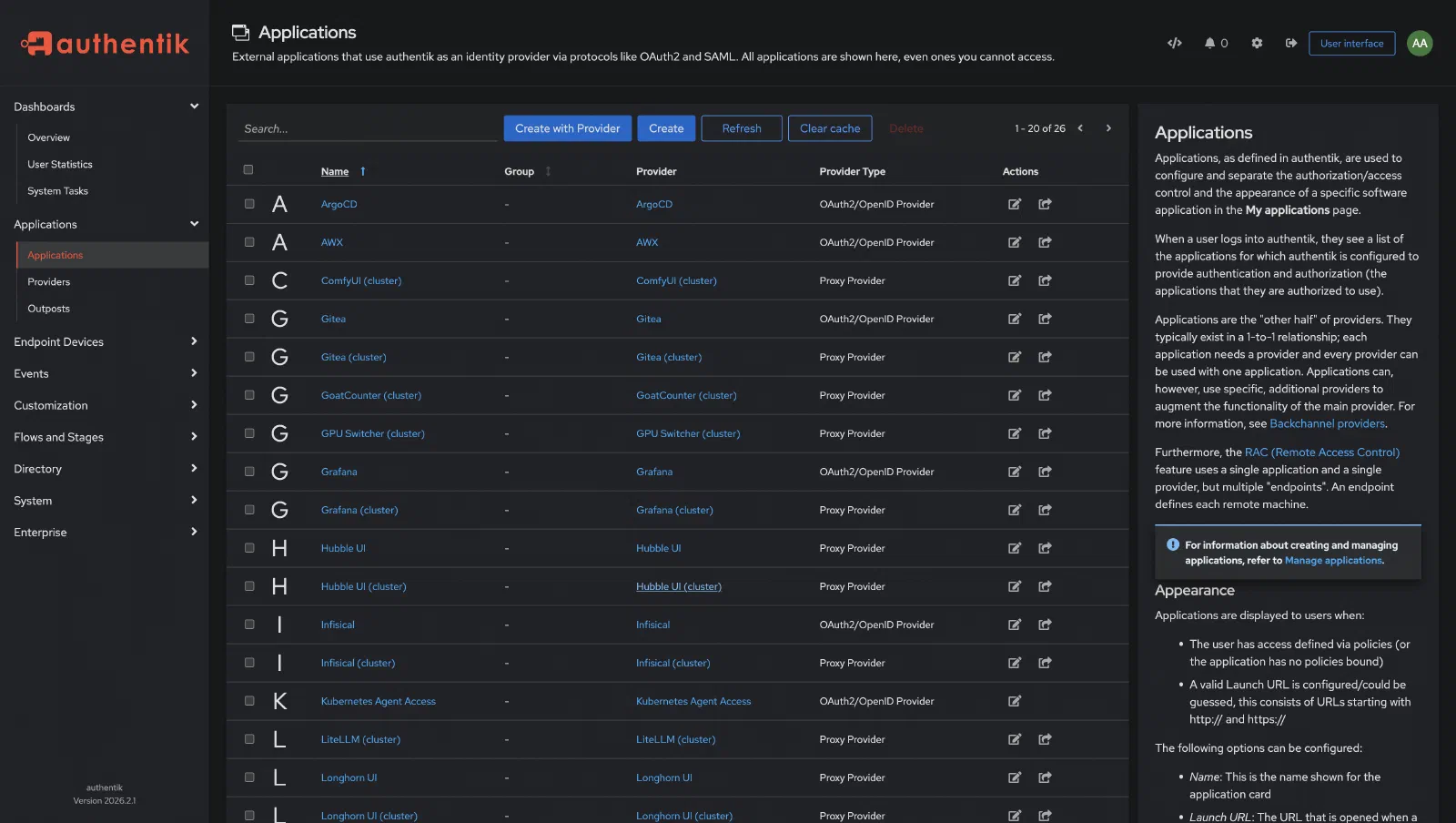
The cost has been scar tissue. Three pieces of it are worth naming in detail, because each is the kind of operational tax that doesn’t appear in any “compare the IdPs” blog post but shows up the second you actually try to run one.
Authentik blueprints can declare a ProxyProvider, but they cannot
assign that provider to the embedded outpost. Every new forward-auth-
protected service requires a kubectl exec running Django ORM
against the Authentik server:
outpost = Outpost.objects.get(name='authentik Embedded Outpost')
provider = ProxyProvider.objects.get(name='<provider>')
outpost.providers.add(provider)
This is a permanent operational tax on a cluster whose stated
principle is “declarative everything.” The blueprint system can
create the resource but cannot manage the relationship between
existing outposts and the new provider without replacing the entire
provider list — and replacing the list would unassign every other
service. Authentik’s own docs acknowledge this is a limitation. The
fix in agents/rules/frank-argocd.md is a documented # manual- operation block. Declarative-everything has an escape hatch shaped
exactly like this.
A new IngressRoute pointed at the embedded outpost and returned 502
on every redirect. The outpost was advertising 0.0.0.0:9000 as
its own URL, because AUTHENTIK_HOST was unset. The Authentik
release notes had introduced this requirement quietly:
“Outposts will use the URL set in the authentik configuration to
access authentik.” The fix is one line in
apps/authentik/values.yaml:
global:
  env:
    - name: AUTHENTIK_HOST
      value: "https://authentik.cluster.derio.net"
global.env applies to both server and worker pods — the Helm
chart’s structure documents the requirement, but nothing flags it
as a contract. The first new forward-auth service after a chart
upgrade is the canary; if you haven’t set AUTHENTIK_HOST, you
find out the hard way.
The 2026.x release ran every existing ProxyProvider blueprint
through a stricter validator and failed all of them. The new schema
required invalidation_flow (the post-logout redirect flow),
signing_key as a Universally Unique IdentifierA 128-bit identifier chosen so collisions are not worth planning for. Note that Tekton's $(uid) is documented only as random — fine as a suffix, wrong as an identity two concurrent runs could collide on. reference rather than a name, and
redirect_uris as an object shape rather than the scalar that used
to be allowed. The API simultaneously moved from basic auth to
Bearer tokens, breaking every automation script we’d written
against the previous major.
Schema-breaking releases are the dossier-tracked failure mode for every self-hosted IdP — Keycloak’s 18→19 migration broke realm-export format, Zitadel rolls major schemas every six months, Authelia changed its YAML format in 4.x. You cannot pin to a major version forever because security patches stop; you cannot upgrade without a controlled migration. The IdP is the layer where “set it and forget it” is most attractive and most wrong.
This is the trade. Authentik is the right answer for Frank’s shape — heterogeneous apps, mix of OIDC and forward-auth, single operator, declarative-first — and it costs me a documented manual escape hatch, a chart-structure-as-contract requirement, and a known-recurring schema-migration burden every few months. The other seven vendors in §2 would cost different things; none of them would cost nothing.
§6 — When Frank’s answer doesn’t generalise
Authentik is the wrong answer for at least four shapes. The decision tree is short on purpose.
    flowchart TD
    Q["What's your auth shape?"]
    Q --> Q1["Small team,<br/>forward-auth only,<br/>maybe AD/LDAP behind it"]
    Q --> Q2["Heterogeneous stack,<br/>mix of OIDC<br/>and opaque apps"]
    Q --> Q3["Enterprise federation,<br/>multiple realms,<br/>compliance audit"]
    Q --> Q4["Service mesh in place,<br/>zero-trust at the proxy layer"]
    Q1 --> A1["Authelia"]
    Q2 --> A2["Authentik<br/>(Frank's pick)"]
    Q3 --> A3["Keycloak"]
    Q4 --> A4["Pomerium"]
Authelia wins when the whole job is “put a login page in front of half a dozen opaque web UIs.” It is one binary, one YAML file, and the easiest possible thing to operate at homelab scale. Its OIDC provider mode is still maturing — if every app you protect already speaks OIDC, Authelia is leaving capability on the table.
Authentik wins when the apps are mixed — some speak OIDC, some don’t — and you want one system that handles both without bolting oauth2-proxy in front of half of them. The price is the §5 scars.
Keycloak wins at enterprise scale: multi-realm federation, SAML parity with OIDC, fine-grained authorisation policies, SCIM provisioning, and a battle-tested upgrade history. If you have multiple business units federating different upstream IdPs against overlapping audit boundaries, Keycloak’s complexity stops being overkill and starts being the feature set you actually need.
Pomerium wins when you’ve already invested in a service mesh and want the IdP to live inside the proxy layer. It is not an IdP — you still need Authentik or Keycloak or Google behind it — but it collapses “forward-auth outpost + authorisation policy engine + mTLS” into one binary. For a multi-service homelab without a mesh, that’s extra surface; for an org running Istio or Linkerd, it’s the natural slot.
§7 — Roadmap & where this space is going
Three trends are reshaping the IdP landscape in 2026, and all three make the §3 architectures look slightly out of date already.
Passkeys and WebAuthn-first identity. Password forms are dying. Apple, Google, and Microsoft have all shipped passkey support in their consumer authenticators; Fast Identity Online 2The standard behind hardware security keys and passkeys — the phishing-resistant end of the authentication spectrum. hardware keys are a $25 commodity. The next generation of IdPs assumes hardware-backed credentials by default — Authentik 2026.x added passkey enrolment to its default user flow; Zitadel’s documentation now leads with passkeys rather than passwords. The blog posts about “how to set up Time-based One-Time PasswordThe rotating six-digit code from an authenticator app. A second factor, and a phishable one — unlike FIDO2. MFA” already feel dated. By the time Paper 11 gets a v2, the expected flow will be “log in with your fingerprint, never type a password” — and IdPs that don’t make that flow first-class will be the ones with friction.
The slow death of SAML. OIDC has won the protocol war. SAML survives in enterprise integrations because regulatory frameworks were written when SAML was the only option; net-new applications ship OIDC and bolt on SAML only when a customer asks for it. The capability matrix in §2 lists SAML as “yes” for most vendors, but the centre of gravity has shifted — Authentik’s SAML support is fine and slightly second-class; Zitadel’s is documented but not showcased. The next decade’s IdP comparisons will list SAML the way this paper lists LDAP: a compatibility checkbox, not a primary protocol.
Identity-aware proxies eating the forward-auth pattern. Pomerium, Cloudflare Access, Google IAP, and Tailscale Access Control ListAn ordered list of allow/deny rules attached to a resource. In Headscale it decides which mesh node may reach which service, independent of network routing.-as-identity are all converging on the same shape: an identity-aware proxy that combines SSO, mTLS, and authorisation policy in front of every service, with the IdP as a pluggable upstream. The “outpost in front of every service” pattern Authentik uses today is a specific implementation of this idea; the broader trend is to make that proxy the universal layer and shrink the IdP to “the thing that mints tokens.” Frank’s auth layer will get re-evaluated against this shape at some point — probably when the manual outpost-provider assignment from §5 becomes too expensive to keep doing by hand.
The IdP is the layer where the security story, the operations story, and the protocol story all converge — and where every choice is a hostage to a release-notes file you didn’t write. Paper 11 will be re-checked against the landscape in two years. The vendors will have shifted; the capability matrix will look different; the scars will be new ones. The pattern will not have changed.
References
- paper
BeyondCorp: A New Approach to Enterprise Security (Ward & Beyer, 2014)
Virtually every company today uses firewalls to enforce perimeter security. However, this security model is problematic because, when that perimeter is breached, an attacker has relatively easy access to a company's privileged intranet.
The BeyondCorp initiative is moving to a new model that dispenses with a privileged corporate network. Instead, access depends solely on device and user credentials, regardless of a user's network location.
The IAP / zero-trust origin paper. Establishes the model that every forward-auth IdP — Authentik's embedded outpost, Pomerium, Cloudflare Access — implements 11 years later. Anchors §1's framing of where an IdP sits in a modern stack.
- vendor-docs
Authentik docs — Forward auth (Proxy provider)
Forward auth uses your reverse proxy (like NGINX, Traefik, or Caddy) to forward authentication requests to authentik before serving the application.
Single application mode allows you to protect a single application with a single proxy provider. Domain level mode allows you to protect multiple applications under the same domain with a single proxy provider.
Vendor's own description of the forward-auth pattern that Frank uses for every protected web UI. Defines the seam between the IdP, the ingress controller (Traefik) and the upstream application, which §3 needs to render as a flowchart.
- vendor-docs
Keycloak docs — Identity Brokering
Keycloak is an open source software product to allow single sign-on with identity and access management aimed at modern applications and services.
An Identity Broker is an intermediary service that connects multiple service providers with different identity providers. As an intermediary service, the identity broker is responsible for creating a trust relationship with an external identity provider in order to use its identities to access internal services exposed by service providers.
Defines how a heavy-enterprise IdP positions itself against the smaller open-source IdPs. Supplies the §2 vendor-landscape claim that Keycloak's centre of gravity is brokering / federation, not embedded forward-auth.
- vendor-docs
Dex docs — A federated OpenID Connect provider
Dex is an identity service that uses OpenID Connect to drive authentication for other apps. Dex acts as a portal to other identity providers through 'connectors.'
This lets dex defer authentication to LDAP servers, SAML providers, or established identity providers like GitHub, Google, and Active Directory.
Defines the 'federation-only' position in the §2 landscape — Dex deliberately does not store users, only proxies authentication. Explains why projects that adopted Dex (ArgoCD's bundled provider) end up adding a 'real' IdP behind it as soon as they want password policies, MFA enrolment, or admin UI.
- talk
TechnoTim — 2 Factor Auth and Single Sign on with Authelia (Traefik forward-auth)
Authelia is an open-source authentication and authorization server providing two-factor authentication and single sign-on (SSO) for your applications via a web portal.
It acts as a companion of reverse proxies like nginx, Traefik or HAProxy to let them know whether requests should either be allowed or redirected to Authelia's portal for authentication.
Highest-visibility homelab/SMB-scale write-up of the forward-auth pattern. Anchors the §2 claim that the open-source homelab world has converged on a small set of forward-auth IdPs glued to one of three reverse proxies.
- postmortem
Authentik — release notes and breaking-change archive
Starting with this release, Outposts will use the URL set in the authentik configuration to access authentik.
OAuth2/OIDC and Proxy Providers now require an Invalidation flow to be set. This flow is used to log the user out of the application.
Source for the schema-migration scar tissue Paper 11 documents — `invalidation_flow`, object-shaped `redirect_uris`, the `AUTHENTIK_HOST` requirement on the embedded outpost. Concrete evidence that 'pin the chart and forget' is not a viable strategy for any self-hosted IdP.