
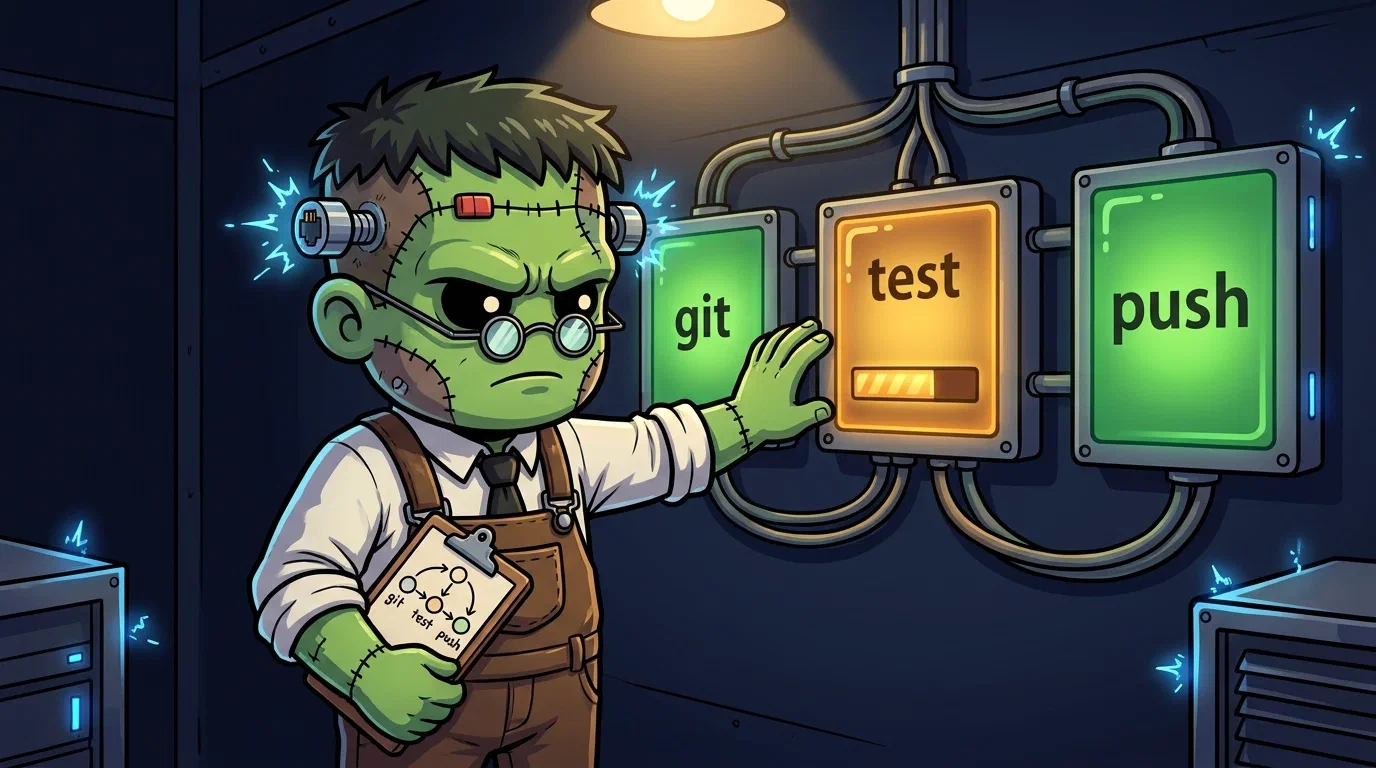
Self-Hosted CI/CD on a Homelab
TL;DR
Self-hosted CI/CD on a homelab is a choice between one tool or three. The six contenders in 2026 (Gitea+Tekton+Zot, GitLab Community EditionThe free build of a product that also ships a paid one. Worth knowing which you are running: n8n CE has no SSO, and LiteLLM's CE image emits none of the Prometheus metrics its dashboards assume., Forgejo+Woodpecker, Drone CI, Jenkins, and the SaaS baseline GitHub Actions) split on integration shape (all-in-one vs three composable services) and Kubernetes-nativity (pods-as-build-steps vs agents-as-VMs); the cost curve is so lopsided that GitHub Actions is the rational answer until it isn’t.
Frank runs Gitea + Tekton + Zot. Three tools, three Load BalancerWhatever spreads traffic across backends and gives them one address. On Frank that is Cilium answering for an address on the LAN, not a cloud appliance. IPs (.209, .223,
.210), pipelines as CustomResourceDefinitionThe object that teaches the Kubernetes API a new resource type. Install a CRD and the API server starts serving a kind it has never heard of, with validation and RBAC like any built-in., registry on a Longhorn PersistentVolumeClaimA Kubernetes request for durable storage. The pod names a claim and the storage layer — Longhorn on Frank — binds real disk behind it, so the data outlives the pod.. The scars came in
the seams: a Tekton v1 Task whose spec.resources was silently eaten
because the field is computeResources, an EventListener that dropped
every Gitea webhook because the github interceptor filters
X-GitHub-Event and Gitea sends X-Gitea-Event, a Zot chart pinned
at v0.1.0 that turned out to lack Transport Layer SecurityThe encryption under HTTPS and most other secure protocols. What a certificate is for, and what fails visibly when the certificate does not match the hostname., auth, and persistence until
v0.1.60+.
Frank’s answer does not generalize. Solo Open Source SoftwareSoftware whose source is public and freely modifiable. Worth flagging here because several projects ship an OSS build alongside a paid one, and the difference is often exactly the feature you wanted — LiteLLM's Prometheus metrics are Enterprise-only. dev → GitHub Actions. Tiny homelab wanting minimal ceremony → Forgejo + Woodpecker. Multi- team enterprise → GitLab CE.
§1 — The capability
A commit lands in the default branch. The unit tests pass on the contributor’s laptop. Somewhere between the new code being merged and an immutable image being available to the deployer, something has to run the build, run the tests, run the linter, build the container, sign it, and push it to a registry where ArgoCD (or whatever else watches images) can find it. That something is the CI/CD platform.
That is the capability under examination. Not “deployment in the abstract” — Paper 14 already covered progressive delivery, and the GitOps loop is its own paper. The capability is what happens between the git push and the registry push: who runs the builds, who stores the images, and what tax do they charge for running them yourself rather than handing the job to a SaaS vendor?
    flowchart LR
    DEV["Developer commit"] --> GH["Git host (Gitea / GitLab / Forgejo)"]
    GH --> CI["Pipeline engine (Tekton / Woodpecker / Drone / Jenkins)"]
    CI --> REG["OCI registry (Zot / GitLab / Harbor / GHCR)"]
    REG --> CD["GitOps (ArgoCD)"]
Three things move between commit and registry: a webhook (the git host tells the pipeline engine), a build (the pipeline engine spawns runners), and an image push (the runners write to the registry). Each of the three movements is a seam, and seams are where self-hosted CI/CD stacks fail. The vendor landscape splits on whether those three movements live inside one tool, two tools, or three.
I run Gitea + Tekton + Zot. That choice was not made because three tools are intrinsically better than one; it was made because every layer of the three-tool stack is a Kubernetes manifest in Git, which makes the pipeline itself a thing the GitOps loop reconciles, not a thing the GitOps loop deploys onto. The point of this paper is to make the trade legible, and then return to Frank’s choice and the operational scars that proved it correct only on Frank’s terms.
§2 — The landscape
Six options dominate self-hosted CI/CD in 2026, and they split on two axes. The horizontal axis is integration shape — three composable tools on the left (git host, pipeline engine, registry, each chosen independently) or one all-in-one platform on the right (GitLab CE bundles all three; GitHub Actions bundles all three plus the SaaS hosting). The vertical axis is Kubernetes-nativity — agent-based runners on the bottom (Jenkins agents, Drone agents, Woodpecker agents) or pods-as-build-steps on the top (Tekton’s whole identity is making every Step a container that runs in its own pod).
quadrantChart

        title Self-hosted CI/CD — 2026
        x-axis "Three composable tools" --> "All-in-one platform"
        y-axis "Agent-based runners" --> "Kubernetes-native pods-as-steps"
        quadrant-1 "All-in-one · K8s-native"
        quadrant-2 "Three-tool · K8s-native"
        quadrant-3 "Three-tool · Agent-based"
        quadrant-4 "All-in-one · Agent-based"
        "Gitea + Tekton + Zot": [0.15, 0.90]
        "GitLab CE": [0.90, 0.40]
        "Forgejo + Woodpecker": [0.25, 0.55]
        "Drone CI": [0.30, 0.55]
        "Jenkins": [0.20, 0.20]
        "GitHub Actions": [0.85, 0.30]
| Feature | Gitea + Tekton + Zot | GitLab CE | Forgejo + Woodpecker | Drone CI | Jenkins | GitHub Actions |
|---|---|---|---|---|---|---|
| All-in-one (one tool, not three) | ❌ | ✅ | ❌ | ❌ | ❌ | ✅ |
| Kubernetes-native pipeline engine | ✅ | 🟡 | 🟡 | 🟡 | 🟡 | ❌ |
| Declarative YAML pipelines | ✅ | ✅ | ✅ | ✅ | 🟡 | ✅ |
| Native webhook triggers | ✅ | ✅ | ✅ | ✅ | 🟡 | ✅ |
| Bundled OCI registry | ✅ | ✅ | ❌ | ❌ | ❌ | ✅ |
| OSS / no contract required | ✅ | ✅ | ✅ | ✅ | ✅ | 🟡 |
| Low operations overhead | ❌ | ❌ | ✅ | ✅ | ❌ | ✅ |
| No infrastructure cost (SaaS only) | ❌ | ❌ | ❌ | ❌ | ❌ | ✅ |
The matrix grades the options on integration, K8s-nativity, declarative YAML pipelines, native webhook triggers, bundled Open Container InitiativeThe body behind the standard image and runtime formats. "OCI registry" means any registry speaking that standard, not a specific vendor's. registry, OSS licensing, operational overhead, and zero-cost SaaS. The mesh-required-equivalent column for CI/CD is operational overhead — the row that does the most work and that vendor docs mention only after you have installed the binary.
Gitea + Tekton + Zot optimises for manifests-as-code at every layer. Gitea is a Go binary that runs in a Pod; Tekton Pipelines and Tasks are CRDs; Zot is an OCI-native registry that runs in a Pod behind a LoadBalancer. The trade is operational complexity: three tools, three sets of webhooks, three release cadences, three failure modes. For most homelab and small-team contexts where the value is GitOps-managed pipelines, that is the right shape. For a developer who just wants a build to run, it is overkill.
Tekton Pipelines are a Kubernetes-native, lightweight, and easy-to-use framework that allow you to build CI/CD systems. A Task defines a series of ordered Steps that you want to execute. Each Step runs in its own container image.Tekton — Concepts
GitLab CE is the inverse trade. One Rails monolith plus runners provides git host, CI/CD, container registry, package registry, and issue tracker. Webhooks are internal; the seams disappear because there are no seams. The benefit is real ergonomic integration. The cost is that GitLab is one of the heaviest self-hosted services in common use — multi-GB RAM baseline, Postgres + Redis + Sidekiq + GitLab Runner, and an upgrade story that is rightly feared. For a team that values Role-Based Access ControlKubernetes' permission model: roles list verbs on resources, bindings attach them to identities. Default-deny, so an omitted rule reads exactly like a broken component., audit, and a single pane of glass, GitLab CE is the answer.
Forgejo + Woodpecker is the homelab pattern — two community- governed forks (Gitea → Forgejo, Drone → Woodpecker) chosen for minimal ceremony. Forgejo is a single Go binary; Woodpecker is a server + agent pair with a small footprint. No bundled registry; pair with whatever (often Docker Hub or GitHub Container RegistryGitHub's OCI registry at `ghcr.io`. Where Frank's CI-built images are published before ArgoCD rolls them out.). The one-tool-each shape is the most popular small-scale self-host combo on r/selfhosted, and deservedly so — at homelab scale it just works.
Drone CI is now under Cloud Native Computing FoundationThe foundation that hosts Kubernetes and most of the projects around it. "CNCF project" is a statement about governance, not quality or maturity. stewardship; the architecture is unchanged. Every pipeline step is a container, the YAML format is minimal, the server + agent model scales linearly. Drone’s design is the architectural predecessor of Tekton’s pods-as-steps approach. Picking Drone over Tekton is choosing a smaller engine with fewer moving parts and giving up the Kubernetes-CRD integration.
Jenkins is the heritage incumbent. Java Virtual MachineThe runtime Java and Scala compile to. Relevant mostly for its memory behaviour: heap limits and container limits are set separately, and disagreeing is how pods get OOM-killed. controller, Groovy DSL (plus declarative Pipeline syntax), thousands of plugins, two decades of accumulated patterns. The plugin ecosystem is genuinely unmatched; the operational tax is genuinely substantial. Jenkins is the right answer for a team that already has Jenkins, and increasingly the wrong answer for a team that does not.
GitHub Actions is the SaaS baseline. It is here in the landscape not because Frank uses it but because every self-hosted decision is implicitly a comparison against it. Free for public repositories, a generous free tier for private, a marketplace of pre-built actions, zero operational overhead. Its purpose in this paper is to mark the upper bound: if you can use GitHub Actions, the rest of the landscape is solving a problem you do not have yet.
§3 — How each option handles the hard part
The hard part of self-hosted CI/CD is triggering a deterministic, isolated build from a webhook and getting an immutable image to a registry without operating the build runner like a snowflake. Every vendor on this list has an answer; the answers diverge enough that they need separate diagrams. The diagrams below use a shared visual language — squares for controllers and servers, rounded rectangles for runners (pods, agents, VMs), diamonds for decision points (interceptors, gates), cylinders for storage (registries, artefact stores), dashed edges for webhook and event paths, solid edges for build-step and data paths.
Gitea + Tekton + Zot
    flowchart TD
    subgraph FRANK["Gitea + Tekton + Zot"]
        G["Gitea (git host)"]
        EL{"EventListener cel interceptor"}
        PR(("PipelineRun pod"))
        TR(("TaskRun pod"))
        Z[("Zot OCI registry")]
    end
    DEV["Developer push"] --> G
    G -.->|"X-Gitea-Event webhook"| EL
    EL --> PR
    PR --> TR
    TR --> Z
Gitea sends a webhook on each push to a Tekton EventListener service
fronted by a Cilium LoadBalancer. The EventListener applies a cel
interceptor matching on the X-Gitea-Event header (the github
interceptor doesn’t work — see §5). On match, it creates a
PipelineRun Custom ResourceAn object of a type Kubernetes did not ship with, added by a CRD. Frank's ArgoCD Applications, Rollouts and Tekton Pipelines are all CRs.. The PipelineRun spawns one TaskRun per Task; each
TaskRun runs the Task’s Steps in a single pod, one container per
Step, sharing a workspace PVC. The final TaskRun pushes the built
image to Zot at the cluster LB IP for the registry.
Promotion is implicit — once the image is in Zot, ArgoCD’s image
updater (or the operator running argocd app sync) sees it.
Time-to-image is dominated by Tekton’s pod startup overhead (a few
seconds per Step container) plus the actual build.
The failure mode is the seam. Three tools, three failure modes; Frank stepped on three of them in three months.
GitLab CE
    flowchart TD
    subgraph GL["GitLab CE (all-in-one)"]
        GLS["GitLab server (Rails monolith)"]
        PG[("Postgres + Redis")]
        REG[("GitLab Container Registry")]
        RUN(("GitLab Runner"))
    end
    DEV["Developer push"] --> GLS
    GLS -.->|"internal webhook"| RUN
    GLS --> PG
    RUN --> REG
GitLab Server holds the git data, the CI/CD orchestration, the
container registry, and the user identity in one Rails monolith
backed by Postgres + Redis. The push triggers an internal
orchestration call (no external webhook) to allocate a CI job; a
registered GitLab Runner picks up the job and runs it. The Runner can
be Kubernetes-native (the kubernetes executor schedules Pods), or
Docker, or shell — operator’s choice. The image push lands in the
bundled container registry, addressable as
registry.example.com/group/project.
Promotion is internal too — GitLab’s own deploy stages or external GitOps both work, but the registry lives next door.
The failure mode is the monolith. When GitLab is up, it works beautifully. When it’s down, all three tools are down.
Forgejo + Woodpecker
    flowchart TD
    subgraph FW["Forgejo + Woodpecker"]
        F["Forgejo (git host)"]
        WS["Woodpecker server"]
        WA(("Woodpecker agent pod"))
        EXT[("External OCI registry")]
    end
    DEV["Developer push"] --> F
    F -.->|"webhook"| WS
    WS --> WA
    WA --> EXT
Forgejo is a single Go binary serving as git host. Woodpecker is a server + agent pair; the server consumes Forgejo’s webhook (Woodpecker speaks Forgejo’s webhook flavour natively), allocates a build, and hands it to an agent. The agent is typically a long-lived pod (or VM, or bare-metal host) that runs the pipeline steps as containers. There is no bundled registry — pair with Docker Hub, GHCR, or a self-hosted Zot.
The failure mode is registry independence. Two tools is one fewer seam than three, but no bundled registry means choosing one externally; that choice can rebound to “three tools after all”.
Drone CI
    flowchart TD
    subgraph DR["Drone CI"]
        DS["Drone server"]
        DA(("Drone runner agent"))
        EXT[("External OCI registry")]
    end
    DEV["Developer push"] --> GH["External git host"]
    GH -.->|"webhook"| DS
    DS --> DA
    DA --> EXT
Drone follows the same shape as Woodpecker — server + agent — because Woodpecker forked from Drone. The Drone server brokers webhooks from whatever git host you wired up (GitHub, GitLab, Gitea, Bitbucket); agents are containers that execute pipeline steps. Lightweight, opinionated, easy to operate; Drone’s footprint at idle is single-digit MB RAM. The trade-off is plugin ecosystem maturity relative to Tekton’s growing CNCF community.
Jenkins
    flowchart TD
    subgraph JK["Jenkins"]
        JC["Jenkins controller (JVM)"]
        AG(("Agent VM / pod / container"))
        PI(("Pipeline executor"))
        EXT[("External OCI registry")]
    end
    DEV["Developer push"] --> GH["Git host"]
    GH -.->|"webhook (push or pull)"| JC
    JC --> AG
    AG --> PI
    PI --> EXT
Jenkins is the heritage architecture. The controller is a JVM process; agents connect over JNLP or SSH and execute Pipeline steps. The Pipeline DSL is Groovy under the declarative-syntax wrapper. No bundled registry; the integration surface is the plugin catalogue, and the failure mode is plugin-pinning drift over the long run. Jenkins remains the right answer for the team that has Jenkins, and an increasingly hard sell for the team that does not.
§4 — What scale changes
Three scale axes flip vendor rankings. The first is quantitative; the second is storage; the third is operational.
Concurrent build count. A homelab with one or two concurrent
builds runs Tekton, Woodpecker, Drone, or Jenkins on a single worker
node without breaking a sweat. At ten concurrent builds, Tekton’s
pod-per-step model starts costing in scheduler churn and image pulls
(each Step container is a separate image pull). At a hundred,
Spinnaker-style heavy controllers and GitLab’s runner-as-service
architecture pay back; the lighter agent-based engines (Drone,
Woodpecker) need horizontal agent scaling to keep up. The crossover
is not a number — it’s “how many concurrent builds before a single
human’s mental model of where builds live falls apart?”
Registry storage growth. Every CI build pushes an image. At five commits per day with 200 MB images, that is one gigabyte per day, thirty gigabytes per month — garbage collection becomes a weekly operational concern by month two. Zot’s retention policies, GitLab’s container-registry cleanup, and Harbor’s GC schedules are all asymmetric in ergonomics. The naive “tag-and-keep” pattern that works fine on month one becomes an unbounded-disk-growth problem on month six. Pick the registry that has a built-in GC story; Zot does, and the chart’s docs cover the policy syntax.
Webhook latency and the seam between three tools. Three-tool
stacks have multiple webhook hops (git host → pipeline engine →
optional registry notification). All-in-one platforms (GitLab CE,
GitHub Actions) have one internal call. At small scale the latency is
indistinguishable. At high concurrency, the three-hop path picks up
retries, ordering bugs, and the kind of silent-drop failure that
Frank’s X-Gitea-Event scar belongs to. The CD Foundation’s State
of CD writeups have flagged the seam-cost-versus-vendor-lock-in trade
as the load-bearing decision in the space for years; the practitioner
folklore on r/selfhosted converges on the same shape.
GitHub Actions is free for public repositories, providing CI/CD with up to 20 concurrent jobs and a marketplace of pre-built actions.GitHub — GitHub Actions now supports CI/CD
The SaaS comparison is honest about its terms — at the homelab end of the curve, GitHub Actions is free, and the self-hosted tax is paid in operator hours rather than dollars. The right question is not “is self-hosting cheaper” but “which currency are you spending?”
§5 — Frank’s choice, and what happened
I run Gitea + Tekton + Zot. Three tools, three IPs (.209 Gitea HTTP +
2222 SSH, .210 Zot HTTPS, .223 the Tekton GitHub-style listener for
external webhooks). Pipelines as CRDs in apps/tekton/manifests/.
Gitea webhooks fed through a cel interceptor matching on the
X-Gitea-Event header. Zot pinned at v0.1.60+ with TLS, htpasswd
auth from Secrets OPerationSMozilla's tool for encrypting the *values* in a YAML file while leaving the keys readable, so an encrypted secret still reviews as a sensible diff., and a Longhorn-backed PVC for image storage.
I did not pick this stack because three tools are intrinsically better than one. I picked it because every layer is a manifest in Git — the EventListener, the Pipeline, the Task, the Zot config, the Gitea webhook spec — which means the CI/CD platform itself is a GitOps-reconciled thing rather than a hand-installed one. That trade is exactly what a learning platform is for.
The honesty of that choice is what makes the resulting scars worth writing down. The three tools were never the problem. The seams between the three tools were the problem.
spec.resources. The CRD validation
accepted it — silently, because resources is the v1beta1 field, and
v1 wants computeResources. The whole ArgoCD Application went green;
the build pod ran without the resource limits we believed we’d set;
we discovered the typo only when a build Out Of MemoryWhat the kernel does when memory runs out — it kills a process by score, not by fault. A container hitting its cgroup limit is killed the same way, which is why the victim is often not the culprit.-killed the cluster
scheduler. The schema migration from v1beta1 to v1 isn’t graceful —
it eats fields whose name differs by one letter, with no error and
no warning. A field-rename across a CRD major version is a category
of bug that schema validation does not catch.github interceptor refused to fire on
Gitea pushes. Gitea sends X-Gitea-Event, not X-GitHub-Event. The
github interceptor silently drops events that don’t match — no log,
no metric, no visible failure. The cost was an afternoon of staring
at the EventListener pod’s log looking for an error message that
wasn’t there. The fix is a cel interceptor matching the actual
header. Filters that silently drop are worse than filters that
reject loudly; the cost of an invisible failure is paid in operator
time, every time, forever, until somebody documents it.The three scars share a shape. None of them are bugs in Tekton, Gitea, or Zot. All of them are emergent properties of running three declarative tools at the seams between them — exactly where the marketing material does not look. A managed CI/CD product would have hidden every one of these failure modes behind its abstraction, which is the right trade for a production team and the wrong trade for a learning platform.
Visible evidence:

Frank exists to encounter the v1-resources-vs-computeResources
trap, the X-Gitea-Event silent drop, and the Zot v0.1.0 schema gap
so that the next operator on this stack does not have to.
§6 — When Frank’s answer doesn’t generalize
Frank’s answer — Gitea + Tekton + Zot, three tools, manifests-as- code — is one leaf of a four-leaf tree. The other three are real.
    flowchart TD
    A["Solo dev / OSS repo?"] -- "Yes" --> L1["GitHub Actions (free, zero-ops)"]
    A -- "No" --> B["Need declarative K8s pipelines + manifests-as-code?"]
    B -- "No, want minimal ceremony" --> L2["Forgejo + Woodpecker (tiny homelab)"]
    B -- "Yes, serious self-host" --> L3["Gitea + Tekton + Zot (Frank's pick)"]
    B -- "Multi-team / RBAC + audit" --> L4["GitLab CE + Runner"]
The first branch is whether you can use GitHub Actions at all. A solo developer with an open-source repo and no air-gap requirement has no rational reason to self-host — the SaaS is free, zero-ops, and faster than anything in the self-hosted landscape. The counter-argument from §1 wins on these terms, and the right answer is one click away.
For everyone else, the second branch is how much architectural investment do you want in the pipeline? If the answer is “minimal — I want one config file and a runner that just works”, Forgejo + Woodpecker is the right pick. Two binaries, one webhook hop, ergonomics tuned for the homelab. If the answer is “the pipeline itself should be GitOps-managed YAML in Git”, Tekton’s CRD model is the only place that fits — and the price of admission is the other two tools (Gitea for the git host, Zot for the registry, because Tekton is the engine and brings neither). If the answer is “I need RBAC, audit, multi-team isolation, and one binary to upgrade”, GitLab CE is the right pick — heavier than anything else on this list, and appropriately so.
This is the section where the paper has to be honest about its audience. Frank’s answer is correct for Frank, a single-operator learning platform that values manifest-as-code at every layer and is willing to pay tuition on three seams to get it. If you are reading this from a team of three and a shared production cluster, the right answer for you is likely one of the other three leaves. The point of documenting Frank’s leaf is that anyone considering the same trade understands the rest of the leaves before picking it.
§7 — Roadmap & where this space is going
Three trends are worth naming. None are settled; all affect the next few years of self-hosted CI/CD on Kubernetes.
Tekton Chains is making supply-chain attestation default. Supply-chain Levels for Software ArtifactsA graded framework for how trustworthy a build pipeline is, from "it happened somewhere" up to hermetic, reproducible and verifiably signed. provenance, in-toto attestations, and sigstore signatures are moving from add-on tooling into the pipeline engine itself. Tekton Chains is the reference implementation; expect Drone, Woodpecker, and GitLab Runner to converge on similar built-in attestation in the next two years. The “supply chain story” row of the capability matrix is the one most likely to flip first.
OCI registries are absorbing arbitrary artefact storage. Helm charts, Tekton Bundles, Cosign signatures, Software Bill of MaterialsA machine-readable inventory of what is inside an artefact. What turns "are we affected by this CVE?" into a query rather than an investigation., Open Policy AgentA general policy engine: rules are written once and evaluated by whatever needs to make an admission or authorisation decision. policy bundles — all OCI-conformant now. Zot, Harbor, and GHCR all store “anything OCI” rather than just container images. The registry stops being a build output and becomes the artefact store for the whole supply chain. The implication for the §3 architectures is that the registry’s role in the diagram grows, and the seam between pipeline engine and registry becomes the load-bearing seam.
Gitea Actions is closing the GitHub-Actions-YAML compatibility gap. Gitea Actions implements the GitHub Actions YAML syntax server-side; Forgejo Actions tracks it closely. In two years the “what runs my Actions YAML” question may collapse to “do you want GitHub Actions semantics or Tekton semantics” — independent of where the syntax came from. That collapse benefits the all-in-one platforms (GitLab CE, GitHub Actions, Gitea Actions) and squeezes the three-tool stacks; the response from the three-tool side is likely to be improved Tekton-to-Actions translation layers, of which several already exist in alpha.
The space is not done evolving. Frank will revisit this paper when the answers change.
References
- vendor-docs
Tekton — Concepts (Pipelines, Tasks, TaskRuns, PipelineRuns)
Tekton Pipelines are a Kubernetes-native, lightweight, and easy-to-use framework that allow you to build CI/CD systems.
A Task defines a series of ordered Steps that you want to execute. Each Step runs in its own container image.
Vendor's authoritative description of Tekton's pods-as-steps model — Tasks are CRDs, Steps are containers, PipelineRuns and TaskRuns are runtime objects. Grounds the §3 architecture diagram and underwrites the §1 claim that Tekton makes the pipeline itself a manifest in Git.
- vendor-docs
Tekton Triggers — EventListeners and Interceptors
Interceptors are an extension mechanism that can be used to validate and modify the events that pass through them, including the headers and the body of the request.
The CEL Interceptor can be used to apply CEL expressions to the request body, headers, or other parts of the request.
Definitive description of Tekton Triggers' interceptor mechanism — the `cel` interceptor is what makes Gitea-webhook-to-Tekton-pipeline wiring possible (matching `X-Gitea-Event`, not `X-GitHub-Event`). Load-bearing source for the §5 scar about the github interceptor silently dropping Gitea events.
- vendor-docs
Gitea — Webhooks documentation
Gitea supports webhooks for repository events. To set up webhooks, in your repository, click on Settings → Webhooks → Add Webhook.
Gitea webhooks send the following headers: X-Gitea-Event, X-Gitea-Delivery, X-Hub-Signature, X-Hub-Signature-256.
Vendor confirmation that Gitea sends `X-Gitea-Event` (not `X-GitHub-Event`). This is the single header difference that makes the Tekton `github` interceptor drop every Gitea webhook silently. Cited in §5's scar callout.
- vendor-docs
Zot — Architecture overview
Zot is a production-ready vendor-neutral OCI-native container image registry that supports the OCI Distribution and Image Specifications.
Zot's modular architecture supports pluggable storage backends, authentication providers, and a sync mechanism that can mirror from other registries.
Vendor's architectural description of Zot as an OCI-native, CNCF-incubated registry. Grounds the §3 architecture diagram (Zot as the image destination) and the §7 roadmap claim that OCI registries are absorbing arbitrary artefact storage.
- paper
GitHub — GitHub Actions now supports CI/CD (free for public repos)
GitHub Actions is free for public repositories, providing CI/CD with up to 20 concurrent jobs and a marketplace of pre-built actions.
Hosted runners are available across Linux, macOS, and Windows, with 2,000 free minutes per month for private repositories on the Free plan.
GitHub's own announcement framing of Actions as the SaaS baseline that self-hosted CI/CD competes with. Establishes the cost-curve geometry the rest of the paper measures against (free for OSS at small scale, expensive almost immediately above).
- postmortem
Frank — Tekton, Gitea, and Zot gotchas (v1 Task computeResources, X-Gitea-Event header, Zot v0.1.0 missing TLS/auth)
v1 Task uses `computeResources` not `resources` — schema validation silently fails the whole app.
Gitea sends `X-Gitea-Event` (not `X-GitHub-Event`) — use `cel` interceptor, not `github`.
Zot Helm chart v0.1.0 too minimal — use v0.1.60+ for TLS/auth/persistence.
Gitea `webhook.ALLOWED_HOST_LIST` blocks in-cluster delivery — add `*.svc.cluster.local`.
Frank's own running postmortem registry — concrete operational scars accumulated while running Gitea + Tekton + Zot in production for this learning platform. Provides source-of-truth dates and recovery commands for the §5 scar callouts and underwrites the §6 decision-tree branches.