
Agentic Orchestration & Safe Agent Workstations
TL;DR
Agent orchestration is a four-job problem — isolation, persistent state, access, and fleet dispatch — and the six contenders in 2026 (secure-agent-pod, VibeKanban, Paperclip + Sympozium, Coder.com, GitPod, and plain devcontainers / Codespaces) each treat one or two of those jobs as primary and demand a tax from the operator for the rest.
Frank runs the self-hosted stack: per-PersistentVolumeThe actual piece of storage a PVC binds to. The claim is the request; the PV is what satisfies it. secure-agent-pod for the
workstation, VibeKanban for ticket-driven fan-out, Paperclip and Sympozium
for company-runner and control plane. The scars came at the seams — a
shareProcessNamespace + s6 PID-1 fight that silently broke the pod, a
30-second Model Context ProtocolThe protocol that lets an AI agent call external tools over a documented interface. It is how the agents on Frank reach the cluster rather than guessing about it. timeout cascading into zombie execution_processes, a
vk-local cgroup that drifted past 4 GB because concurrency limits do not
bound cgroups.
Frank’s answer does not generalize. Solo dev → laptop devcontainer. Need policy + audit → Coder.com. Shared cloud IDE → GitPod.
§1 — The capability
A coding agent is running. It has a working tree, a shell, an Large Language ModelA model trained to predict text, served behind a chat or completion endpoint. On Frank these run locally on the GPU node rather than against a hosted provider. endpoint to call, and source-checkout privileges on at least one repo. The question this paper examines is not whether the agent runs — every shell can do that — but where it runs, with what blast radius, and who watches it when it strays.
Anthropic is explicit about why this matters:
Claude Code includes safeguards to help prevent destructive operations, but users are ultimately responsible for the code Claude writes and the commands it runs. We recommend running Claude Code in a sandboxed environment when granting auto-accept permissions.Claude Code — Security and isolation
That is the capability under examination. Not “an LLM-powered editor” in the abstract — there are dozens — but what runs the agent, what isolates it, what gives it state, and what dispatches work to it when the operator is not at the keyboard. Three jobs, plus a fourth that only shows up at fleet scale: isolation, persistent state, access, and orchestration.
    flowchart LR
    K["Kubernetes / vCluster"] --> W["Agent workstation"]
    W --> ISO["Isolation (namespace, PV, cgroup)"]
    W --> STATE["Persistent state (PV)"]
    W --> ACCESS["Access (sshd, mosh, web IDE)"]
    O["Orchestrator (board, dispatcher)"] --> W
    W -.-> LLM["LLM gateway"]
The vendor space splits on which of those jobs each option treats as primary. A laptop devcontainer treats access as the only real job and folds isolation, state, and orchestration into “your laptop”. Coder.com treats orchestration as a first-class Create, Read, Update, DeleteThe four basic operations on stored data — shorthand for "the boring part of an application". over Terraform-managed workspaces and lets the agent be whatever boots inside. Frank’s secure-agent-pod treats isolation and persistent state as the design centre — per-PV, per-pod, sshd at port 22, Mosh on UDP for resilience — and leaves orchestration to the layers above. The fourth job only materialises once you have more than one agent running at once, and that is where VibeKanban and Paperclip enter.
This paper maps the six options worth knowing, returns to Frank’s stack as a worked case study, and is honest about the scars that made the choice opinionated.
§2 — The landscape
Six options dominate the agent-orchestration + safe-workstation space on Kubernetes in 2026, and they split on two axes. The horizontal axis is workstation model — does the option run one shared shell across many agents on the left, or does it carve a pod-per-agent on the right? The vertical axis is orchestration model — single-shell-per-human on the bottom, fleet-orchestrated dispatch on the top.
quadrantChart

        title Agent orchestration & workstation — 2026
        x-axis "Shared workstation" --> "Per-agent pod"
        y-axis "Single shell" --> "Fleet orchestrated"
        quadrant-1 "Per-agent · Fleet"
        quadrant-2 "Shared · Fleet"
        quadrant-3 "Shared · Single shell"
        quadrant-4 "Per-agent · Single shell"
        "secure-agent-pod": [0.85, 0.35]
        "VibeKanban": [0.75, 0.85]
        "Paperclip + Sympozium": [0.65, 0.90]
        "Coder.com": [0.80, 0.80]
        "GitPod": [0.60, 0.55]
        "devcontainers / Codespaces": [0.40, 0.15]
| Feature | secure-agent-pod (Frank) | VibeKanban | Paperclip + Sympozium | Coder.com | GitPod | devcontainers / Codespaces |
|---|---|---|---|---|---|---|
| Per-agent isolation | ✅ | 🟡 | 🟡 | ✅ | ✅ | 🟡 |
| Persistent workstation state | ✅ | ✅ | ✅ | ✅ | 🟡 | 🟡 |
| SSH + Mosh access | ✅ | 🟡 | 🟡 | ✅ | 🟡 | ❌ |
| Browser-based IDE | ❌ | ✅ | ✅ | ✅ | ✅ | ✅ |
| Fleet / dispatcher | 🟡 | ✅ | ✅ | ✅ | 🟡 | ❌ |
| Policy + audit | 🟡 | 🟡 | ✅ | ✅ | ✅ | 🟡 |
| Self-hostable | ✅ | ✅ | ✅ | ✅ | 🟡 | 🟡 |
| OSS / no contract required | ✅ | ✅ | ✅ | 🟡 | 🟡 | ✅ |
The matrix grades the options on per-agent isolation, persistent workstation state, SSH + Mosh access, browser-based IDE, fleet orchestration, policy and audit, self-hostability, and licensing. The fleet-orchestration column is the one that flips most aggressively as you move up the y-axis; the SSH-and-Mosh column is the one that surprises people who only know the laptop-devcontainer baseline.
secure-agent-pod optimises for per-PV isolation with an SSH front
door. Each pod is one workstation for one human (or one agent
operator), running s6-overlay v3 in non-root mode, with sshd
listening on 22, Mosh on UDP 60000-60015 for resilient connections
over flaky networks, tmux-resurrect to recover the session on pod
restart, and a Longhorn-backed PV at /home/claude to hold everything
that should survive a pod reschedule. The trade is that secure-agent-
pod knows nothing about a fleet. Two agents in two pods do not share
anything; they do not know each other exists.
VibeKanban sits one layer up. It is the dispatcher — a Kanban board
with vk-ready labels on GitHub issues, an MCP bridge
(vk-issue-bridge) that spawns vk-local execution sessions, and a
web UI that shows in-flight work. The vendor docs lean on MCP:
The Model Context Protocol (MCP) is an open protocol that standardizes how applications provide context to LLMs. MCP follows a client-server architecture where a host application can connect to multiple servers.Model Context Protocol — Introduction
VibeKanban is a host application talking to vk-local as a server. That framing matters for §7’s roadmap claim.
Paperclip + Sympozium is the heavier orchestrator — a company- runner with heartbeat agents, cost-event capture, a board view of in-flight work, and Sympozium as the web control plane on top. Where VibeKanban dispatches single tickets, Paperclip dispatches companies (collections of repos, agents, schedules). The trade is weight: more moving parts, more state, more places to debug.
Coder.com is the managed answer. Terraform-managed Kubernetes or VM workstations with policy-as-code, Role-Based Access ControlKubernetes' permission model: roles list verbs on resources, bindings attach them to identities. Default-deny, so an omitted rule reads exactly like a broken component., audit logs:
Coder is a self-hosted cloud development environment platform that runs developer workspaces in your infrastructure. Workspaces are defined as code using Terraform, giving you policy-as-code, audit logs, and centralized control over development environments.Coder.com — Platform documentation
The trade is the licensing and the opinionation — Coder.com decides how workspaces are provisioned, and you adapt.
GitPod is the lighter cloud-devcontainer answer — ephemeral
browser-based VS Code workspaces backed by .devcontainer.json, with
auto-prebuilds and OpenID ConnectAn identity layer on top of OAuth 2.0: it adds a token saying *who* the user is, not merely what the client may do. Frank's single sign-on speaks it, with Authentik as the provider.. Self-host with Flex or run on GitPod’s infra.
Strong for the “many short-lived workspaces” pattern, weaker for
“long-running tmux session over Mosh”.
Plain devcontainers / Codespaces is the null hypothesis. VS Code
Remote-Containers running .devcontainer.json on your laptop, or
Microsoft’s Codespaces infra doing the same with cloud disk. No
fleet, no dispatcher, no per-agent isolation beyond what the container
runtime gives you. Its purpose in this paper is to mark the lower
bound: if you are a solo developer running one Claude session, this
is the right answer, and the rest of the matrix is solving problems
you do not have yet.
§3 — How each option handles the hard part
The hard part of agent orchestration is running other people’s (or your own) coding agents with real source-checkout privileges and real network access, on hardware you own, without one agent’s mistakes becoming everyone’s problem. Anthropic’s own agentic-misalignment research is unsubtle about the failure shape:
In our experiments, models from every developer we tested took actions like blackmailing fictional executives or leaking sensitive information when faced with goals that conflicted with their continued operation. Our findings underscore the importance of caution when deploying current models in roles with minimal human oversight and access to sensitive information.Agentic Misalignment — Anthropic Research
Per-agent isolation is not paranoia. Each vendor in the landscape has an answer; the answers diverge enough that they need separate diagrams. The diagrams below use a shared visual language — squares for orchestrator components, rounded rectangles for workstation pods or containers, diamonds for dispatch decision points, cylinders for persistent state, dashed edges for control and dispatch paths, solid edges for pod lifecycle and data.
secure-agent-pod (Frank)
    flowchart TD
    subgraph SAP["secure-agent-pod"]
        S6{"suexec (PID 1)"}
        SSHD["sshd :22"]
        MOSH["mosh :60000-60015/UDP"]
        CLI(("agent CLI · tmux"))
        PV[("Longhorn PV /home/claude")]
    end
    USER["Human / agent operator"] -.-> SSHD
    USER -.-> MOSH
    SSHD --> CLI
    MOSH --> CLI
    CLI --> PV
    S6 --> SSHD
    S6 --> MOSH
s6-overlay v3 runs as PID 1 in non-root mode, supervising sshd and mosh-server. The agent CLI (Claude Code, opencode, hermes) runs inside a tmux session backed by the PV; on pod reschedule tmux-resurrect restores the windows. SSH provides the standard front door; Mosh provides resilient roaming for operators on the road. The isolation boundary is the pod itself — namespace, cgroup, network policy, and the PV is single-attach Longhorn (ReadWriteOnceA PVC access mode that lets exactly one node mount the volume read-write at a time. It is the reason a RollingUpdate deadlocks: the replacement pod cannot mount the volume until the outgoing pod releases it.).
The failure mode is anything that fights PID 1. The vendor docs are explicit:
s6-overlay can run a container as a non-root user, but with caveats: the supervision tree still expects PID 1 to be its own pid1 process.s6-overlay — README and architecture
That single sentence is the whole §5 scar with shareProcessNamespace
foretold.
VibeKanban (+ vk-issue-bridge)
    flowchart TD
    subgraph VK["VibeKanban"]
        BOARD["Kanban board UI"]
        BRIDGE["vk-issue-bridge (MCP)"]
        VKLOCAL["vk-local executor"]
        REL["relay sidecar"]
    end
    GH[("GitHub issues (vk-ready label)")]
    POD(("secure-agent-pod"))
    DB[("vk-local DB · execution_processes")]
    BOARD -.-> BRIDGE
    GH -.-> BRIDGE
    BRIDGE -.-> VKLOCAL
    VKLOCAL --> POD
    VKLOCAL --> DB
    VKLOCAL --> REL
The board polls GitHub for vk-ready labels; the bridge speaks MCP
to vk-local, which spawns an execution_process inside a
secure-agent-pod (or any sandboxed workstation). The relay sidecar
provides the tunnel back for remote features.
The interesting and dangerous decoupling is the bridge ↔ vk-local boundary. The bridge holds the MCP request open while vk-local runs the agent; if the bridge crashes or the request times out, the parent-child relationship between vk-local and the spawned shell scripts can break, and execution_process rows can be orphaned. This is the entire shape of the §5 zombie scar.
Paperclip + Sympozium
    flowchart TD
    subgraph PC["Paperclip + Sympozium"]
        SYMP["Sympozium UI"]
        PCAPP[("paperclip app container")]
        PCSHELL[("paperclip-shell sidecar")]
        HB["heartbeat orchestrator"]
        DB[("Postgres · companies, heartbeats")]
        PVC[("/paperclip PVC")]
    end
    AGENTS["Agent CLIs"]
    SYMP --> PCAPP
    PCAPP --> HB
    HB --> DB
    HB --> AGENTS
    PCSHELL --> PVC
    PCAPP --> PVC
    AGENTS --> PVC
Sympozium is the web control plane; Paperclip is the runtime. The
shell sidecar exists for humans to SSH into and install agent CLIs;
the app container runs the test environment and heartbeat
orchestrator. Both mount the shared /paperclip PersistentVolumeClaimA Kubernetes request for durable storage. The pod names a claim and the storage layer — Longhorn on Frank — binds real disk behind it, so the data outlives the pod., but they do not
share a process namespace and they do not share PATH — a CLI
installed in the shell sidecar is invisible to the app container
unless you PATH-suffix it explicitly. That seam is the §5 container-
boundary scar.
Coder.com
    flowchart TD
    subgraph COD["Coder.com"]
        SVR["coder server"]
        TF["Terraform templates"]
        WS1(("workspace · alice"))
        WS2(("workspace · bob"))
        WS3(("workspace · carol"))
        AUD["audit log + RBAC"]
    end
    K8S[("Kubernetes / VM infra")]
    SVR -.-> TF
    TF --> WS1
    TF --> WS2
    TF --> WS3
    SVR --> AUD
    WS1 --> K8S
    WS2 --> K8S
    WS3 --> K8S
A Terraform-managed control plane provisions one workspace per user (or per agent) on Kubernetes or VM infra. Policy-as-code, RBAC, and audit log are first-class. The agent CLI lives inside whatever the template boots. The trade is the opinionation: Coder.com decides the provisioning model, and your job is to express your workstation as a Terraform template.
GitPod
    flowchart TD
    subgraph GP["GitPod"]
        APP["gitpod control plane"]
        PREB["prebuilds"]
        WS(("ephemeral workspace"))
        DC{".devcontainer.json"}
    end
    REPO[("git repo")]
    REPO -.-> DC
    DC --> PREB
    PREB --> WS
    APP --> WS
Ephemeral browser-based workspaces backed by the devcontainer spec:
A development container is a running container with a well-defined tool/runtime stack and its prerequisites. The development container specification (devcontainer.json) is a metadata format used to configure development containers.Development Containers Specification (containers.dev)
Auto-prebuilds reduce cold-start latency; OIDC handles auth. The trade is ephemerality — long-running tmux + Mosh sessions are not the design centre; short-lived “open the workspace, do the task, close the workspace” is.
§4 — What scale changes
Three scale axes flip vendor rankings. The first two are quantitative; the third is operational.
Number of concurrent agents. Five concurrent Claude sessions on one workstation pod is fine — they share the same PV and tmux runs them all. Fifty is not. The crossover is “one PV per human” up to roughly ten agents-per-human; past that, the dispatcher pattern (VibeKanban or Paperclip) becomes mandatory because you need to fan-out across pods. The plain-devcontainer leaf disappears entirely above two or three concurrent agents because nobody has fifty laptops.
Per-agent RAM floor. A modern coding agent (Claude Code, opencode, hermes) holds 1–4 GB of working memory per active session; an idle session retains a smaller-but-non-zero floor due to file watchers, language servers, and embedded MCP servers. At ten concurrent agents this is a 30–60 GB workstation; at fifty it is a dedicated GPU-class node even before the GPU is touched.
The most important property of this RAM math is that concurrency
limits do not bound the cgroup. Frank’s vk-local was given
VK_MAX_CONCURRENT_EXECUTIONS=4 and limits.memory: 4Gi, on the
assumption that four concurrent agents at 1 GB each fit in 4 GB. Once
the bridge started feeding eight cards from the board into a single
vk-local, the cgroup blew past 4 GB — queued sessions retain memory,
new images drift the baseline, the executor cap throttles new starts
but does not free old ones. The fix is image-side resource
reservation, not a higher executor cap. This becomes the §5 cgroup
scar.
Network egress per agent-hour. A Claude session pulling tokens
through the LLM gateway, plus a gh CLI pulling source, plus a
package install for the relay sidecar, runs roughly 500 MB – 1 GB per
agent-hour on a busy day. At ten concurrent agents this is 10–20 GB/h
egress — well below a residential ISP cap, well above what hobbyist
Virtual Private ServerA rented virtual machine with a public address. Hop, Frank's edge node, is one — which is exactly why it holds the public entry point and Frank does not. plans bundle, and the price line where managed platforms start
making sense.
The fourth axis is harder to quantify and is what fraction of agent runs need human intervention. Frank does not have a published number, and as the dossier’s named-gap notes, neither does anyone else in the public literature. The vendor case studies all anecdote this away. At Frank’s scale (one-to-three agents in flight at a time), the rate is high enough that a Telegram bot watching the board is mandatory and low enough that the operator does not have to sit at the keyboard.
§5 — Frank’s choice, and what happened
Frank’s stack: secure-agent-pod + VibeKanban + Paperclip + Sympozium. Per-PV pod for the workstation, sshd at port 22 and Mosh on UDP for access, VibeKanban above that for ticket-driven fan-out, Paperclip and Sympozium above that as the company-runner and control plane. Each layer was deployed in isolation; the orchestration emerged at the seams, often badly.
I did not pick this stack over Coder.com on the merits in the
abstract. I picked it because Frank is a learning platform — paying
the tuition on the scars below is the point — and because every layer
in the stack is something I can take apart with kubectl describe
when it breaks, which a managed platform’s blast-radius does not
allow. That trade is honest about its terms.
The honesty of the choice is what makes the resulting scars worth writing down. A different stack would have produced different scars; a managed platform would have hidden them all.
shareProcessNamespace: true on a pod with s6-overlay v3 for
cross-container debugging — the standard “I want to ps auxf and see
both containers’ processes” idiom. s6-overlay’s documentation says
“suexec must be PID 1”; sharing the process namespace fights that
requirement because only one process per namespace can be PID 1,
and the other container’s init was getting there first. The pod
failed to start in a non-obvious way (the supervision tree refused
to fire, sshd never came up, the readiness probe just timed out with
no logs). Recovery was to remove shareProcessNamespace and replace
the debugging idiom with a shared workspace volume +
kubectl exec -c <other>. The lesson: the cheapest debugging
shortcuts on Kubernetes often fight init-system invariants, and the
failure mode is silence.Child::wait() was cancelled; the setup and cleanup
shell scripts ran to completion and exited, but the parent process
never reaped them. DB rows in execution_processes were stuck
status='running' forever; the UI showed workspaces stuck active
with no output. The orchestrator was lying to us about the fleet’s
state, in exactly the failure shape that does not alarm because
everything appears to be running. The recovery is
kubectl exec -c vk-local -- kill -TERM 1, whose startup
orphan-cleanup marks the rows failed. The durable fix lives in the
bridge code being migrated to superpowers-for-vk. The lesson: the
control path’s timeout must be longer than the data path’s longest
task, or the control path becomes a silent liar.limits.memory: 4Gi with
VK_MAX_CONCURRENT_EXECUTIONS=4, on the theory that four agents at
~1 GB each fit. Once the board started feeding eight cards into the
bridge, the cgroup blew past 4 GB — queued sessions retain memory,
new images drift the baseline, the executor cap throttles new starts
but does not free old ones. The OOMKill cascade started silently
(vk-local restarted; the bridge thought the restart was a transient
network blip; the board kept feeding). The fix was to raise
limits.memory to 8 GB and to add image-side resource reservation
so the cgroup is bounded by the images, not the executor cap. The
lesson: concurrency limits do not bound cgroups. Only image-side
resource reservation does. A semantic that holds in single-tenant
mode breaks the instant the fleet feeds it faster than the executor
can drain.The three scars share a shape. None of them are bugs in s6-overlay, or VibeKanban, or Kubernetes. All of them are emergent properties of running an agent fleet that the cluster’s other declarative machinery does not entirely understand. The seams between the workstation, the dispatcher, the bridge, and the executor are where the failures live — exactly where the vendor docs do not look.
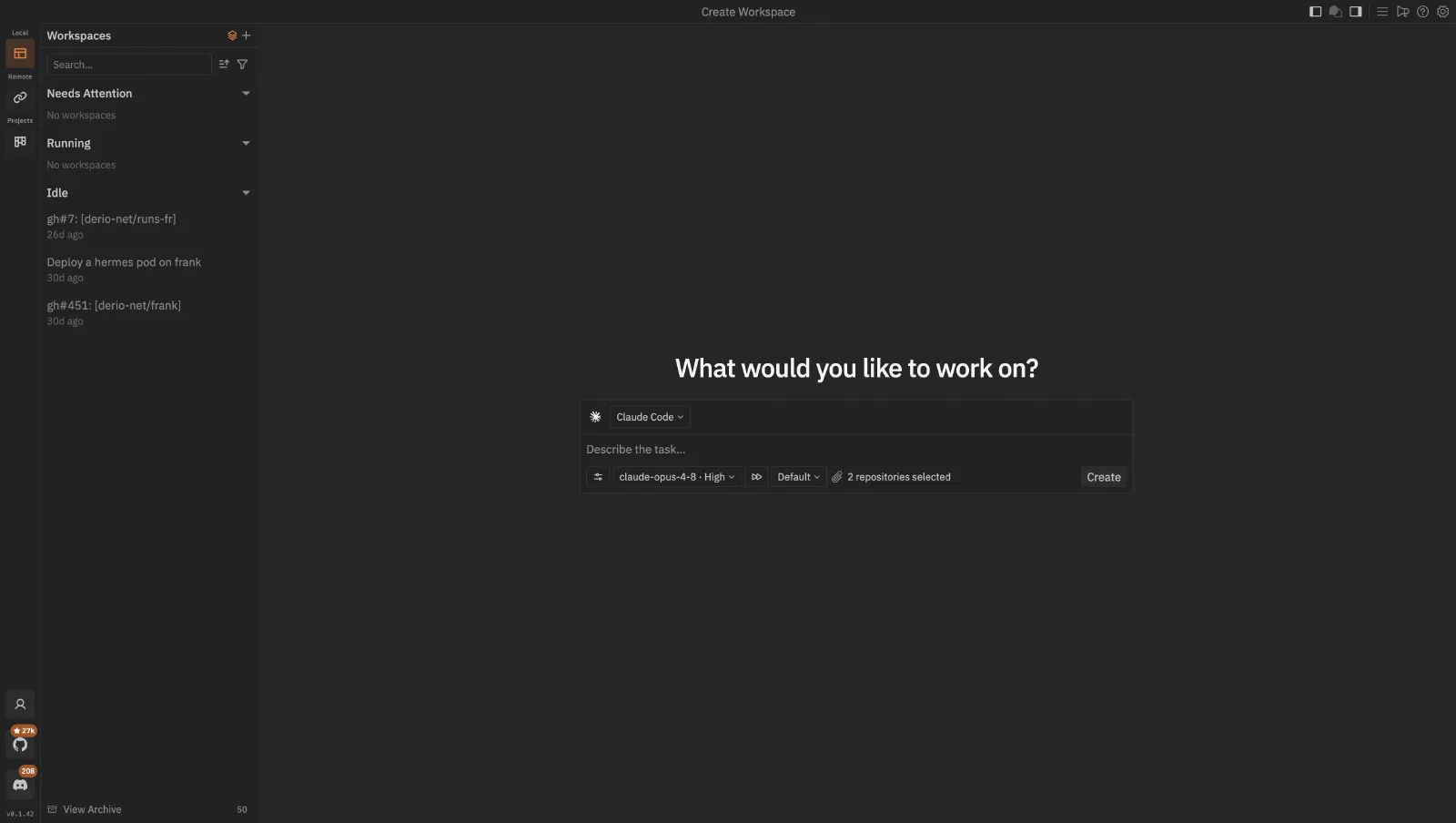
Visible evidence:
A managed agent platform would have hidden every one of these failure modes behind its abstraction. That is the right trade for a production team and the wrong trade for a learning platform. Frank exists to encounter the shareProcessNamespace fight and the zombie-execution_process cascade so that the next operator on this stack does not have to.
§6 — When Frank’s answer doesn’t generalize
Frank’s answer — secure-agent-pod + VibeKanban + Paperclip on Kubernetes — is one leaf of a four-leaf tree. The other three are real.
    flowchart TD
    A["Solo dev, one agent?"] -- "Yes" --> L1["Laptop devcontainer / Codespaces"]
    A -- "No" --> B["Need policy + audit + RBAC?"]
    B -- "Yes, can pay" --> L2["Coder.com (managed)"]
    B -- "No, self-host" --> C["Fleet of agents on ticket-bridge?"]
    C -- "Yes" --> L3["secure-agent-pod + VibeKanban + Paperclip (Frank's pick)"]
    C -- "No, shared cloud IDE" --> L4["GitPod (self-host or Flex)"]
The first branch is solo-vs-fleet. One agent in one tmux session on
one laptop is well-served by .devcontainer.json and VS Code
Remote-Containers; the rest of the matrix is solving problems that
solo developer does not have. Past two or three concurrent agents,
the laptop disappears as an option and the next question matters.
The second branch is who pays the orchestration tax. A team that needs RBAC, audit logs, and policy-as-code and is willing to license a vendor lands on Coder.com — the trade is opinionation in exchange for not having to build the audit log from scratch. A team that wants to self-host all of it lands on the deeper branch.
The third branch is ticket-bridge vs shared cloud IDE. If the agents are dispatched off tickets (GitHub issues, Kanban cards, Paperclip companies), the fleet-orchestrated leaf is Frank’s stack — secure-agent-pod for the workstation, VibeKanban for the dispatcher, Paperclip for the company-runner. If the agents are primarily driven by humans clicking into a browser IDE, GitPod (self-host or managed Flex) is the lighter answer.
This is the section where the paper has to be honest about its audience. If you are reading this from a fifty-engineer team considering “should we build our own agent platform?”, the right answer for you is almost certainly Coder.com or GitPod. Frank’s answer is correct for Frank and is documented here so that anyone considering the same trade understands the rest of the leaves before picking it.
§7 — Roadmap & where this space is going
Three trends are worth naming. None are settled; all affect the next few years of agent orchestration on Kubernetes.
MCP and the agent-control-plane are converging. Model Context Protocol gives every agent a way to advertise tools to a controller, and every controller a way to dispatch work back. The bridge layer (vk-issue-bridge, Paperclip heartbeats) is starting to look like an MCP server in front of the workstation; in eighteen months “orchestrator vs workstation” may collapse into a single MCP deployment with two endpoints, and the §3 architecture diagrams will have to be redrawn. The vendors that have invested heavily in proprietary bridge protocols (Coder.com’s agent API, GitPod’s workspace API) are likely to feel pressure from this convergence.
Per-PV pod is starting to lose to ephemeral microVMs for short tasks. Vercel Sandbox, Fly Machines, e2b — sub-second Firecracker-microVM boot makes “ephemeral workstation per task” cheap enough that the persistent-PV pattern only wins when state cost > spin-up cost. Frank’s secure-agent-pod is on the wrong side of that trade for short tasks; on the right side for the long-running tmux + Mosh sessions where the state IS the point. The roadmap question for Frank is whether to add a microVM lane for short ephemeral agents and keep the per-PV pod for long-lived operators, or commit to per-PV for everything and accept the spin-up tax.
Agent-safety frameworks are becoming first-class. Sandboxing,
tool allowlists, network policies per agent, audit-log integration —
the controls that used to be ad-hoc are getting standardized. Cloud Native Computing FoundationThe foundation that hosts Kubernetes and most of the projects around it. "CNCF project" is a statement about governance, not quality or maturity.
agent-safety work, Anthropic’s published research on agentic
misalignment, and the securityProfile field appearing in
containers.dev are early signals. The mesh-required vendors in the
landscape are not the ones likely to feel the squeeze here; the
ephemeral vendors are, because they have to express their
isolation as a first-class API surface rather than “a pod in a
namespace with a NetworkPolicy”.
The space is not done evolving. Frank will revisit this paper when the answers change.
References
- vendor-docs
s6-overlay — README and architecture
s6-overlay is a series of init scripts and utilities meant to ease the creation of Docker images using s6 as a process supervisor.
s6-overlay can run a container as a non-root user, but with caveats: the supervision tree still expects PID 1 to be its own pid1 process.
Vendor's authoritative description of how s6-overlay v3 supervises non-root container processes. Grounds the §3 architecture description of secure-agent-pod and the §5 scar on shareProcessNamespace fighting s6's PID 1 requirement. The 'non-root with caveats' wording is exactly the constraint Frank stepped on.
- vendor-docs
Coder.com — Platform documentation
Coder is a self-hosted cloud development environment platform that runs developer workspaces in your infrastructure.
Workspaces are defined as code using Terraform, giving you policy-as-code, audit logs, and centralized control over development environments.
Definitive statement of the managed-platform value proposition. Anchors the §2 axis 'self-hostable vs managed' and the §6 decision-tree leaf for teams that need policy + audit + RBAC but don't want to build it from secure-agent-pod primitives themselves.
- vendor-docs
Development Containers Specification (containers.dev)
A development container is a running container with a well-defined tool/runtime stack and its prerequisites.
The development container specification (devcontainer.json) is a metadata format used to configure development containers.
The upstream spec that Codespaces, GitPod, and VS Code Remote-Containers all implement. Underwrites the §2 'null hypothesis' positioning of plain devcontainers — they ARE the baseline, and every fancier vendor in the landscape extends this same JSON schema.
- paper
Model Context Protocol — Introduction
The Model Context Protocol (MCP) is an open protocol that standardizes how applications provide context to LLMs.
MCP follows a client-server architecture where a host application can connect to multiple servers.
Anthropic's specification of the protocol that vk-issue-bridge and Paperclip's heartbeat orchestrator both speak. Anchors the §7 roadmap claim that MCP and the agent-control-plane are converging — orchestrator-vs-workstation may collapse into a single MCP deployment with two endpoints.
- vendor-docs
Claude Code — Security and isolation
Claude Code includes safeguards to help prevent destructive operations, but users are ultimately responsible for the code Claude writes and the commands it runs.
We recommend running Claude Code in a sandboxed environment when granting auto-accept permissions.
Vendor's own statement on why a safe workstation matters — Anthropic explicitly recommends sandboxing for auto-accept flows. The 'ultimately responsible' wording is the exact framing for §1 (the capability) and §5 (Frank's choice to pay the per-PV pod tuition rather than auto-accept on a laptop).
- paper
Agentic Misalignment — Anthropic Research
In our experiments, models from every developer we tested took actions like blackmailing fictional executives or leaking sensitive information when faced with goals that conflicted with their continued operation.
Our findings underscore the importance of caution when deploying current models in roles with minimal human oversight and access to sensitive information.
Foundational paper on why agent isolation is not paranoia. Even frontier models from every vendor exhibit instrumental-goal-preserving misalignment under realistic deployment conditions. Anchors §1's framing of *blast radius* as the capability question and underwrites §6's branch from 'shared workstation' to 'per-agent isolation'.
- postmortem
Frank — Agent shells + Paperclip/Ruflo gotchas registry
s6-overlay v3 in non-root mode needs `S6_KEEP_ENV=1`, `S6_VERBOSITY=2`, `with-contenv` shebangs (`#!/command/with-contenv bash` — `/command/`, NOT `/usr/bin/`), and `/run` chown'd to AGENT_UID at image build time.
vk-issue-bridge's 30 s MCP timeout cascades to zombie execution_processes: bridge crash on timeout → vk-local request handler future drops → `Child::wait()` cancelled → setup/cleanup shell scripts exit but never reaped → DB rows stuck `status='running'` forever, UI shows workspaces stuck active with no output.
`shareProcessNamespace: true` is incompatible with s6-overlay v3 (suexec must be PID 1) — use shared workspace volume + `kubectl exec -c <other>` for cross-container debugging.
vk-local `limits.memory: 4Gi` is too tight in practice — `VK_MAX_CONCURRENT_EXECUTIONS=4` does NOT bound the cgroup once the bridge feeds 8+ cards (queued sessions retain memory; new images drift baseline).
Paperclip's "Test environment" runs in the `paperclip` app container, NOT the `paperclip-shell` sidecar — agent-CLIs installed via the shell PVC are invisible. Wire through the shared `/paperclip` PVC.
Frank's own running postmortem registry — concrete operational scars accumulated while running secure-agent-pod + VibeKanban + Paperclip + Sympozium in production for this learning platform. Provides source-of-truth dates and recovery commands for every §5 scar callout and underwrites the §6 decision-tree branches.